

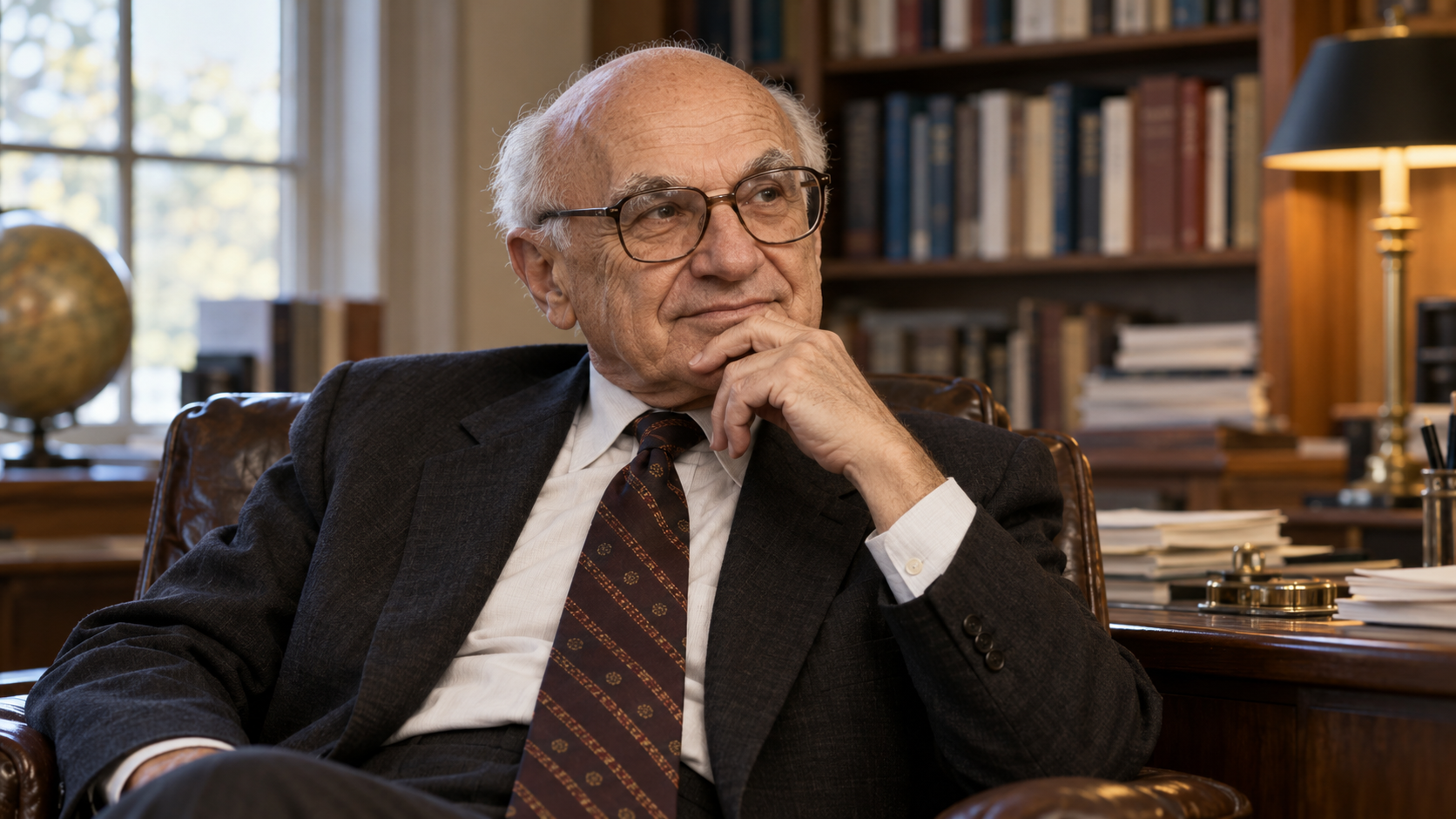
“There is one and only one social responsibility of business—to use its resources and engage in activities designed to increase its profits.”
Milton Friedman placed this sentence near the end of his 1970 New York Times Magazine essay on corporate responsibility. He argued that an executive acts as an agent of a company’s owners and should pursue their purposes within the rules of society, including both law and ethical custom. In his view, spending corporate money on social aims selected by managers was a form of private taxation without democratic authority. The essay became a landmark because it stated the shareholder-centered case with unusual clarity, forcing later theories of corporate purpose to answer a precise argument rather than a vague preference for profit.
For business leaders, the statement highlights accountability and the danger of using broad moral language to conceal weak performance or personal ambition. A company needs a coherent purpose, owners deserve honest stewardship, and managers should not promise resources they do not control. Profit also supplies information: sustained returns can show that customers value an offering and that the enterprise is using scarce inputs productively. Without financial viability, even admirable commitments become difficult to maintain. Friedman’s challenge is strongest when it asks who authorized a decision, who bears its cost, and how the result will be judged.
The quotation is often shortened in ways that erase Friedman’s qualifications. He did not endorse fraud, coercion, or breaking the law; his full formulation required open and free competition without deception. Critics reply that legal rules are incomplete, companies affect people who are not shareholders, and owners themselves may value responsibilities beyond short-term returns. Workers, communities, suppliers, and the environment can absorb costs that accounting statements omit. The real dispute is therefore not profit versus goodness. It concerns whose interests count, which duties are built into legitimate enterprise, and how corporate power should be governed.
Modern boards can use the debate as a discipline rather than a slogan. They can state the time horizon behind a profit target, identify material effects on stakeholders, explain how those effects influence durable value, and separate genuine responsibility from reputation theater. A climate investment, safer product, or fairer supplier agreement should withstand both ethical and economic scrutiny. Friedman’s sentence remains important because it marks one pole of a continuing argument. It asks companies that claim a wider purpose to define their authority, accept measurable obligations, and show how responsible conduct becomes part of a sustainable business rather than a substitute for one. A board memo can make that connection explicit by listing the expected financial effect, the stakeholder consequence, the governing obligation, and the evidence to be reviewed later. That format prevents both a narrow calculation that hides social cost and a purpose statement that hides economic weakness. It also lets investors decide whether management’s use of corporate resources matches the mandate they were promised.
Friedman published the sentence in his September 1970 New York Times Magazine essay on corporate social responsibility.
His argument treated executives as agents of owners and required them to operate within law and accepted ethical custom.
The claim stresses financial stewardship and questions managers who spend corporate resources on personally chosen public aims.
It is not a defense of deception or lawbreaking, and it leaves open hard questions about external costs and incomplete rules.
Shareholder primacy still shapes debates about climate, labor, governance, and the time horizon of corporate performance.
Boards can respond by connecting stakeholder duties to transparent authority, measurable effects, and durable enterprise value.
Explore more "Quotes of The Day"
Discover more notable quotes from influential voices across politics, science, business, technology, sports, and culture. Each quote offers insight into how ideas, beliefs, and decisions shape the world around us.