

Salad Spinner Explainer
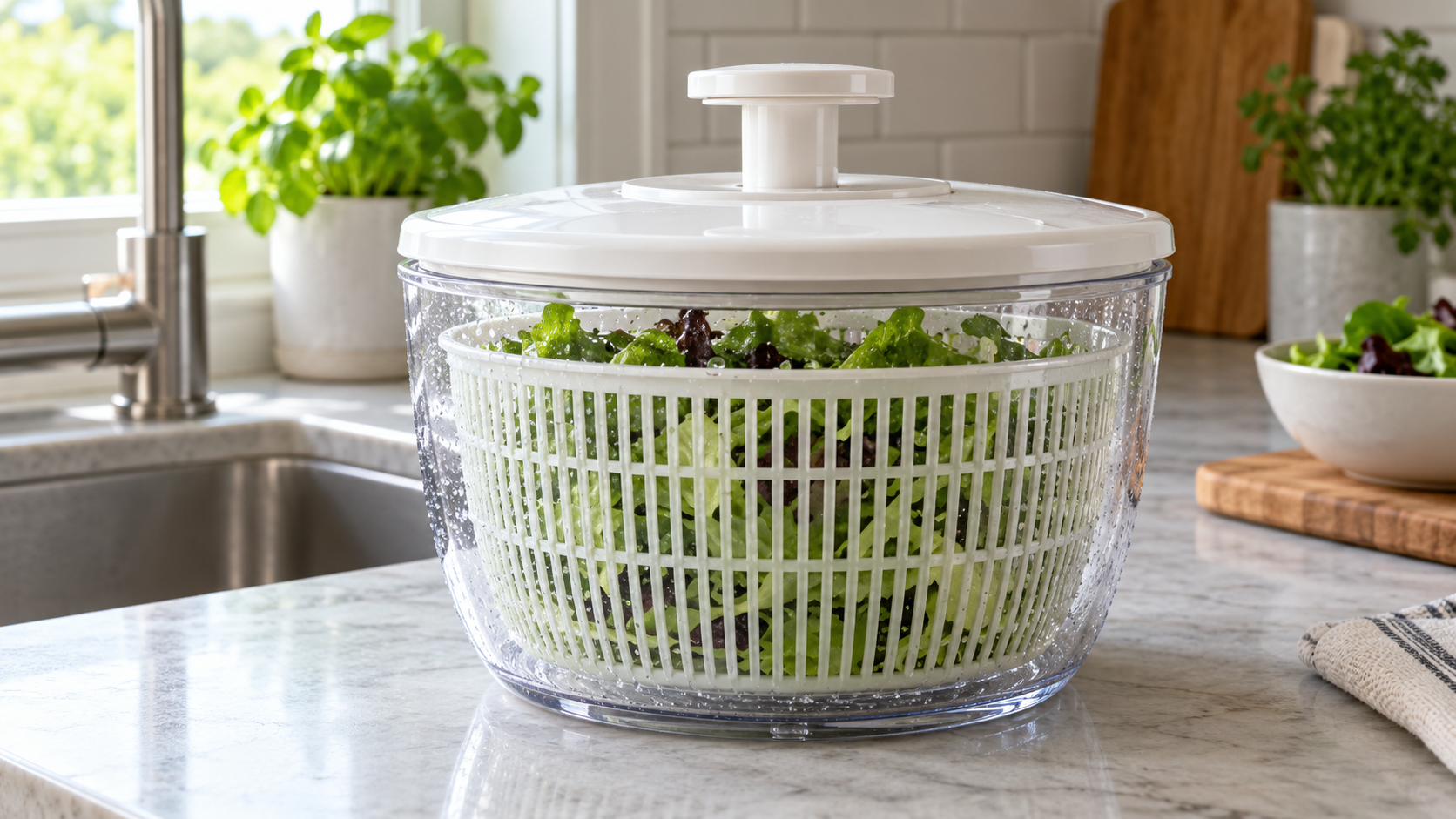
A salad spinner dries washed leaves by rotating them rapidly inside a perforated basket. The basket constrains the greens to travel in a circle, but loose water on their surfaces tends to continue along a straighter path because of inertia. Droplets move outward relative to the leaves, pass through the basket openings, strike the stationary outer bowl, and run to the bottom. The leaves remain inside while much of the water is physically separated from them.
People often describe the effect as centrifugal force. In the rotating basket’s frame, that outward apparent force is a useful way to predict what happens. From a stationary viewpoint, the basket continuously supplies the inward centripetal force that bends each leaf’s motion into a circle. Water that is not strongly attached fails to receive enough inward force and leaves the circular path. Faster rotation and a larger radius increase the acceleration available for separation.
The drive can be a crank, pull cord, or pump handle. Gears may multiply basket speed so a comfortable hand motion creates several revolutions. A one-way clutch can let the basket coast between pumps, while a brake button presses a pad or mechanism against the rotating assembly. The lid keeps leaves contained and supports the drive shaft. Bearings or low-friction plastic interfaces reduce the effort needed to maintain speed.
Water adheres to leaves through surface tension and can collect in folds, stems, and overlapping layers. The spinner does not remove every molecule; it removes droplets whose inertia overcomes adhesion and obstruction. Overfilling packs leaves together, blocks airflow and escape paths, and increases the rotating mass. Dividing a large batch and redistributing leaves between spins usually works better than forcing a full basket to turn slowly.
Dry greens matter because dressing clings better when it is not immediately diluted by rinse water. Less surface moisture can also slow some deterioration during refrigerated storage, although a spinner does not sanitize produce or make damaged leaves safe. Greens should still be washed according to food-safety guidance, inspected, and stored promptly. Delicate herbs may bruise under excessive speed or a hard brake, so short controlled spins are preferable.
After use, the outer bowl contains the separated water while the basket acts as a colander. The parts should be cleaned and dried, especially around cord housings or lid mechanisms that may trap moisture. A cracked basket or loose spindle can become unbalanced and should be replaced. The machine’s elegance lies in selective containment: the perforated basket forces solid leaves around a curved path but gives mobile water an opening through which to escape.
Rotation forces leaves to follow a circular path while loosely attached droplets continue outward through the basket holes. Key terms include inertia, centripetal acceleration, centrifugal effect, perforated basket, drive, clutch, brake, and surface tension.
No. It mainly accelerates the leaves in a circle so surface droplets separate and pass through openings without compressing the greens.
Packed leaves block one another and add mass, slowing rotation and trapping water. Smaller loose batches provide clearer paths for droplets and air.
Explore more "Explainers"
Discover additional explainers across politics, science, business, technology, and other fields. Each explainer breaks down a complex idea into clear, everyday language—helping you better understand how major concepts, systems, and debates shape the world around us.