

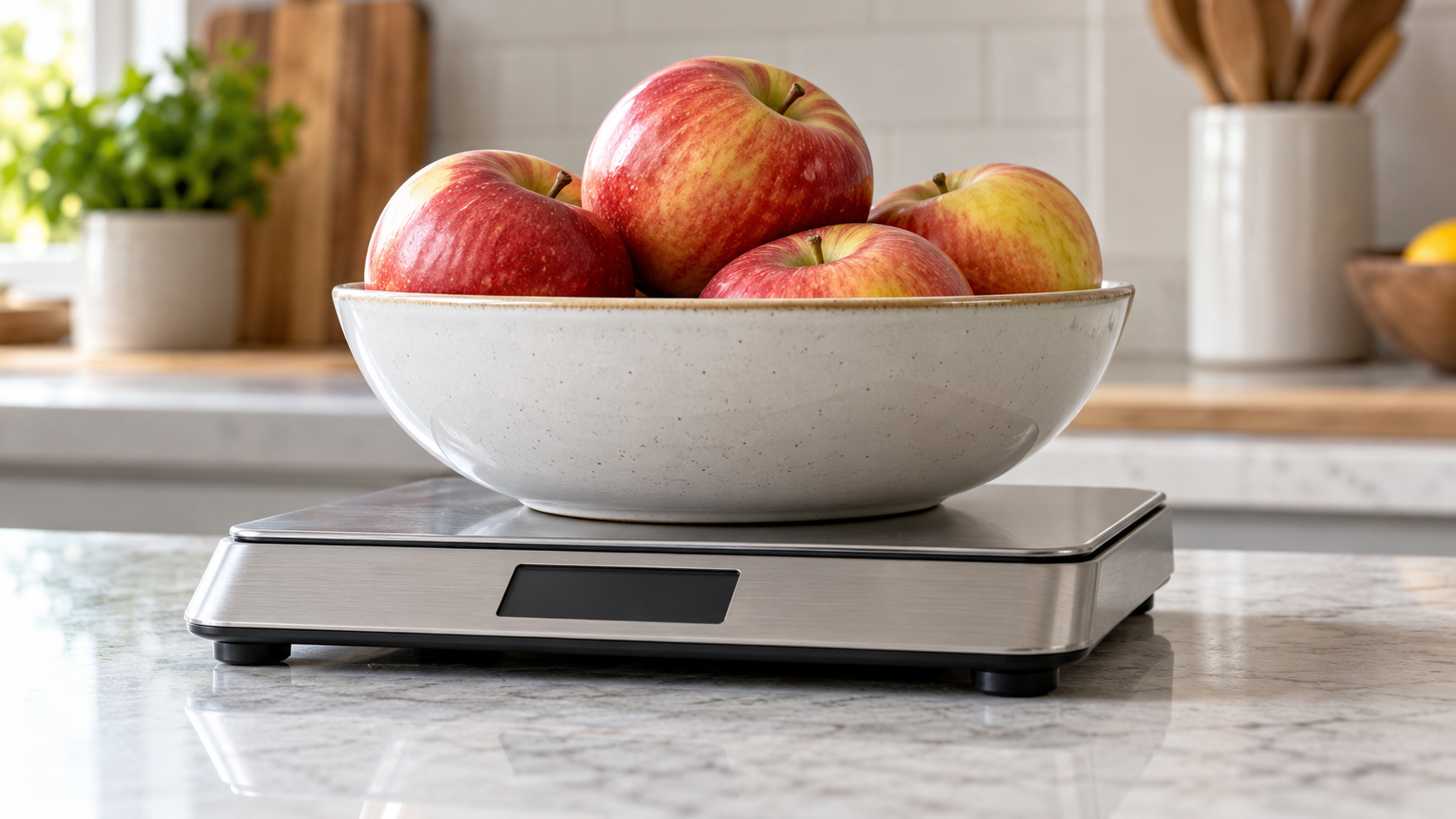
Digital Kitchen Scale Explainer
A digital kitchen scale does not count grams directly. The platform transfers the downward force of an ingredient to a metal load cell designed to bend by a microscopic, repeatable amount. Thin electrical resistors called strain gauges are bonded to that element. As the metal deforms, some gauges stretch and others compress, changing their resistance. An electronic circuit detects that tiny pattern and converts it into a number related to the applied force.
The gauges are commonly connected as a Wheatstone bridge. With no load, the bridge is nearly balanced and produces very little output. Added force unbalances it, creating a small voltage proportional to strain. An amplifier raises the signal to a useful level, and an analog-to-digital converter turns it into numerical samples. A microcontroller applies stored calibration factors, filters vibration and electrical noise, converts between units, and updates the display.
A scale reports mass units even though the sensor responds to force. During calibration, known masses establish the relationship between bridge output and the displayed grams or ounces under local gravity. Kitchen accuracy does not require a laboratory gravity correction, but it does require a firm, level support and a load centered within the intended platform area. A soft towel, uneven counter, overloaded corner, or object touching the wall can divert force and produce an unstable or incorrect reading.
The tare button stores the current reading as a temporary zero. Place an empty bowl on the platform, press tare, and the scale subtracts the bowl from every later measurement. The load cell still supports the bowl, so its weight counts toward the scale’s maximum capacity even though the display reads zero. Successive taring is convenient for adding ingredients, but the remaining measurable capacity becomes smaller each time. A negative reading may appear when a tared container is removed.
Resolution and accuracy are not the same. A display that changes in one-gram increments cannot guarantee every reading is within one gram. Linearity, temperature, creep in the metal, battery voltage, mechanical friction, and calibration all contribute error. Many household scales stabilize by averaging several samples, which is why the last digit may pause or step. Very small amounts such as a fraction of a gram may fall below the reliable range even when the display shows a value.
Good technique is simple: use a hard level surface, keep the platform clean and dry, stay below capacity, and let the reading settle. Calibrate only by the manufacturer’s procedure and specified mass; random household objects are poor standards. The essential chain is mechanical and electronic: force bends the load cell, strain alters resistance, the bridge produces voltage, and stored calibration translates the signal into the ingredient mass shown on screen.
A load bends a metal element carrying strain gauges. Their resistance changes unbalance a bridge circuit, and electronics convert the signal to mass. Key terms include load cell, strain gauge, Wheatstone bridge, amplifier, calibration, resolution, capacity, and tare.
Tare records the current load as a new temporary zero, letting the display exclude a bowl while the bowl still counts toward maximum capacity.
A soft or uneven support can twist the case or divert force away from the load cell. A hard level counter lets the sensor receive the load as calibrated.
Explore more "Explainers"
Discover additional explainers across politics, science, business, technology, and other fields. Each explainer breaks down a complex idea into clear, everyday language—helping you better understand how major concepts, systems, and debates shape the world around us.