

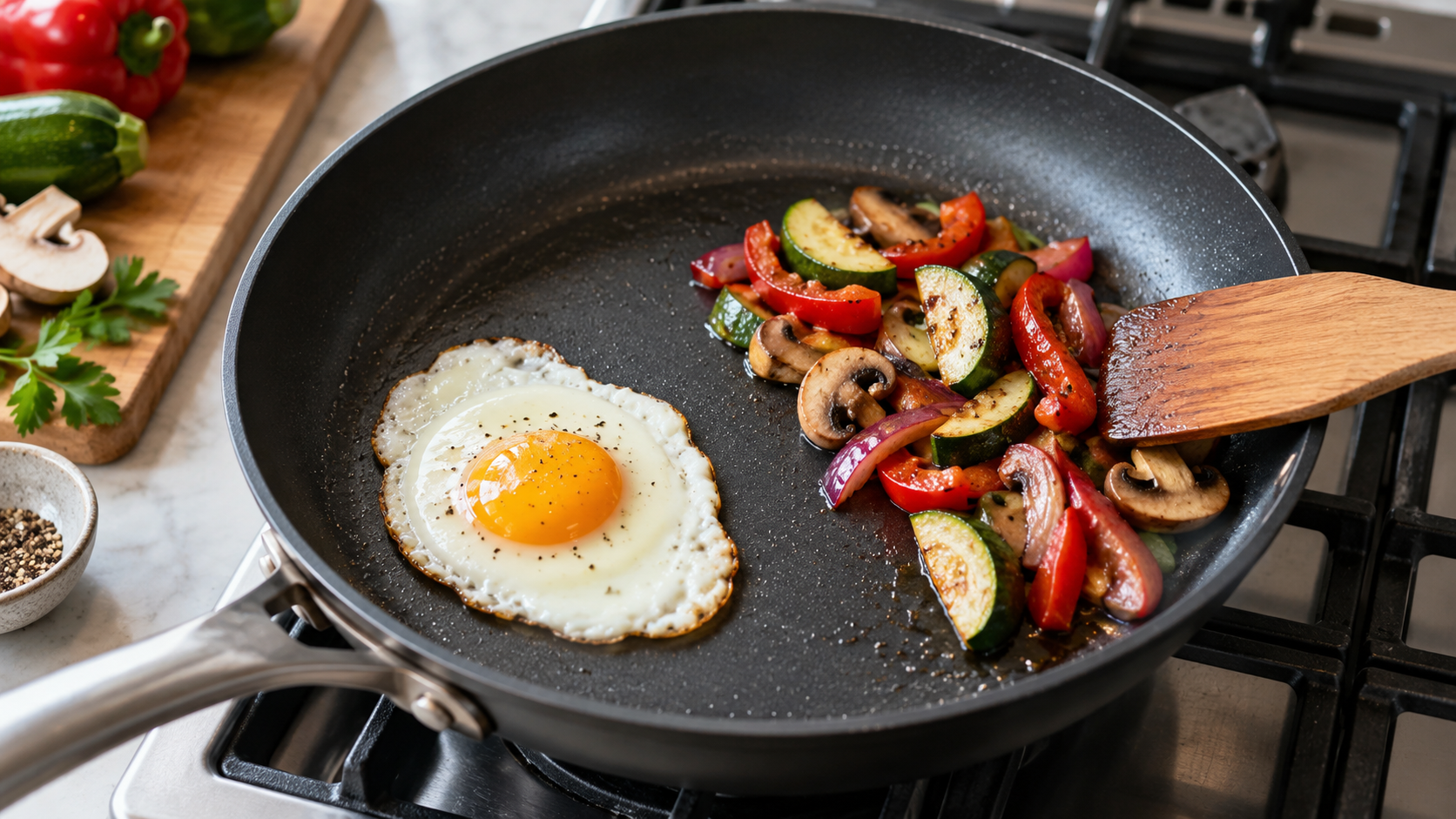
Nonstick Pan Coating Explainer
Food sticks when proteins, sugars, and other molecules make strong contact with microscopic features of a hot cooking surface. A nonstick pan covers the metal with a thin coating that has very low surface energy, most commonly based on polytetrafluoroethylene, or PTFE. Many substances do not wet or bond readily to that fluoropolymer. The coating also fills fine surface irregularities, reducing the mechanical grip available to cooked food and making release and cleanup easier.
Manufacturing begins by cleaning and roughening the metal so the coating system can anchor to it. A primer and one or more fluoropolymer layers may be sprayed or rolled on and then baked to fuse them into a continuous film. The finished surface feels smooth, but its durability depends on adhesion between layers and the pan body. Hard particles, sharp metal edges, and abrasive cleaning can scratch or remove the film even though ordinary food does not adhere strongly.
The pan underneath still performs most heat distribution. Aluminum is common because it conducts heat well, while stainless or induction-compatible layers may add strength or magnetic response. The nonstick film is relatively thin and cannot correct severe hot spots. Moderate preheating and enough food to absorb heat help keep temperature controlled. A small amount of oil may improve browning and heat contact, though the coating usually allows much less fat than an uncoated surface.
PTFE is stable at normal cooking temperatures, but an empty pan can heat rapidly beyond its intended range. Severe overheating can degrade the coating and release fumes, so manufacturers advise low-to-medium settings, ventilation, and never leaving an empty pan unattended. Birds are particularly sensitive to overheated cookware fumes and should be kept away from cooking areas. The exact temperature limits and utensil guidance belong to the product instructions.
Nonstick does not mean nothing can ever adhere. Burned sugar, spray residues, carbonized oil, or a damaged area can become sticky. Proteins also brown less readily when the surface is kept very cool, while excessive heat shortens coating life. Silicone, wood, or other approved utensils protect the film. Cleaning after cooling with a soft sponge preserves it; thermal shock from cold water on a very hot pan can warp the base or stress the layers.
A pan with peeling, blistering, deep scratches, exposed substrate, or persistent warping has lost the controlled surface it was designed to provide and should be replaced. The useful explanation is a materials partnership: the metal supplies shape and heat, the bonded coating presents a low-energy interface, and sensible temperature control protects both. The coating reduces molecular attraction and mechanical interlocking, making release easier without eliminating the physics of heat, browning, and residue.
A bonded low-surface-energy coating reduces wetting, molecular attraction, and mechanical grip between food and the pan. Key terms include PTFE, fluoropolymer, surface energy, substrate, primer, heat distribution, thermal shock, and abrasion.
Without food to absorb heat, the pan can become extremely hot quickly. Excess temperature can damage the coating and produce hazardous fumes.
Often very little, but a small amount can improve contact, flavor, and browning. Follow the pan instructions and avoid residues from incompatible sprays.
Explore more "Explainers"
Discover additional explainers across politics, science, business, technology, and other fields. Each explainer breaks down a complex idea into clear, everyday language—helping you better understand how major concepts, systems, and debates shape the world around us.