

On This Day in Business: April 1, 1976
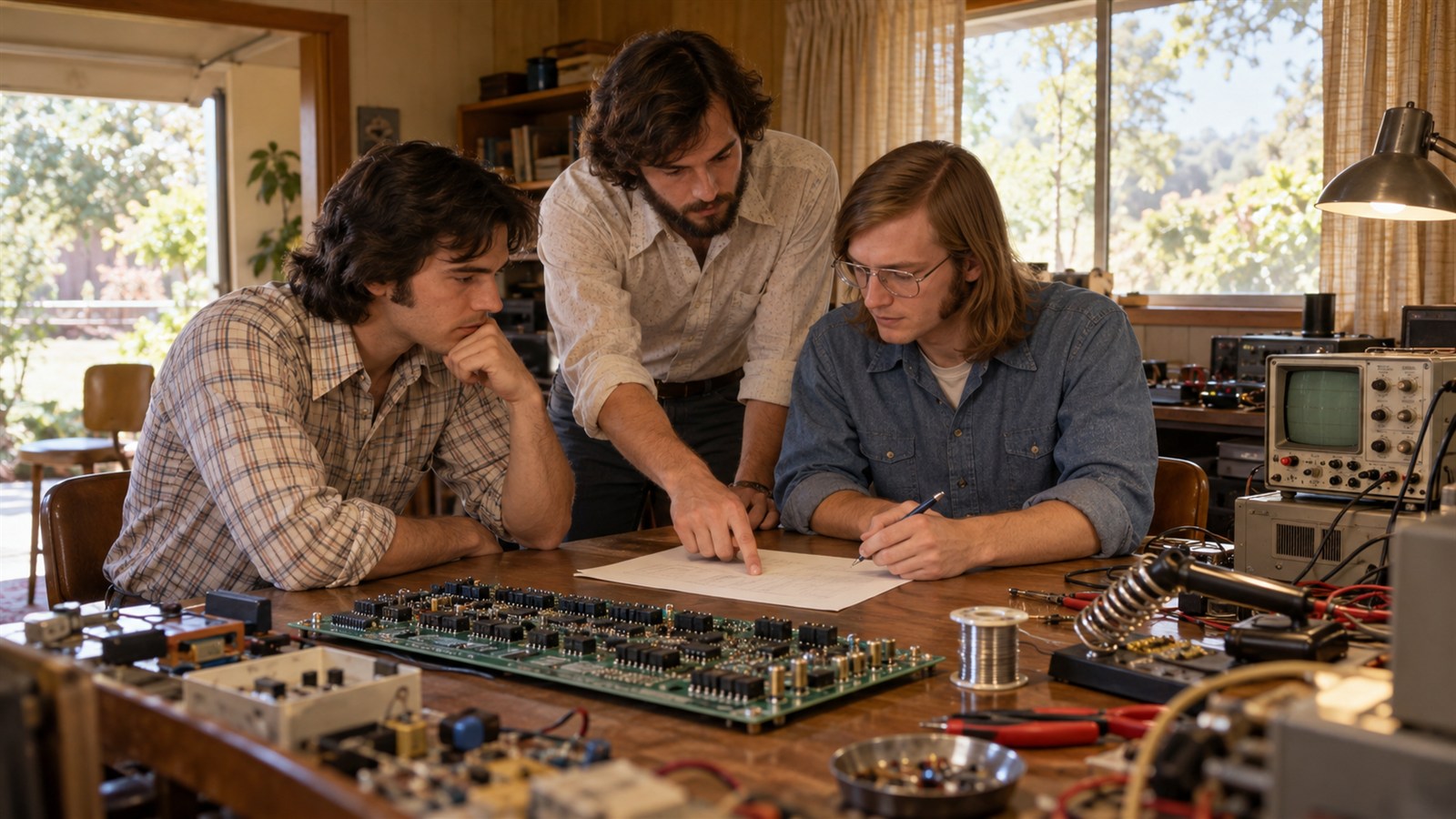
On April 1, 1976, Steve Jobs, Steve Wozniak, and Ronald Wayne signed a partnership agreement creating Apple Computer Company in California. Wozniak had designed a compact computer board that could work with a keyboard and display, while Jobs recognized that hobbyists might buy a finished board rather than assemble every component themselves. Wayne supplied business experience and drafted early documents, though he soon sold his share back to the other partners. The company's first commercial offering, later called the Apple I, began as a small production effort built around Wozniak's engineering and Jobs's determination to find customers, parts, and credit.
The founders entered a market shaped by electronics clubs, mail-order components, and do-it-yourself machines. Their opportunity was to make computing more approachable without abandoning the flexibility valued by enthusiasts. Jobs secured an order from the Byte Shop for assembled boards, but fulfilling it required components the young partnership could not easily afford. Supplier credit and intense manual work bridged the gap. The result was not yet a complete consumer appliance: buyers still needed a case, power supply, keyboard, and monitor. Even so, an assembled board reduced friction and demonstrated that a tiny company could package technical knowledge into a saleable product.
Apple's early choices pointed toward a much larger business. The Apple II, introduced the following year, added color graphics, expansion slots, and a more polished form. Software such as VisiCalc gave businesses a compelling reason to purchase personal computers, while dealers and developers expanded the system's usefulness. Apple incorporated in 1977 with new investment and professional management, then went public in 1980. Growth brought tensions over strategy, leadership, manufacturing, and product design, but it also helped move the personal computer from hobby benches into homes, schools, and offices across a rapidly growing market.
The founding matters because it joined complementary skills at exactly the moment component costs and consumer interest were changing. Wozniak created an elegant technical design, Jobs pressed for a product and market, and early partners, suppliers, retailers, and investors supplied capabilities the founders lacked. Their story shows that a startup is not only an idea; it is a network of commitments that must convert a prototype into reliable delivery. Apple later transformed itself many times, but the April 1976 partnership established its recurring formula: integrate hardware and software, simplify a difficult technology, and make design part of the value customers are willing to pay for. The origin also highlights the value of strategic storytelling. A bare circuit board needed to be described as the beginning of personal computing rather than a kit for a narrow club. Jobs repeatedly framed technical capabilities in terms of what ordinary people could create. That translation attracted customers and talent, while Wozniak's disciplined design made the claim believable. Market vision and engineering credibility reinforced each other.
Wozniak's computer board grew from the Homebrew Computer Club culture, where enthusiasts exchanged designs and demonstrated new microprocessor possibilities.
Jobs believed assembled boards could reach buyers who wanted to use a computer without constructing every circuit from loose parts.
The partnership agreement signed on April 1, 1976, divided responsibilities among Jobs, Wozniak, and Wayne and created Apple Computer Company.
Wayne left within days, while an early Byte Shop order forced Jobs and Wozniak to secure parts on credit and assemble boards quickly.
The Apple II turned the early experiment into a scalable product supported by software, dealers, investors, and a growing installed base.
Apple's origin became a classic example of engineering, product judgment, and outside capital combining to commercialize a new technology.
Explore more of "On This Day ..."
Discover more events from the same date across news, politics, technology, sports, and other fields. Each link highlights significant moments that shaped history on different fronts.