

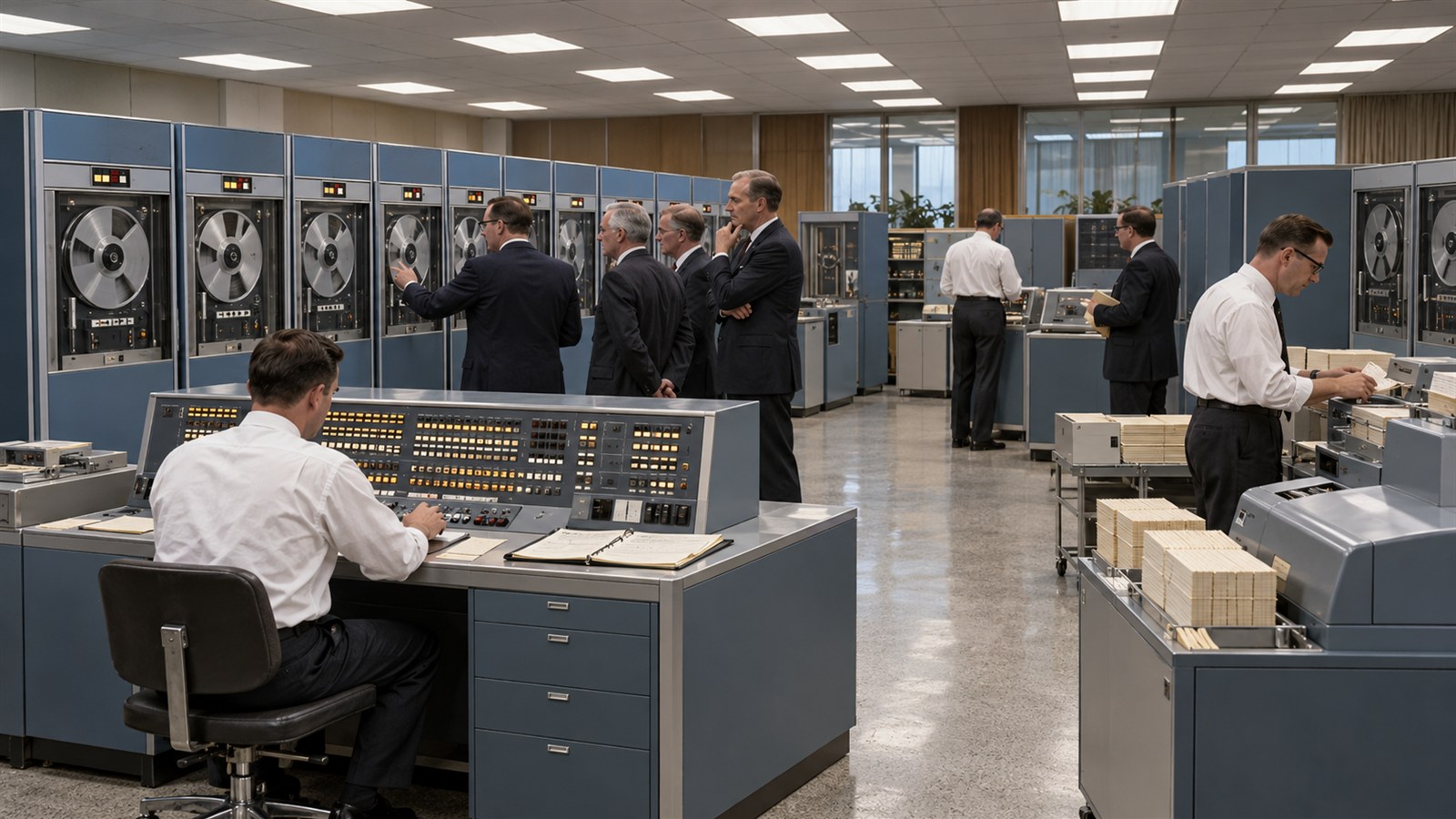
On This Day in Business: April 7, 1964
On April 7, 1964, IBM announced System/360, a family of mainframe computers designed around a common architecture. Earlier computers were often built as separate models with incompatible instructions, peripherals, and software. Customers that outgrew one machine could face expensive rewrites when moving to another. System/360 promised a range of performance levels that could run compatible programs and use standardized peripheral interfaces. The name suggested a full circle of applications, from commercial data processing to scientific calculation. IBM presented the family simultaneously at numerous locations, making the announcement one of the most ambitious product introductions in business-computing history.
The project required IBM to replace many of its own successful products and coordinate factories, engineers, suppliers, and software teams on an extraordinary scale. Developing new processors, storage devices, input-output channels, manufacturing processes, and operating software consumed billions of dollars. Compatibility was a commercial promise as much as a technical one: a customer could invest in programs and training with greater confidence that those assets would survive an upgrade. IBM also had to deliver machines whose prices and performance varied widely without allowing each model to become an isolated design. The effort imposed discipline across a global organization.
Execution was difficult. Some hardware arrived late, and the OS/360 operating system became famous for its complexity and schedule problems. IBM used interim software and extensive field support while customers waited for promised capabilities. Despite those strains, System/360 became a major success. Banks, manufacturers, airlines, governments, and universities adopted the family, and compatible architecture influenced later IBM mainframes for decades. Standardized byte sizes and interfaces also helped software and peripheral markets grow. Customers still depended heavily on IBM, but they gained a clearer migration path within the product line.
System/360 illustrates the power and danger of platform commitments. Compatibility protects customer investment and can expand a market, yet it transfers risk to the supplier, which must coordinate many products and preserve promises over time. IBM deliberately disrupted its own installed base rather than wait for competitors to do so. The decision demanded capital, organizational authority, and tolerance for short-term disorder. Modern cloud services, processors, and enterprise software still face the same tradeoff between innovation and continuity. April 7 marks the moment IBM publicly wagered its future on the idea that a family of compatible systems could be more valuable than a collection of individually optimized machines. System/360 also changed how customers evaluated computing purchases. The decision concerned not only today's processor speed but the future path for data, applications, peripherals, and people. IBM sold confidence that the environment would persist across upgrades. That long relationship supported service revenue and customer loyalty, but it also raised the cost of failure. A platform promise becomes valuable precisely because customers organize so much other investment around it.
Customers once faced costly software rewrites and retraining when they moved between computer models designed as separate systems.
IBM chose a common instruction architecture and peripheral strategy so organizations could scale within one broad product family.
The company announced System/360 on April 7, 1964, after committing enormous engineering and manufacturing resources to the program.
Operating-system delays and complex production schedules tested IBM's ability to fulfill the compatibility and delivery promises it had sold.
System/360 became a commercial success and established architectural ideas that continued through later generations of IBM mainframes.
The program remains a landmark in platform strategy, showing why preserving customer investment can be worth a supplier's immense coordination risk.
Explore more of "On This Day ..."
Discover more events from the same date across news, politics, technology, sports, and other fields. Each link highlights significant moments that shaped history on different fronts.