

On This Day in Business: April 8, 1952
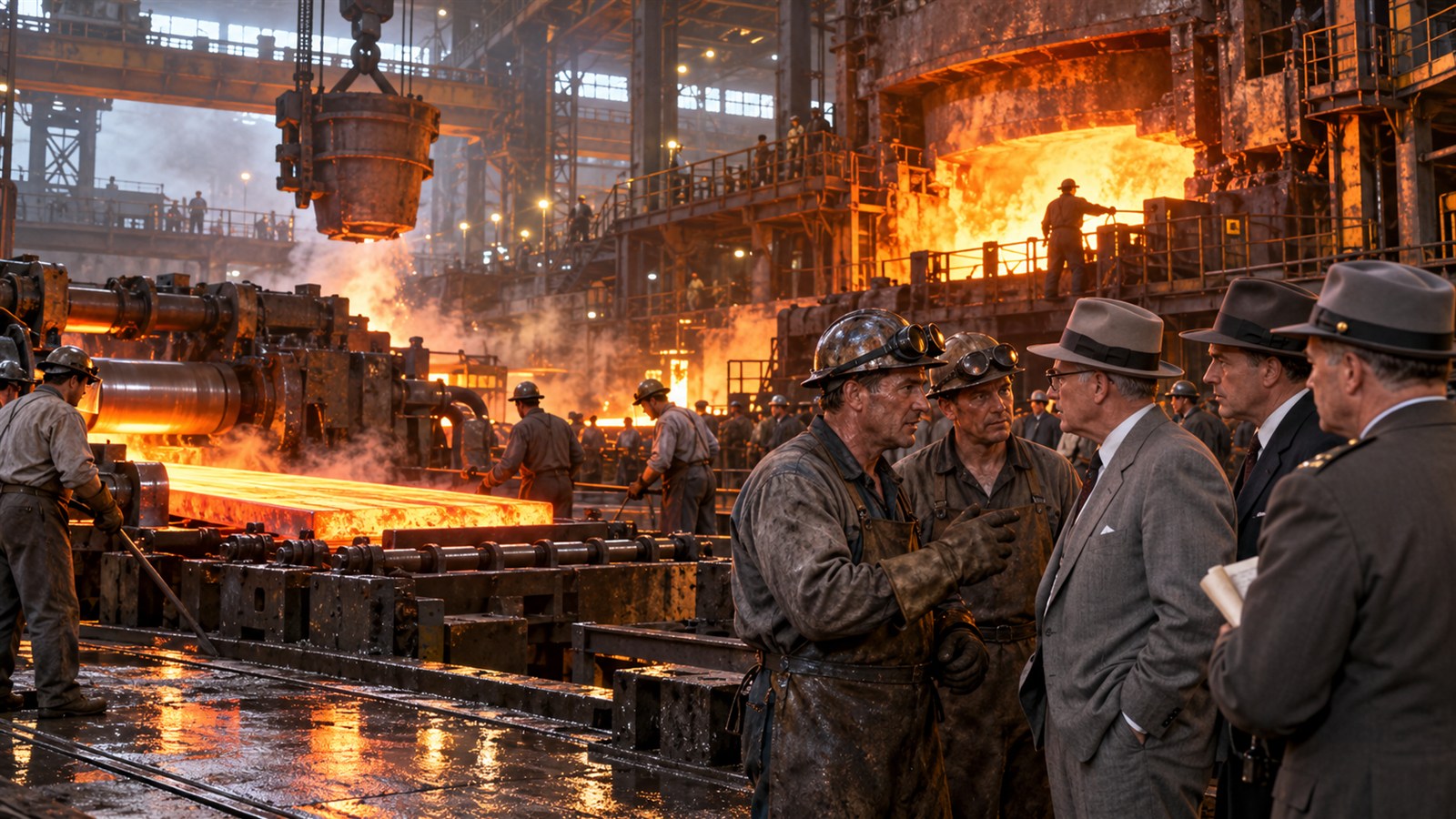
On April 8, 1952, President Harry S. Truman ordered Secretary of Commerce Charles Sawyer to take possession of much of the nation's steel industry. A strike by the United Steelworkers was about to begin after negotiations over wages and prices failed. The Korean War made steel essential for weapons, vehicles, infrastructure, and civilian production, and Truman argued that a prolonged shutdown would endanger national defense. Federal officials moved quickly to operate the mills under existing management while the government attempted to keep furnaces producing. The action placed private industrial property at the center of a constitutional and economic crisis.
The dispute grew from wartime controls. Unions sought wage increases, steel companies wanted price adjustments, and federal stabilization policies tried to limit inflation. Each side faced incentives shaped by government rules as well as the labor market. Truman chose seizure rather than use the Taft-Hartley Act's strike-delay procedures, which he had opposed. Steel companies challenged the order, arguing that the president lacked statutory or constitutional authority to take their property. The conflict therefore concerned not only labor terms but who could command critical productive capacity when Congress had not expressly authorized that remedy.
The Supreme Court resolved the case in Youngstown Sheet & Tube Co. v. Sawyer. On June 2, 1952, the Court ruled that Truman had exceeded his authority. Justice Robert Jackson's influential concurrence described presidential power as strongest with congressional authorization, uncertain when Congress was silent, and weakest when the president acted against congressional policy. The mills returned to private control, workers later struck, and a settlement eventually followed. The episode established a lasting framework for evaluating executive power, especially when national emergencies intersect with private enterprise and legislative choices.
For business, the seizure demonstrates that operational risk includes constitutional and political risk. A company can own factories yet find control contested when its output becomes essential to national policy. Labor, prices, procurement, and emergency authority may converge faster than ordinary contracts can resolve them. The case also shows why clear statutory processes matter: uncertainty about who can act may be as disruptive as the underlying shortage. Modern firms in energy, transportation, communications, and defense still operate near this boundary. Their assets are private, but their continuity may be treated as a public necessity during crisis. Jackson's framework also gave executives and counsel a practical way to analyze later government action. A national emergency may increase urgency without automatically supplying legal authority, so firms must distinguish political pressure from enforceable power. At the same time, litigation cannot keep a plant running or settle a strike by itself. Crisis planning must therefore combine legal strategy with labor relations, supply alternatives, and communication before a dispute reaches constitutional scale.
Korean War demand made steel production strategically important while wage claims and federal price controls blocked a labor settlement.
Truman feared an immediate strike would interrupt defense supply and ordered the commerce secretary to take possession of major mills.
Federal officials kept existing managers in place, but the companies challenged the seizure as an unauthorized use of presidential power.
The Supreme Court rejected the order in Youngstown Sheet & Tube Co. v. Sawyer and returned the mills to private control.
Justice Jackson's concurrence supplied a durable framework for measuring presidential authority against congressional authorization or opposition.
The crisis shows how essential industries can face sudden government intervention when labor, inflation, and national security collide.
Explore more of "On This Day ..."
Discover more events from the same date across news, politics, technology, sports, and other fields. Each link highlights significant moments that shaped history on different fronts.