

On This Day in Business: April 9, 1967
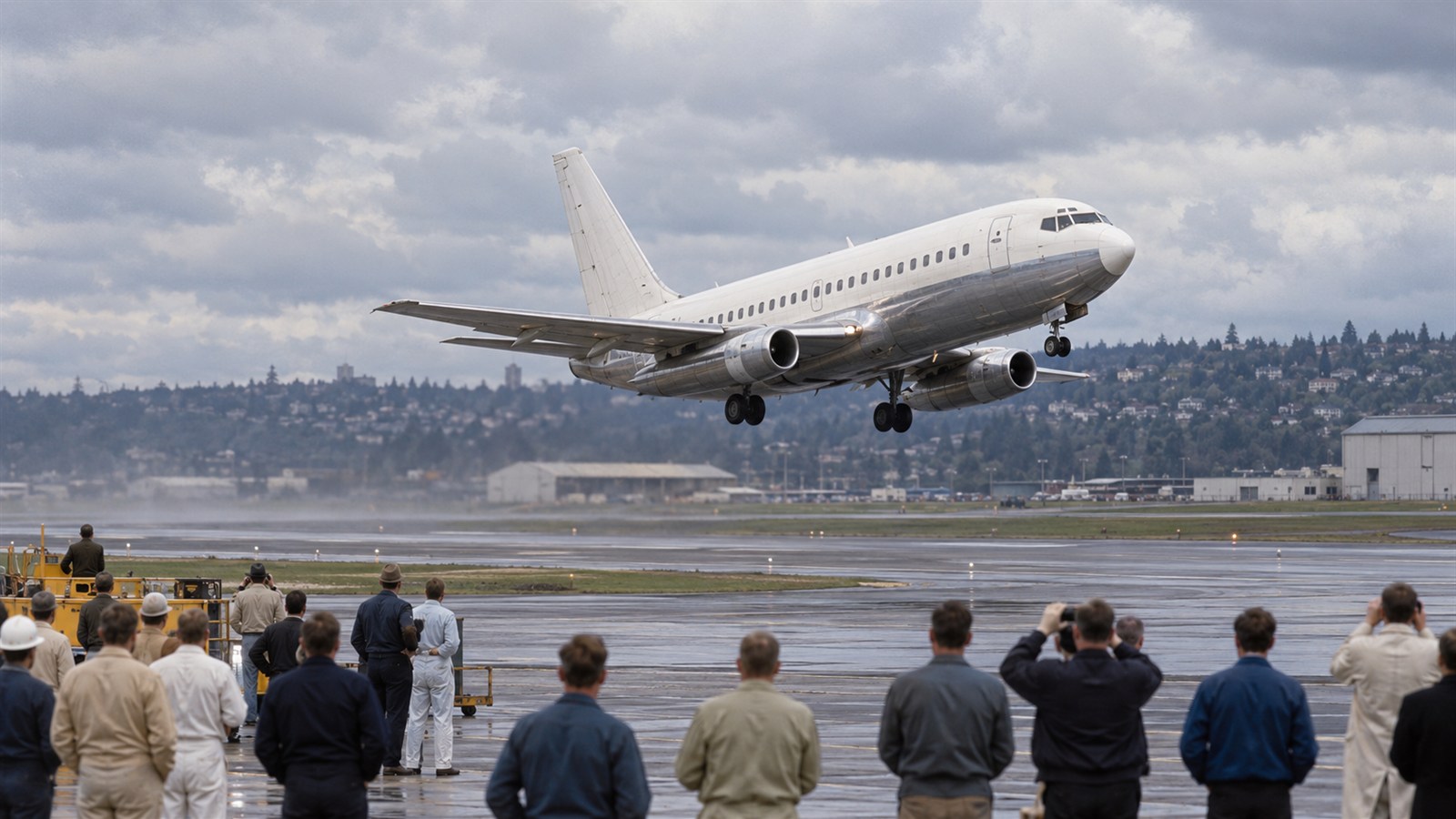
On April 9, 1967, Boeing's first 737 took off from Boeing Field near Seattle on its maiden flight. Test pilots Brien Wygle and Lew Wallick flew the twin-engine jet to Paine Field, beginning a certification program for an aircraft aimed at shorter routes. Boeing had entered the market after rival manufacturers, and the initial order book was modest. The company designed the 737 to share important features with its larger 707 and 727, including a similar fuselage cross-section and cockpit philosophy. That commonality could simplify crew training, maintenance, and passenger handling for airlines already using Boeing jets.
The aircraft's layout placed two engines beneath the wings and kept the fuselage relatively low to the ground. Airlines serving smaller airports valued easier access for baggage and passengers where elaborate ground equipment was unavailable. Boeing offered different fuselage lengths and worked closely with launch customers Lufthansa and United Airlines. Developing a new jet remained expensive and uncertain; the manufacturer had to finance engineering, tooling, testing, suppliers, and production before the market was proven. Certification also required evidence that the airframe, systems, engines, and procedures could operate safely under demanding conditions.
The first 737 entered airline service in 1968. Sales initially lagged, but successive versions improved range, capacity, fuel economy, avionics, and operating performance. The basic family eventually became central to airline fleets around the world and supported an enormous network of pilots, mechanics, lessors, airports, and parts suppliers. Commonality made it easier for operators to add aircraft and schedule crews. The program also faced severe crises, including accidents and regulatory scrutiny in later generations, underscoring that commercial scale increases the consequences of design, oversight, and safety decisions.
The maiden flight represents the start of a long-lived industrial platform. Boeing did not sell only a finished airframe; it created a service ecosystem that required training, documentation, spare parts, finance, and continuous engineering. A platform can endure when upgrades preserve enough commonality to protect customer investment while responding to new requirements. The same continuity can also constrain design choices and create pressure to fit major changes within an established certification and operating framework. April 9 therefore marks both an engineering achievement and the beginning of a complex commercial responsibility that extends through every aircraft's working life. Aircraft finance deepened the platform effect. Airlines often lease jets or borrow against long-lived assets, so residual value and a worldwide operator base influence the cost of capital. A type with plentiful parts, trained crews, and active secondary markets may be easier to finance. Boeing's installed base therefore supported more than production sales; it affected the economic life of each airframe and the confidence of lenders and lessors.
Boeing entered the short-haul twin-jet market behind established rivals and needed a design that offered airlines practical operating advantages.
Shared fuselage and cockpit features with other Boeing jets promised lower training, maintenance, and fleet-integration costs.
The first 737 flew from Boeing Field to Paine Field on April 9, 1967, opening the aircraft's formal test program.
Certification and early production required large investment even though the initial order book did not guarantee commercial success.
Repeated generations expanded the family into the world's most widely produced jetliner platform and created a vast support ecosystem.
The program demonstrates both the value of compatibility and the safety obligations that accumulate around a long-lived industrial design.
Explore more of "On This Day ..."
Discover more events from the same date across news, politics, technology, sports, and other fields. Each link highlights significant moments that shaped history on different fronts.