

On This Day in Business: April 18, 1906
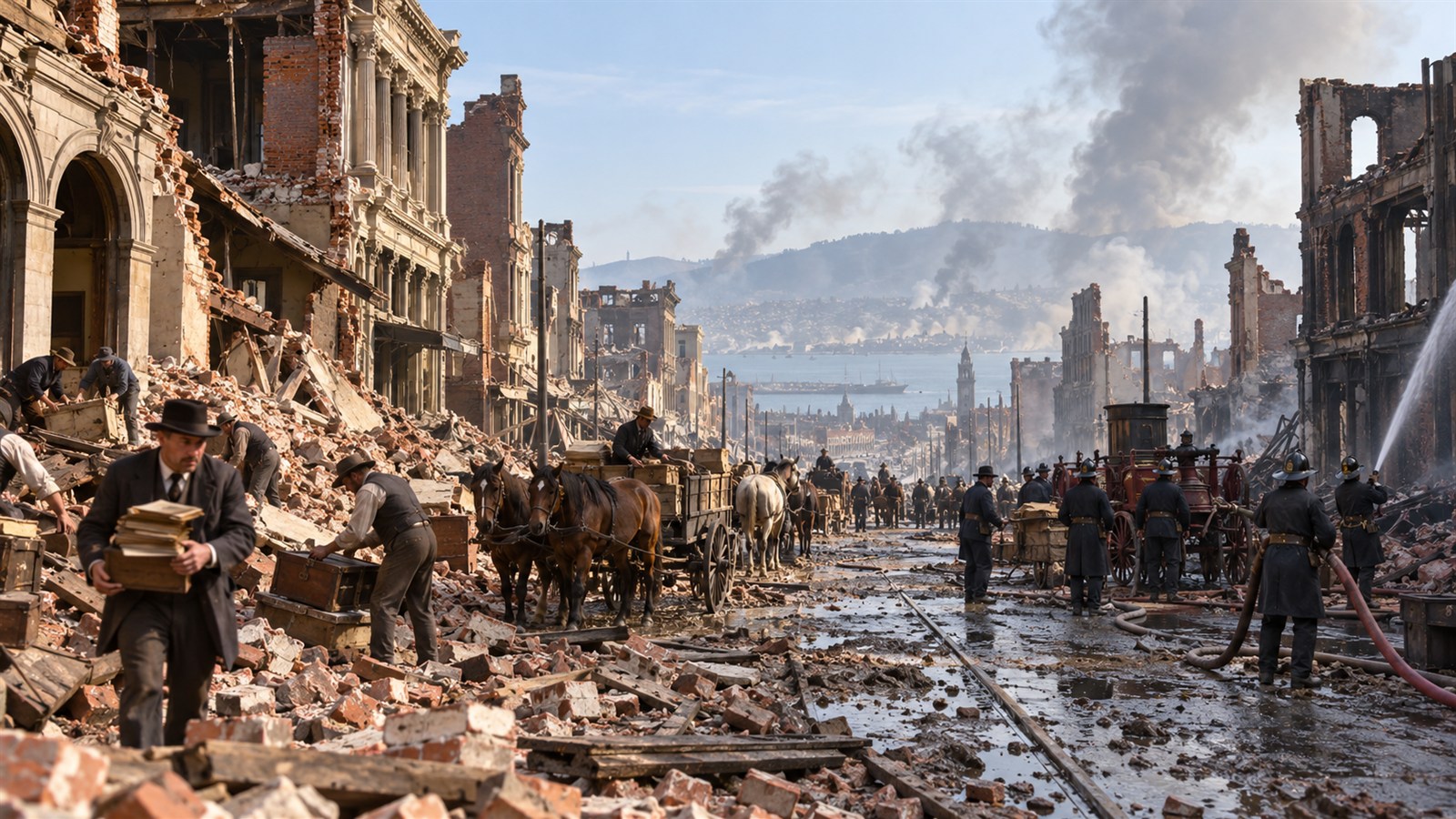
On April 18, 1906, a powerful earthquake struck near San Francisco shortly after dawn. Buildings collapsed, water mains broke, and fires spread through the city for days. Commercial districts, warehouses, banks, hotels, factories, and homes were destroyed across hundreds of blocks. Thousands died and many more were displaced. Business records, inventories, transportation links, and communications disappeared with physical property. The disaster demonstrated how a single regional event could disable an interconnected urban economy, leaving firms unable to operate even when their own structures remained standing because suppliers, employees, utilities, and customers had been scattered.
Insurance became a central issue. Many policies covered fire but excluded earthquake damage, so the cause assigned to a loss could determine whether an insurer paid. Some companies settled broadly to protect reputation and market position, while others disputed claims or failed under the scale of liabilities. British and American insurers moved large sums into the rebuilding economy, affecting international financial flows. Banks and businesses improvised temporary offices, preserved credit where possible, and attempted to reconstruct ownership and account records. The response tested contracts written for individual losses against a catastrophe that affected an entire system.
Reconstruction generated enormous demand for labor, lumber, steel, cement, transport, and finance. Authorities changed building practices and infrastructure, though political conflict and uneven aid influenced who could return and rebuild. The city restored commerce faster than many observers expected, helped by its port, regional importance, and determined local institutions. Yet resilience was not equally distributed. Small firms and households with limited savings or disputed coverage faced greater barriers, while reconstruction decisions changed neighborhoods and land values for decades.
The disaster transformed the understanding of concentration risk. An insurer might diversify across many policyholders yet remain exposed if one event damaged them all. A business might protect a building but still fail when utilities, records, and transportation were unavailable. Modern catastrophe modeling, reinsurance, business-continuity planning, and geographic redundancy address versions of that problem. April 18 is therefore not only a story of physical destruction. It is a lesson in how contracts, capital, and infrastructure behave when ordinary assumptions of independent losses and rapid service restoration collapse at the same time. Record protection became another lesson. Contracts, account balances, customer lists, and ownership evidence can be as vital as buildings, yet physical papers stored in one office were easily destroyed. Later firms adopted off-site archives and eventually digital redundancy for similar reasons. Backups still fail if they depend on the same power, network, or region as primary systems. True continuity requires separating critical information and recovery capability from the event that threatens normal operations.
The earthquake damaged structures and broke water systems, allowing fires to consume much of San Francisco's commercial core.
Businesses lost property, inventory, records, utilities, employees, suppliers, transportation access, and customers in one regional catastrophe.
Insurance disputes centered on whether particular losses resulted from excluded earthquake damage or covered fire after the shaking stopped.
Insurer payments, banking improvisation, and public decisions determined which owners could finance rebuilding and how quickly commerce returned.
Reconstruction created demand and modernized parts of the city but distributed costs, opportunities, and displacement unevenly.
The disaster remains a foundational example of correlated risk and the need for reinsurance, continuity plans, and resilient infrastructure.
Explore more of "On This Day ..."
Discover more events from the same date across news, politics, technology, sports, and other fields. Each link highlights significant moments that shaped history on different fronts.