

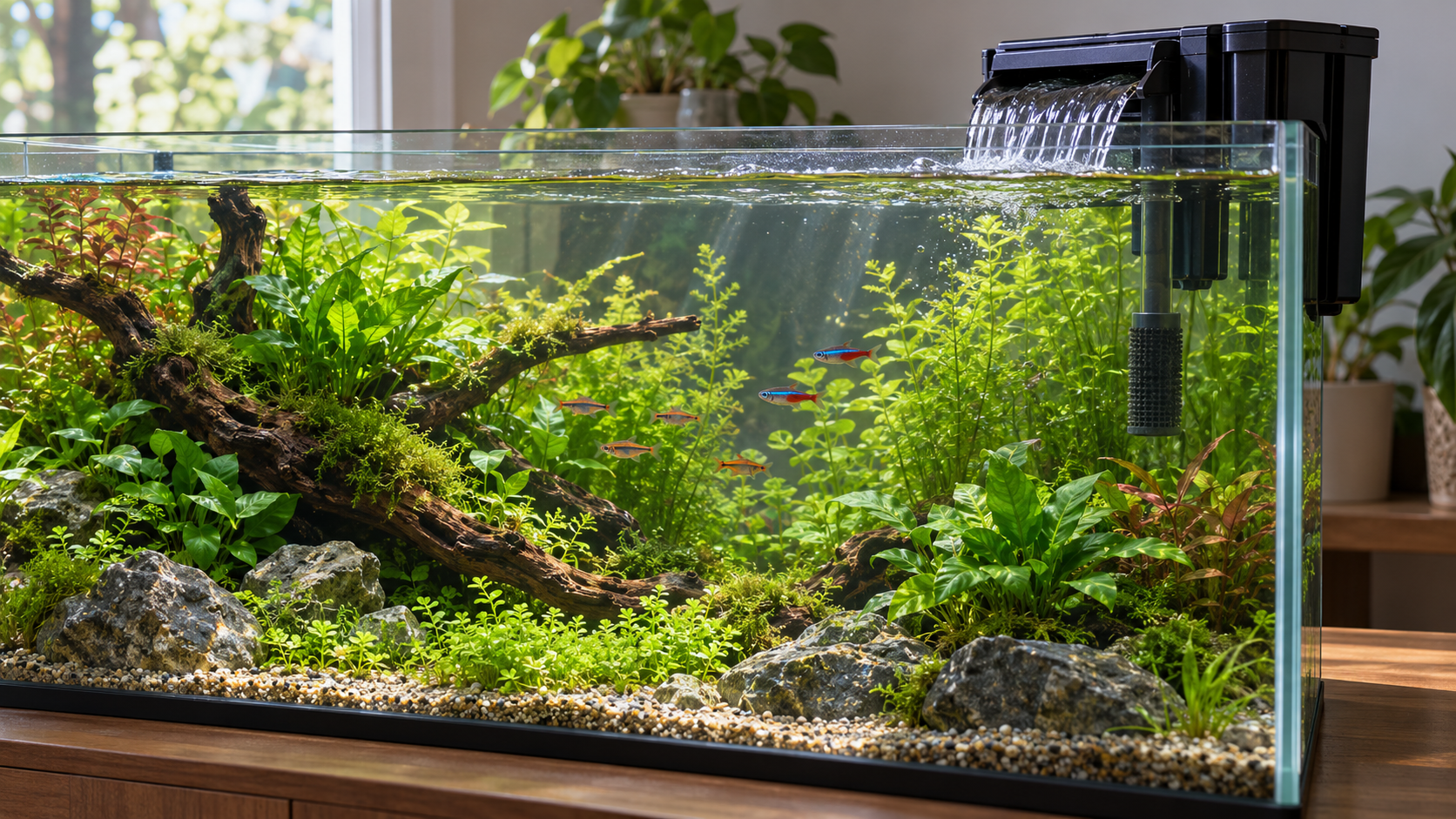
Aquarium Filtration Explainer
An aquarium filter uses a pump or air-driven lift to circulate tank water through media selected for different jobs. A sponge, pad, or floss provides mechanical filtration by trapping uneaten food, plant fragments, and suspended particles. The water then passes across porous surfaces colonized by microorganisms. This biological community converts toxic ammonia from animal waste and decomposition into nitrite and then into less acutely toxic nitrate, forming the core of the aquarium nitrogen cycle.
The filter does not remove waste simply because water looks clear. Dissolved ammonia and nitrite are invisible, and beneficial microbes need oxygen, water flow, and surface area to work. They grow on bio-rings, sponges, gravel, decorations, and every wet surface, not as a free-floating additive. A new tank needs time for populations to develop, and fish must not be added faster than the biological system can process their waste. Water testing reveals conditions appearance cannot.
Chemical media perform optional targeted work. Activated carbon can adsorb some dissolved organic compounds and medication residues, while ion-exchange materials may remove particular substances under defined conditions. These media have finite capacity and do not replace biological filtration or water changes. Their usefulness depends on the tank’s animals, water source, and treatment goal. Randomly mixing products can change water chemistry or remove medication that was supposed to remain active.
Flow carries oxygen and waste to the filter, but more velocity is not always better. Fish, shrimp, and plants have different current tolerances, and a clogged intake or packed media can reduce output sharply. Surface movement promotes gas exchange by continually renewing the water-air interface; bubbles mainly help by moving water rather than injecting all their oxygen directly. A prefilter sponge can protect small animals and catch coarse debris before it reaches an impeller.
Maintenance should preserve the microbial population. Mechanical media can be rinsed in removed aquarium water when dirty, while replacing every biological component at once may strip away much of the established community. Chlorinated tap water can harm microbes if used improperly on bio-media. The impeller and intake need cleaning, and the filter must restart after a power outage; stagnant sealed media can lose oxygen and should be handled according to the equipment and aquarium guidance.
Filtration is only one part of husbandry. Regular partial water changes dilute nitrate and other accumulating substances, while feeding control, stocking density, temperature, pH, and plant care shape the load. A filter makes waste processing continuous by bringing water, oxygen, particles, and microbes together. It cannot make an overcrowded tank self-cleaning, but a correctly sized, mature, maintained system turns dangerous nitrogen compounds into forms that routine care can manage.
A pump moves water through debris-catching mechanical media and oxygenated biological surfaces where microbes convert ammonia to nitrite and nitrate. Key terms include intake, impeller, mechanical media, bio-media, nitrification, ammonia, nitrite, nitrate, and gas exchange.
Much of the tank’s nitrifying community lives on wet filter surfaces. Replacing everything can sharply reduce biological processing capacity.
No. Ammonia, nitrite, nitrate, pH problems, and other dissolved conditions may be invisible. Testing and regular husbandry are still required.
Explore more "Explainers"
Discover additional explainers across politics, science, business, technology, and other fields. Each explainer breaks down a complex idea into clear, everyday language—helping you better understand how major concepts, systems, and debates shape the world around us.