

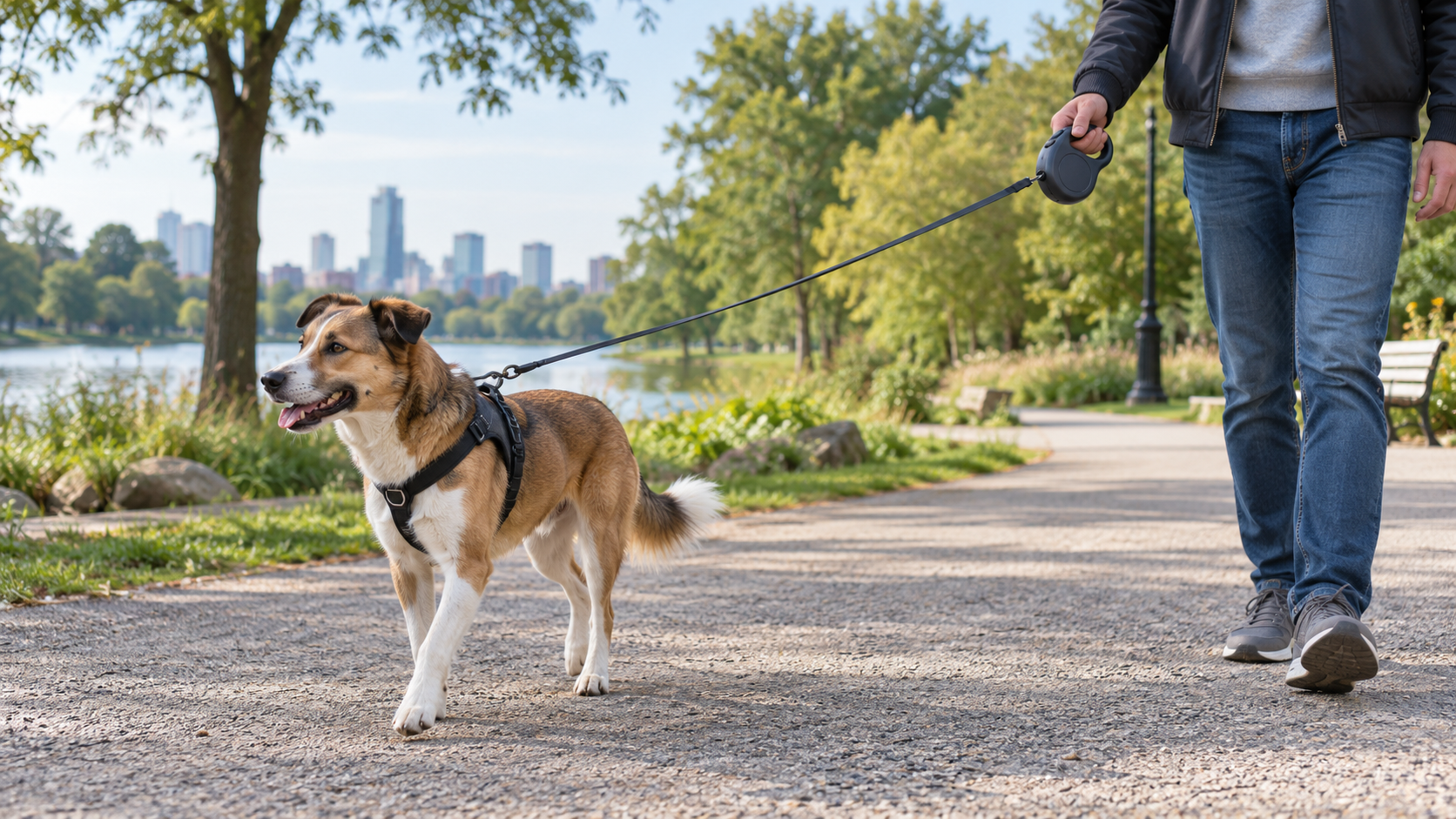
Retractable Dog Leash Explainer
A retractable leash stores a long tape or cord on a reel inside the handgrip. A spiral spring connects the reel to the housing and is wound as the dog pulls material out. When tension eases, the spring turns the reel in the opposite direction and retrieves slack. A guide at the case opening keeps the line aligned as it enters and leaves. The spring provides take-up, not enough restraint to stop a strong dog by itself.
A thumb lever operates a brake that presses against the reel or engages a toothed component. Holding the brake stops additional payout; a separate latch can keep it locked without continuous thumb pressure. Releasing the brake allows the reel to turn again under the balance of dog pull and spring tension. The device does not automatically train a fixed walking distance because the dog learns that pulling can extend the available radius whenever the brake is open.
The long range changes control. A dog several meters ahead can enter a roadway, approach another animal, round a corner, or build speed before reaching the end. The sudden stop multiplies force on the dog, attachment point, handler, and mechanism. A well-fitted harness can distribute load better than a neck collar for some uses, but equipment choice should reflect the animal, setting, and professional guidance. Busy sidewalks and close encounters usually call for a shorter controlled lead.
Thin cord or tape moving quickly can wrap skin, legs, fingers, or another animal and cause cuts or burns. It should never be grabbed with a bare hand or looped around the wrist. Dropping the housing can frighten a dog as the case chases behind while retracting. The handle must be held securely, and children need adult supervision rather than being given control of a dog whose force they cannot manage.
Dirt, sand, water, twists, and chewing can damage the line or keep it from winding evenly. Fraying, a sticky brake, cracked case, weak spring, or unreliable lock means the leash should be retired. Opening the housing can release a tightly wound spring unexpectedly, so repair is not a casual task. The attachment clip and harness ring need the same inspection as the reel, because the strongest internal mechanism cannot compensate for a failing connection.
The retractable leash is essentially a self-rewinding tape measure adapted to a moving animal. A spring continuously manages slack, the reel stores length compactly, and the brake lets the handler set a temporary boundary. That convenience is most appropriate in open, low-conflict spaces with an attentive adult and a responsive dog. It is not a substitute for training, environmental awareness, or the immediate close control provided by a fixed-length leash.
A spiral spring rewinds tape or cord onto a reel, while a thumb brake stops payout and a latch can hold the reel. Key terms include reel, spiral spring, payout, guide, brake, lock, tape, attachment clip, and handling radius.
No. It mainly retracts slack. The handler must use the brake and appropriate equipment, and the mechanism cannot replace training or physical control.
A moving thin cord or tape can tighten or slide rapidly across skin, causing cuts, burns, or entanglement injuries.
Explore more "Explainers"
Discover additional explainers across politics, science, business, technology, and other fields. Each explainer breaks down a complex idea into clear, everyday language—helping you better understand how major concepts, systems, and debates shape the world around us.