

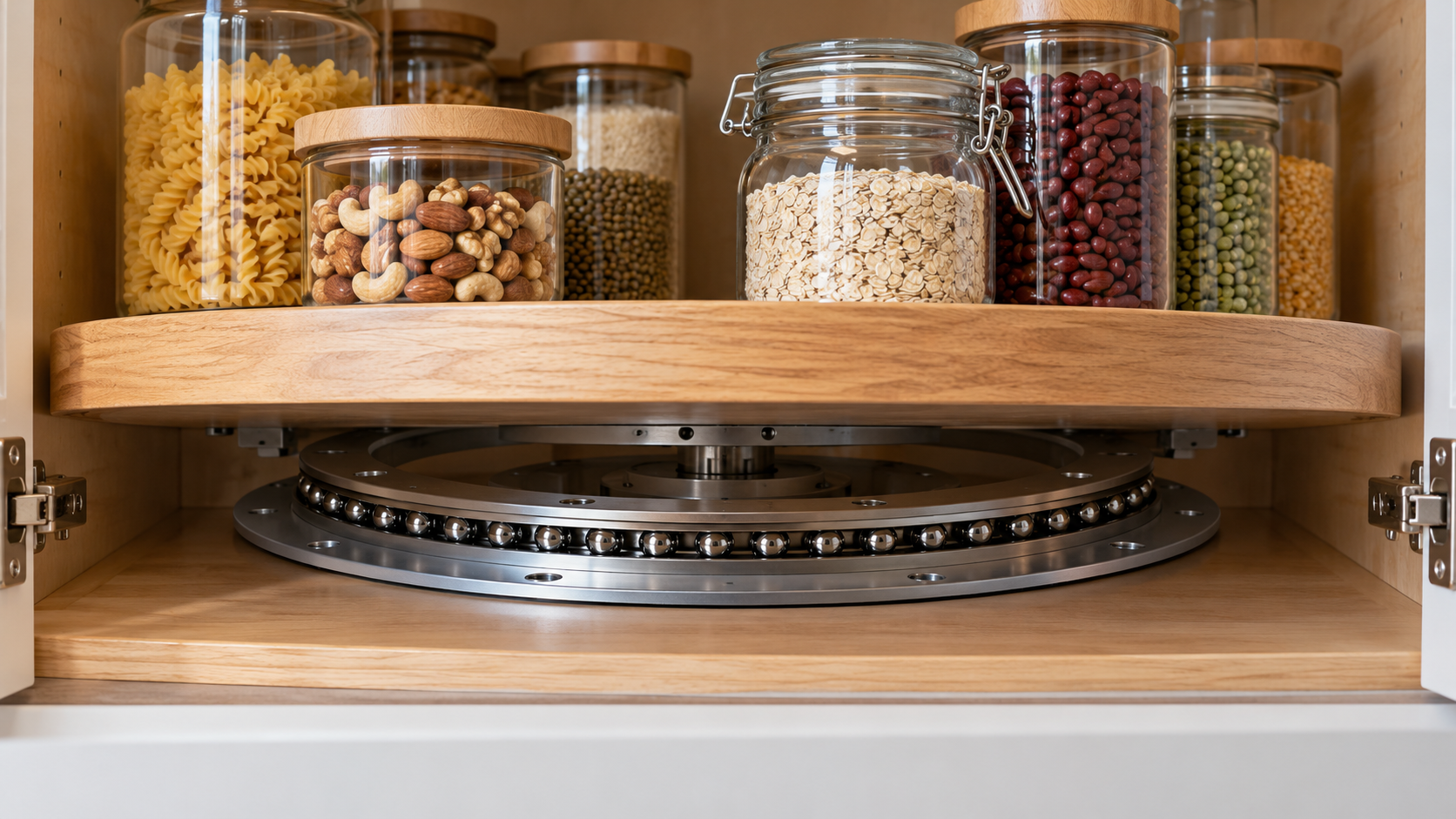
Lazy Susan Bearing Explainer
A Lazy Susan is a rotating platform supported by a bearing between the turntable and its stationary base. A common furniture bearing uses two stamped metal rings or plates with matching circular grooves. Steel balls sit between those grooves. When the top plate turns, the balls roll around the raceway instead of forcing broad surfaces to slide across one another. Rolling contact greatly reduces friction, making a loaded tray easier to start, continue, and stop by hand.
The balls also carry the vertical load. Each ball touches the upper and lower race over a small region, and a group of balls shares the weight around the circle. A separator, dimples, or controlled spacing prevents the balls from bunching. The wide diameter of the race helps resist tipping moments when a heavy object sits away from the center. Some turntables use a central post or ring bearing, while others add detents that index a cabinet shelf at a preferred position.
Mounting changes how well the bearing works. The fixed plate must sit flat, and the rotating platform needs to be centered closely enough that loads remain within the supported footprint. Screws should be secure without distorting thin metal. Many square-plate bearings include an access hole so fasteners for the hidden side can be installed by rotating the plates. Rubber feet may replace screws on portable serving turntables, but they must prevent the stationary base from sliding.
A larger or more distant load creates greater torque on the bearing. If dishes are concentrated at one edge, the balls on that side carry more force and the platform may tilt or scrape. Rated capacity assumes a particular orientation and reasonably distributed weight, not a sharp impact or someone leaning on the rim. Grease reduces contact friction and noise, while seals or close-fitting races keep crumbs and grit from entering. Very free bearings may continue spinning unless deliberately damped.
Roughness, wobble, or clicking can come from contamination, loose fasteners, a warped tray, dented races, missing balls, or overload. Cleaning instructions depend on whether the bearing is open or sealed. Adding random oil can wash out grease or attract debris. A turntable used for food should also be stable, level, and sized so items cannot extend dangerously beyond its edge. Fingers need clearance from pinch points between the rotating platform and fixed support.
The familiar tray is therefore a compact load-bearing machine. Two concentric races define the path, rolling elements replace sliding friction, and a broad support circle keeps the platform stable. The bearing does not drive the motion; the user supplies torque at the rim, where leverage is greatest. With centered installation and balanced loading, a small push can move several dishes smoothly while the base remains planted on the table or inside the cabinet.
Steel balls roll between circular races in two plates, supporting the platform while reducing friction. Key terms include turntable, raceway, ball bearing, separator, torque, radial load, axial load, and detent.
An off-center load creates a tipping moment and concentrates force on part of the race. A warped platform or loose mounting can make the effect worse.
They provide tool access to mounting screws on the otherwise hidden plate. The bearing is rotated until each fastener lines up with the access opening.
Explore more "Explainers"
Discover additional explainers across politics, science, business, technology, and other fields. Each explainer breaks down a complex idea into clear, everyday language—helping you better understand how major concepts, systems, and debates shape the world around us.