

Pressure-Sensitive Adhesive Tape Explainer
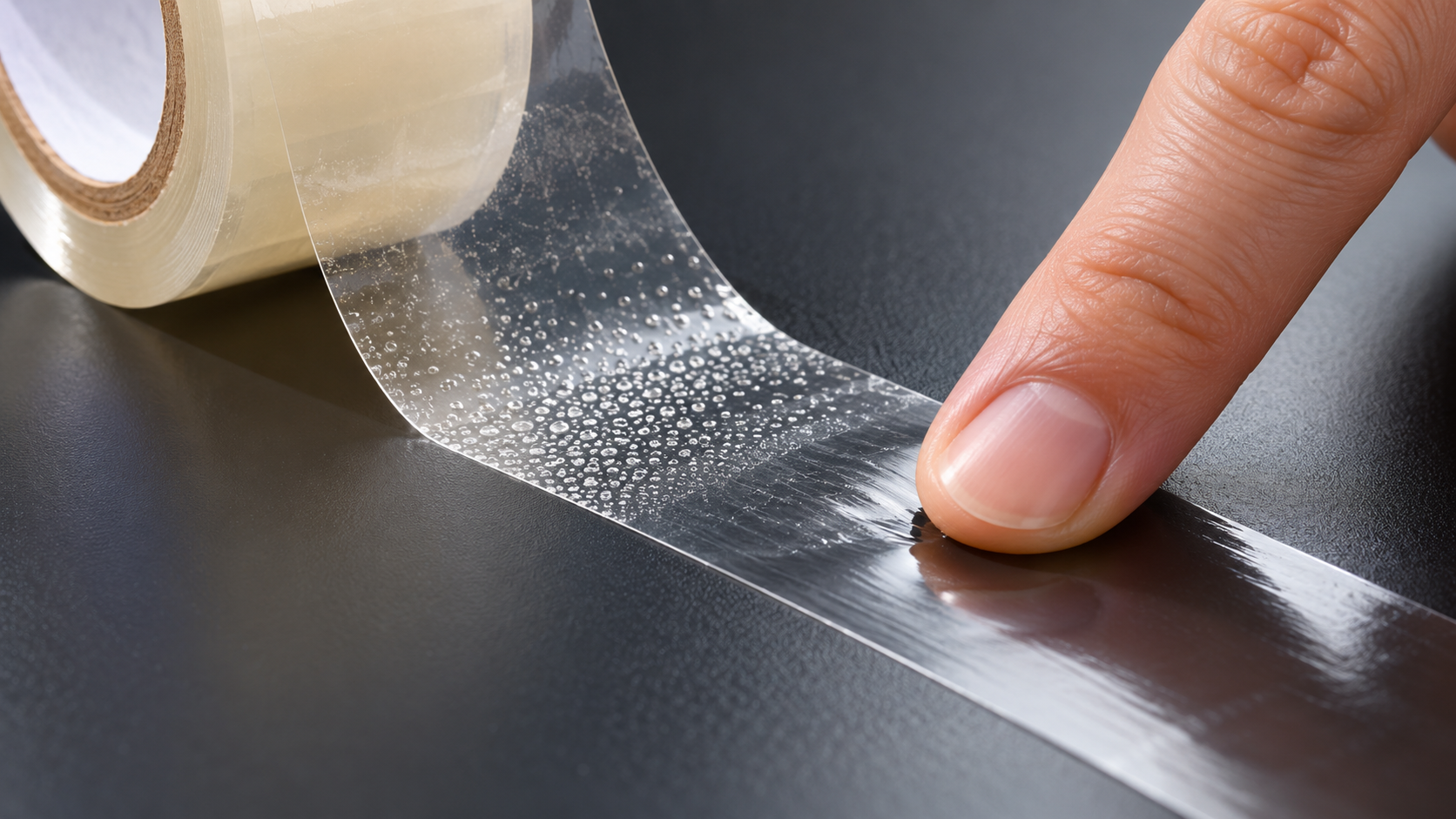
Pressure-sensitive tape sticks without water, heat, or a separate curing step because its adhesive is already soft and active at use temperature. Pressing the tape against a surface makes the adhesive flow into tiny valleys and around microscopic high points. That wetting creates a much larger true contact area than a strip laid down lightly. At close range, intermolecular attractions act across the interface. The tape feels instantly tacky because the adhesive can make that contact during a brief application.
The adhesive must behave as both liquid and solid. Its viscous side lets it deform slowly and conform to texture; its elastic side lets it resist flowing away under load. This combination is called viscoelasticity. A formulation that is too stiff may not wet the surface, while one that is too fluid may creep or leave residue. Rubber, acrylic, and silicone chemistries tune this balance differently for temperature, aging, sunlight, removability, and the surface energy of the material being joined.
A typical tape adds a backing that carries tensile load and controls stretch. Primer may anchor adhesive to the backing, and a release coating lets the roll unwind. Double-sided products put adhesive on both faces of a carrier or use a free adhesive film protected by a liner. Foam carriers accommodate uneven gaps and spread stress. These layers are engineered together: a strong adhesive on a weak backing can tear, while a rigid backing may concentrate peel force at one sharp line.
Bond strength usually grows after application because the adhesive continues to wet the surface. Firm pressure improves initial contact, particularly on textured materials. Cleanliness is critical: dust, oil, moisture, and loose paint create a weak boundary that the tape may remove instead of bonding to the intended substrate. Cold can make adhesive too stiff to wet properly; high heat can soften it and encourage creep. Product data therefore specify application and service temperature ranges.
Tape is strongest when loads act in shear across a broad area and weakest when an edge is peeled back. Peeling concentrates force into a narrow moving front, which is why a tab can remove a tape that supports weight when pulled parallel to the wall. Removal angle and speed affect behavior because the adhesive has time-dependent flow. Delicate finishes should be tested, and safety-critical, overhead, high-temperature, or structural loads require tape specifically rated for that use.
The familiar stick is an engineered compromise. Pressure creates intimate contact, molecular forces provide adhesion, and the polymer network supplies cohesion so the material does not simply stay on both surfaces as goo. The backing distributes force and gives the user a handle for placement and removal. Choosing the right chemistry and applying it to a clean compatible surface lets a very thin layer turn fingertip pressure into a useful bond within seconds.
A viscoelastic adhesive flows into microscopic surface texture under pressure, creating close molecular contact while retaining enough cohesion to hold. Key terms include tack, wetting, viscoelasticity, adhesion, cohesion, backing, shear, and peel.
Pressure increases real contact area by pushing the soft adhesive into surface texture and displacing small pockets of air.
Peeling concentrates force along a narrow advancing edge. Shear spreads the load across much more of the bonded area, so the same tape can resist it better.
Explore more "Explainers"
Discover additional explainers across politics, science, business, technology, and other fields. Each explainer breaks down a complex idea into clear, everyday language—helping you better understand how major concepts, systems, and debates shape the world around us.