

Windshield Wiper Linkage Explainer
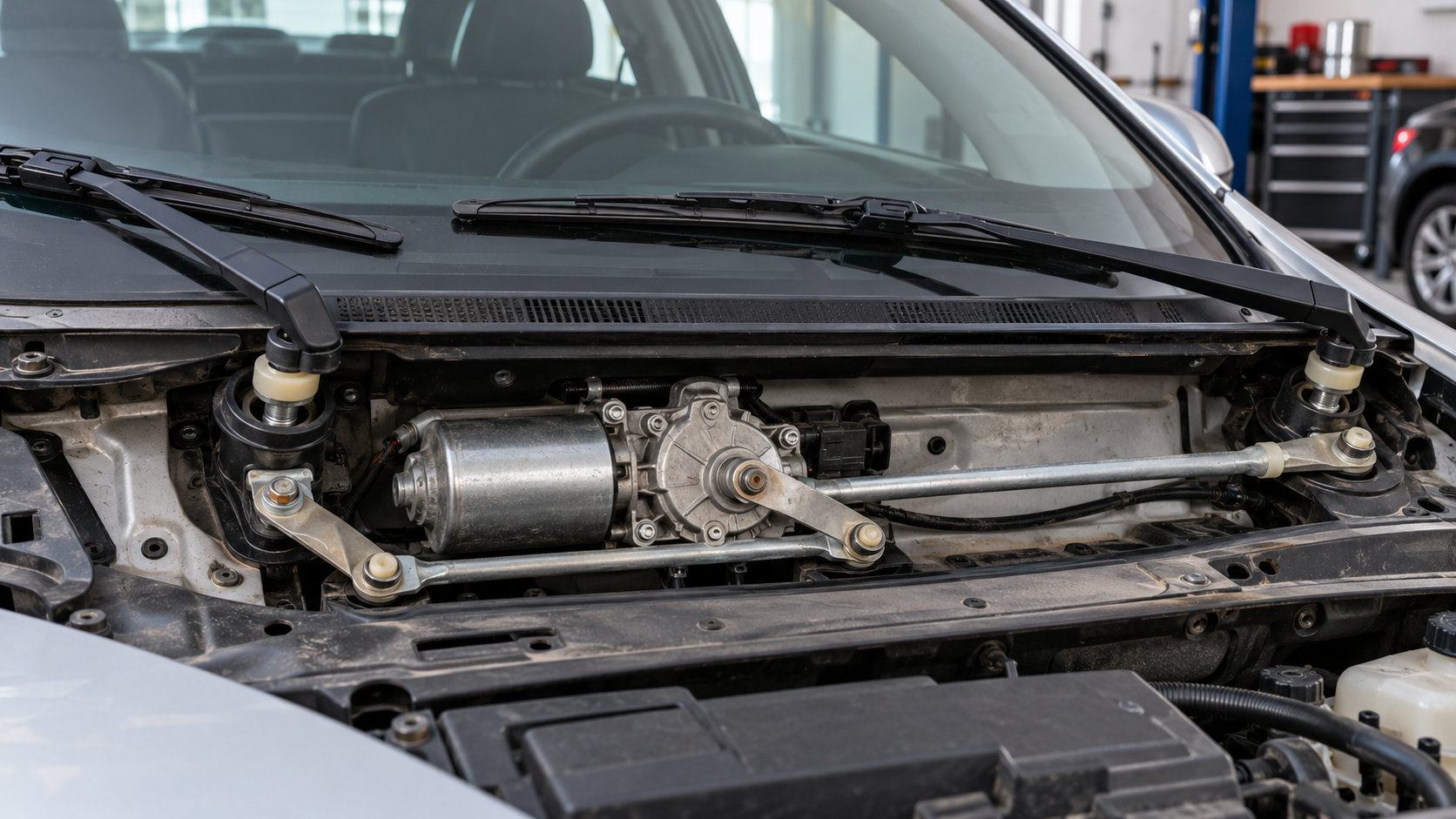
A windshield-wiper motor spins in one direction, but the blades must reverse at the ends of every sweep. A reduction gearbox first lowers motor speed and raises torque. On the gearbox output, a short crank rotates continuously. A connecting rod attached away from the crank center is pushed and pulled as that point travels in a circle. Linkage arms carry the reciprocating motion to pivot shafts beneath the cowl, and the external wiper arms oscillate with those shafts.
The geometry is a form of crank-rocker or four-bar linkage. Near the middle of a wipe, the mechanism converts crank movement into relatively rapid blade travel. Near each reversal, the relationship changes and the wiper slows before changing direction. Designers choose arm lengths and pivot positions to cover a broad glass area without the blades colliding, leaving the windshield, or striking trim. Vehicles with opposing, tandem, or single-arm patterns use different linkages to create their required paths.
Each blade must stay pressed against curved glass. A spring in the wiper arm supplies normal force, while a flexible blade frame or beam distributes that force along the rubber edge. The linkage handles sweep position; it does not alone guarantee wiping contact. Washer fluid loosens dirt and reduces dry friction. Ice, packed snow, a torn blade, or a bent arm can dramatically raise load, stressing pivot bushings, splines, gears, and the motor.
A park switch keeps the motor powered after the driver turns the control off until the crank reaches a defined resting position. Contacts or electronic position sensing then stop the blades at the bottom of the windshield rather than wherever the switch was released. Intermittent modes use timing logic to begin individual cycles. Variable-speed systems change motor control while preserving the same basic conversion from rotating crank to reversing linkage.
Sluggish, noisy, or unsynchronized wipers may indicate worn blades, loose arm splines, seized pivots, failed plastic bushings, bent rods, poor electrical supply, or a tired motor. Wipers frozen to glass should be freed before activation. The system should be switched off and parked before service, because an unexpected motor start can move the linkage with enough force to injure fingers. Correct arm indexing matters; reinstalling at the wrong angle can make a blade hit the cowl or pillar.
The wiper mechanism is a compact motion converter repeated thousands of times in bad weather. Continuous motor rotation turns a crank, the crank alternately pulls and pushes the link, and pivot arms create the familiar sweep. Mechanical geometry controls range and reversal, while the electrical park circuit chooses the resting point. Clear vision depends on all layers—motor torque, free linkage joints, correctly indexed arms, blade pressure, suitable rubber, and fluid on the glass.
A geared motor rotates a crank whose offset pin pushes and pulls linkage rods, making the wiper pivots oscillate. Key terms include gearbox, crank, connecting rod, four-bar linkage, pivot, spline, park switch, and blade pressure.
The linkage geometry changes mechanical advantage as the crank approaches reversal, naturally reducing output speed before the arm changes direction.
A park circuit keeps the motor energized until a position switch or sensor detects the designated resting point, then interrupts power.
Explore more "Explainers"
Discover additional explainers across politics, science, business, technology, and other fields. Each explainer breaks down a complex idea into clear, everyday language—helping you better understand how major concepts, systems, and debates shape the world around us.