

Power Window Regulator Explainer
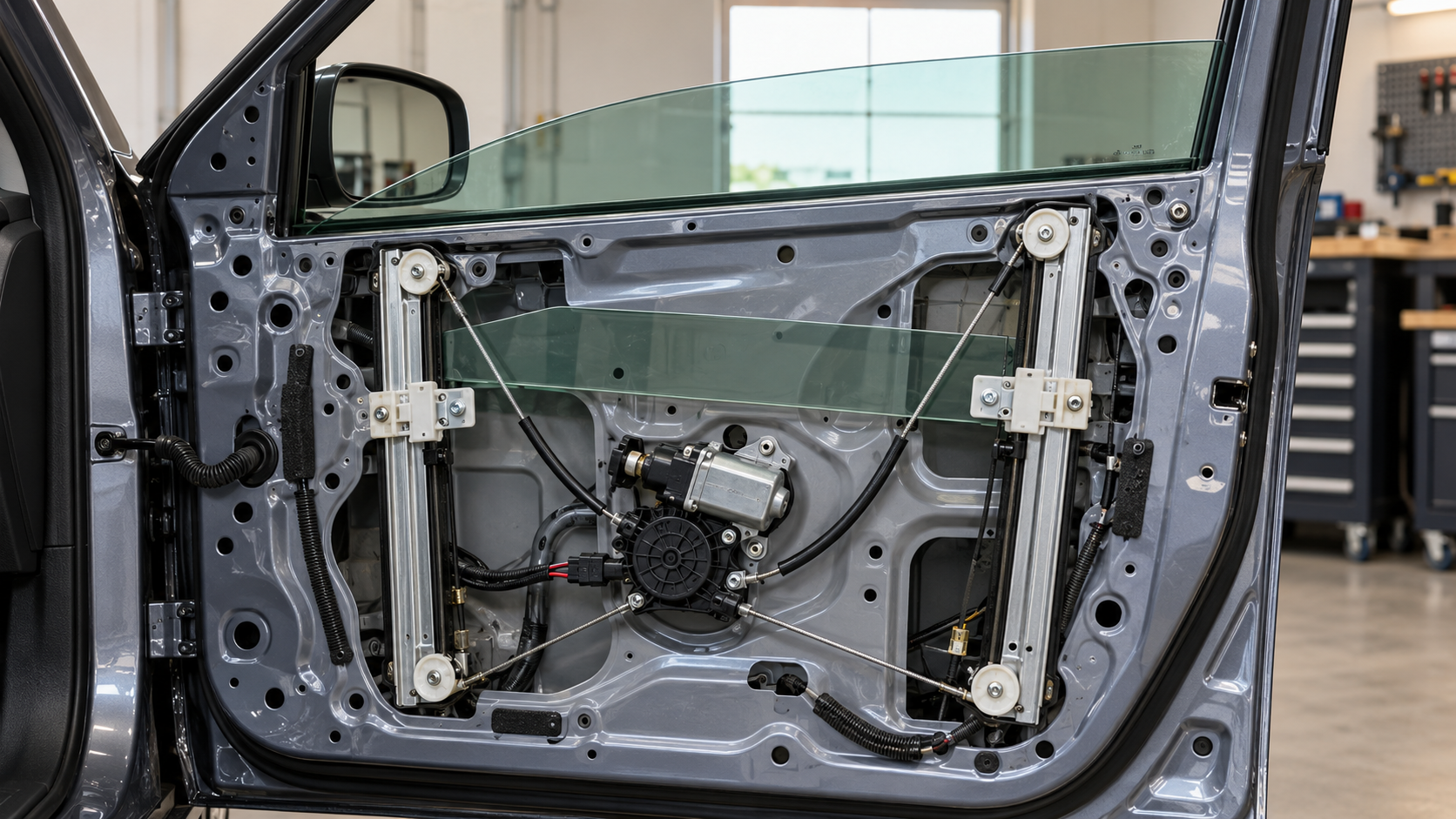
A car power window hides a lifting machine inside the door. Pressing the switch sends power to a reversible electric motor through the vehicle’s control circuit. Changing switch direction reverses motor polarity and rotation. The motor turns a reduction gearbox, trading speed for torque, and the gearbox drives the window regulator. The regulator moves a carrier attached to the bottom of the glass while tracks and felt-lined guides keep the pane aligned as it enters or leaves the upper frame.
Scissor regulators use crossed metal arms that pivot like expanding shears. A sector gear or driven arm changes their angle, raising the glass platform as the assembly opens and lowering it as the arms fold. Cable regulators use a drum to wind and unwind cable around pulleys, pulling one or more sliding carriers along rails. Cable systems package compactly in shaped doors, while scissor systems spread load through rigid links. Both must control a relatively large pane through limited space.
The glass does not ride on the motor. Its lower edge is clamped or bonded to carriers, and the side channels absorb wind force and prevent rotation. Weatherstrips wipe water from the surface and reduce rattles, but they also create friction. Curved glass may follow a slightly angled path rather than moving straight down. Stops or controller calibration define the fully open and closed positions so the mechanism does not continue forcing the pane after travel ends.
Many modern systems monitor motor current, speed, or position. Current rises when the glass reaches a stop or encounters resistance. Anti-pinch control can reverse closing when the pattern indicates an obstruction, though detection capability and legal requirements vary. One-touch operation uses logic to continue movement after the switch is released. After battery disconnection or repair, the controller may need a specified relearn sequence to restore position limits and automatic functions.
Slow or crooked movement can come from dry or damaged guides, a loose carrier, frayed cable, cracked pulley, worn gear, corroded wiring, or a tired motor. Repeatedly holding the switch against a stalled window overheats components. Doors contain sharp metal, side-impact systems, wiring, and sometimes airbags, while regulator springs or suspended glass can move unexpectedly. Diagnosis and repair require the vehicle procedure, supported glass, disconnected power where specified, and suitable protective equipment.
The window’s smooth motion is the product of a chain of conversions. The switch requests direction, the motor turns electricity into rotation, the gearbox increases torque, and the regulator turns that rotation into controlled vertical travel. Carriers transmit force to the glass, while guides carry side loads and define the path. When one small cable, slider, or plastic pulley fails, the pane may drop or tilt even though the motor can still be heard running.
A reversible motor and reduction gear drive a scissor-arm or cable regulator that moves glass carriers along guided tracks. Key terms include motor, polarity, gearbox, regulator, carrier, pulley, guide channel, and anti-pinch.
The cable, gear, pulley, arm connection, or carrier may have failed, disconnecting the spinning motor from the supported pane.
Many systems watch motor current, speed, or position for an abnormal change during closing and command reversal when the calibrated threshold is exceeded.
Explore more "Explainers"
Discover additional explainers across politics, science, business, technology, and other fields. Each explainer breaks down a complex idea into clear, everyday language—helping you better understand how major concepts, systems, and debates shape the world around us.