

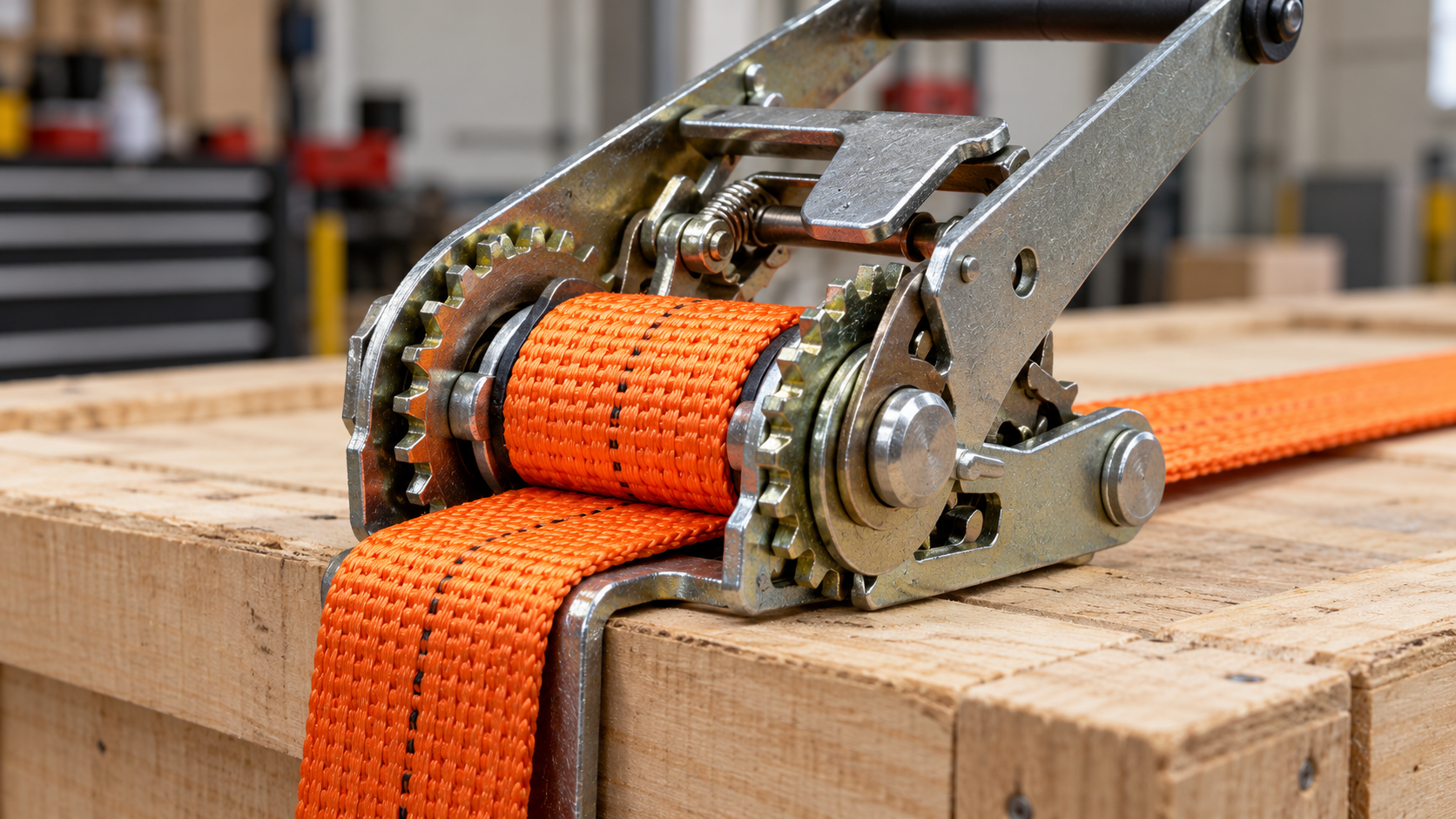
Ratchet Strap Mechanism Explainer
A ratchet strap tightens by winding flat webbing around a rotating shaft called a mandrel. The loose end passes through a slot in the mandrel, and most slack is pulled through by hand. Pumping the handle then rotates the mandrel a small amount on each stroke. Ratchet wheels fixed to the shaft have asymmetric teeth. A spring-loaded drive pawl pushes on those teeth during the tightening stroke, converting repeated handle motion into one-directional winding.
A second holding pawl mounted in the frame prevents the mandrel from turning backward between strokes. Its tip drops behind each tooth with the familiar clicking sound. The handle gives mechanical advantage, so the user can create far more webbing tension than by pulling the tail alone. As webbing builds into layers around the mandrel, its effective radius grows. Too many wraps reduce remaining space and mechanical advantage, which is why excess slack is removed before ratcheting.
Closing the handle places the mechanism in its locked travel position, with the pawls engaged. To release it, the user pulls the release latch and opens the handle fully so both pawls lift clear of the ratchet teeth. The mandrel can then rotate freely and the webbing unwinds. Partially moving the handle without reaching the designed release position may leave a pawl loaded. Tension can release suddenly, so hands, face, and bystanders stay out of the strap’s line.
The strap secures by preloading cargo against a deck or restraint points. Friction between the load and surface helps resist sliding, while direct lashings can restrain specific directions. Working load limit applies to the complete assembly and arrangement, not just the strongest-looking hook. Edge bends, knotting, twisting, heat, chemicals, and sharp corners reduce capacity. Anchor points must also be rated and positioned so the strap cannot slip off or crush fragile cargo.
Before use, webbing is checked for cuts, melted fibers, severe abrasion, broken stitching, and chemical damage. Hardware is checked for bent frames, cracked hooks, corrosion, worn teeth, and sluggish pawls. Damaged assemblies are removed from service rather than tied together. Cargo is rechecked after initial travel because loads settle and vibration changes tension. Ratchet straps are not lifting slings, fall-protection equipment, tow ropes, or a substitute for the vehicle’s rated restraint system.
The mechanism succeeds by separating motion into small irreversible steps. The handle supplies leverage, the drive pawl advances the toothed wheel, the holding pawl preserves each gain, and the mandrel stores that gain as wound webbing. Opening the release deliberately removes both one-way locks. Correctly selected and inspected equipment can apply repeatable tension, but the security of the load still depends on routing, anchors, edge protection, capacity, and regular reinspection.
The handle advances toothed wheels that wind webbing onto a slotted mandrel, while a holding pawl blocks reverse motion. Key terms include mandrel, ratchet wheel, drive pawl, holding pawl, leverage, preload, webbing, and working load limit.
Too many layers on the mandrel consume space, enlarge the winding radius, and can prevent the ratchet from closing or developing tension effectively.
Pulling the latch and opening the handle to its full release position lifts both pawls away from the teeth so the mandrel can unwind freely.
Explore more "Explainers"
Discover additional explainers across politics, science, business, technology, and other fields. Each explainer breaks down a complex idea into clear, everyday language—helping you better understand how major concepts, systems, and debates shape the world around us.