

On This Day in Business: May 4, 1904
On May 4, 1904, the United States formally began work on the Panama Canal after taking control of property and unfinished works from the earlier French enterprise. At Ancon, Army lieutenant Mark Brooke received the keys to storehouses and a hospital, symbolizing the transfer. The objective was commercially and strategically immense: create a controlled water route across the isthmus so ships could avoid the long voyage around South America. The undertaking would require far more than excavation. It demanded a governing organization, reliable supply lines, housing, sanitation, rail transport, medical care, and an engineering plan capable of operating in difficult tropical terrain.
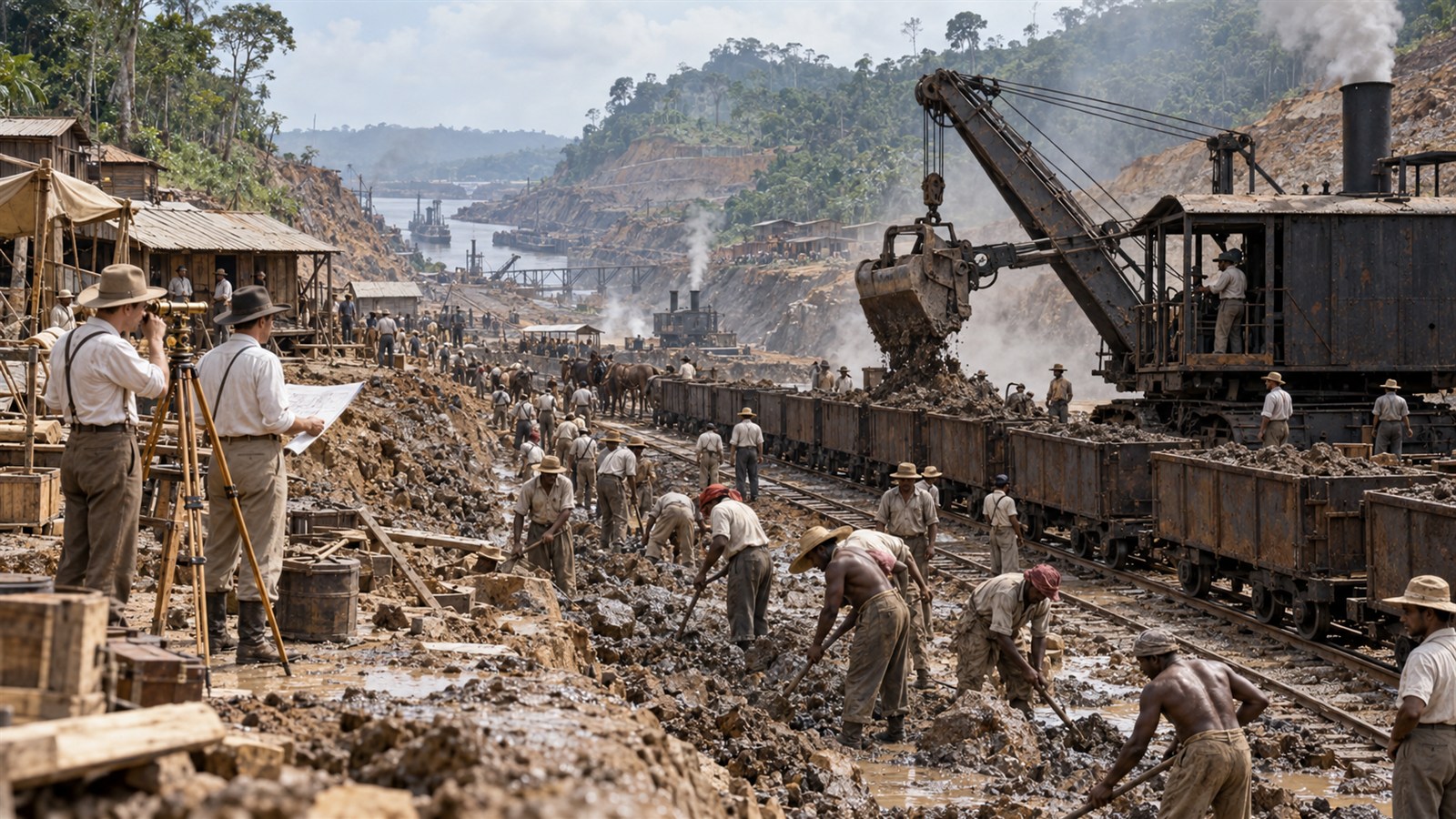
The first American phase exposed weaknesses in administration and health conditions. Yellow fever and malaria had devastated the French effort, and disease continued to threaten workers. Dr. William Gorgas led campaigns against mosquitoes through drainage, screening, fumigation, and cleaner settlements. Engineering leadership changed, and the United States abandoned a sea-level concept in favor of a lock canal using Gatun Lake. Railroads carried spoil from the Culebra Cut, while steam shovels, drills, concrete plants, and repair shops operated as parts of one vast production system. Progress depended on coordinating machines and people across the entire Canal Zone.
Labor came from many countries, especially the Caribbean, under a segregated wage system that divided workers into “gold” and “silver” rolls. Conditions, pay, and opportunity were unequal, even as tens of thousands of workers made the canal possible. The project also rested on U.S. political and military power in newly independent Panama, a relationship that remained contested long after construction. When the canal opened in 1914, it shortened important maritime routes and changed calculations for shipping companies, ports, commodity traders, and navies. Tolls and scheduling turned geography into a managed transportation service.
The May 1904 start matters because it began a new operating institution as much as a construction job. Success required public-health science, workforce recruitment, logistics, financing, and a design that could be maintained after opening. The canal created enormous economic value by saving distance, but that value cannot be separated from labor inequality, imperial power, and environmental change. For businesses, it illustrates how infrastructure redraws markets by lowering one bottleneck while creating new dependencies on capacity, pricing, and governance. The waterway’s commercial importance came from continuous operation, not from the excavation alone; a route between oceans became valuable only when ships could trust the system to move them safely and predictably.
The United States acquired French assets and accepted control of canal facilities in Panama on May 4, 1904.
Disease, weak organization, and the scale of excavation made the early phase as much a management problem as an engineering problem.
Mosquito control and improved sanitation reduced yellow fever and malaria, making a stable workforce possible.
A lock-canal plan, Gatun Lake, rail logistics, and heavy machinery turned the isthmus into an integrated construction system.
A multinational labor force worked under unequal conditions while U.S. power shaped the Canal Zone’s politics.
Opening in 1914 transformed trade routes by selling reliable passage through a managed geographic shortcut.
Explore more of "On This Day ..."
Discover more events from the same date across news, politics, technology, sports, and other fields. Each link highlights significant moments that shaped history on different fronts.