

Safety Pin Spring and Clasp Explainer
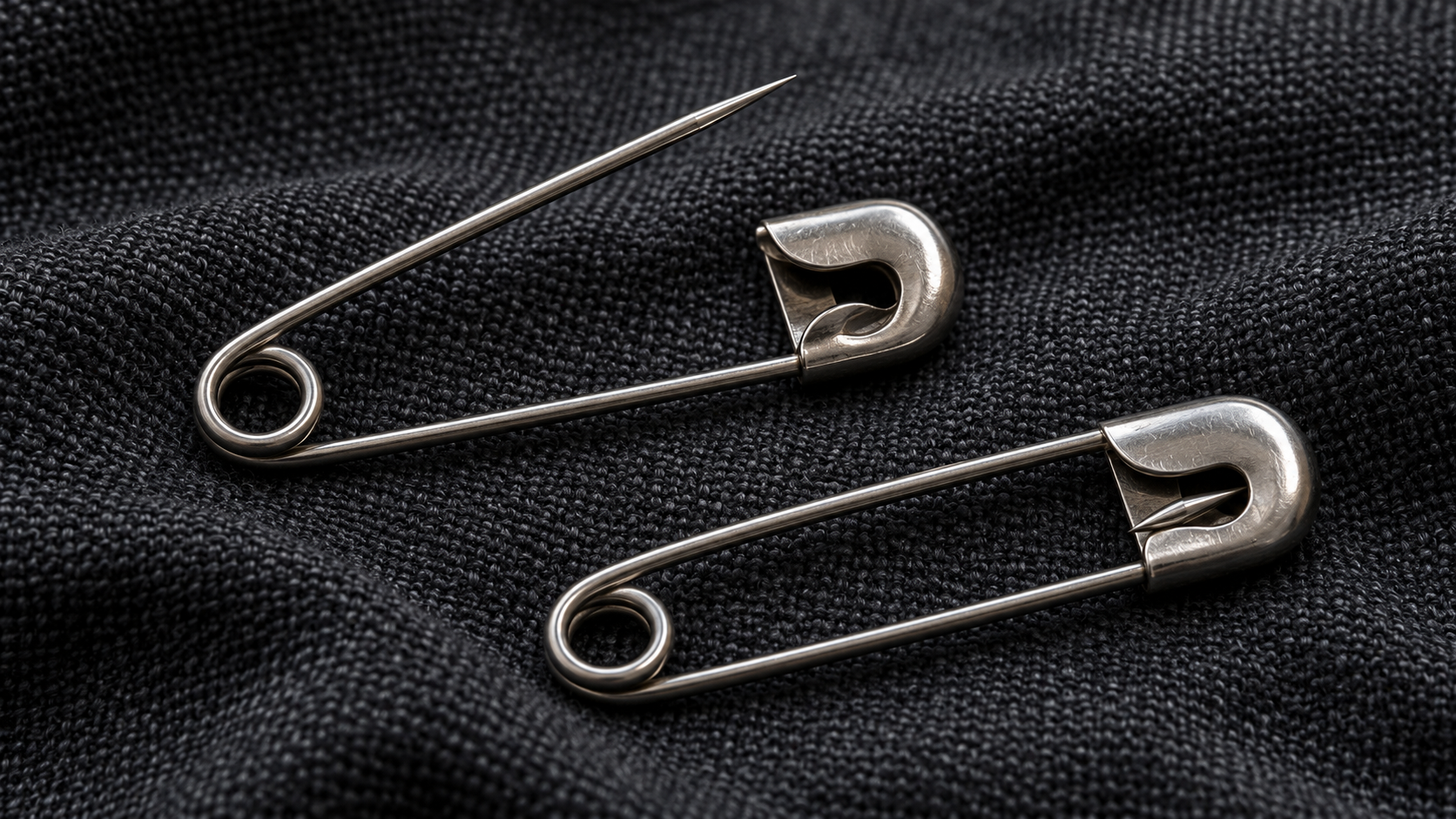
A safety pin is made from one shaped length of springy wire. Near its middle, the wire forms a tight coil; one side ends in a sharp point and the other in a folded clasp. Bending the pointed arm toward the clasp twists and flexes the coil. The metal responds by trying to return toward its open shape, which keeps the point pressed firmly into the clasp.
The coil works as a torsion spring. Movement of the long arm rotates the wire around the coil axis and stores elastic energy along the bend. Because the arm is much longer than the coil radius, fingers gain leverage to move it. Once released inside the clasp, the same stored energy supplies closing force. A properly formed wire remains within its elastic range and survives many opening cycles.
The clasp performs two jobs. Its curved channel captures the point sideways so ordinary pulling does not let the arm spring straight out. It also surrounds the sharp tip, reducing snags and accidental punctures. To open the pin, the user first pushes the arm inward against spring tension, then moves it laterally out of the retaining channel before allowing it to swing away.
When the pin passes through fabric, the two arms and coil form a closed loop around the material. The clasp is not intended to carry a large structural load; it merely keeps the point captured while the wire spans the layers. Thick material increases bending and may hold the point at a poor angle. Overloading can spread the clasp, permanently bend the arm, or fatigue the coil.
Rust, nicks, and repeated overextension weaken the wire. A point that no longer reaches deeply into the clasp or a clasp that can be brushed open should not be trusted. The sharp end should be directed away from skin during insertion, and pins are unsuitable where a child could remove or swallow them. Decorative pins may use different metals and may not have the resilience of hardened steel.
The safety feature is therefore a combination of force and geometry. The coil continuously urges the pointed arm outward, while the clasp turns that force into retention by blocking the point’s path. Opening requires a deliberate two-part motion against the spring and sideways from the channel. A tiny piece of wire can consequently pierce, hold, and shield its own tip without a separate hinge or latch.
A coiled section acts as a torsion spring, pressing the pointed arm into a curved clasp that blocks and covers the tip. Key terms include spring wire, coil, torsion, elastic range, arm, point, clasp, and retention.
The clasp surrounds the point's normal outward path. Compressing the spring first creates clearance so the arm can move sideways out of the channel.
The coil or arm may have yielded from overextension, or the clasp may have spread. Corrosion and fatigue can also reduce reliable spring force.
Explore more "Explainers"
Discover additional explainers across politics, science, business, technology, and other fields. Each explainer breaks down a complex idea into clear, everyday language—helping you better understand how major concepts, systems, and debates shape the world around us.