

Glue Stick Adhesive Explainer
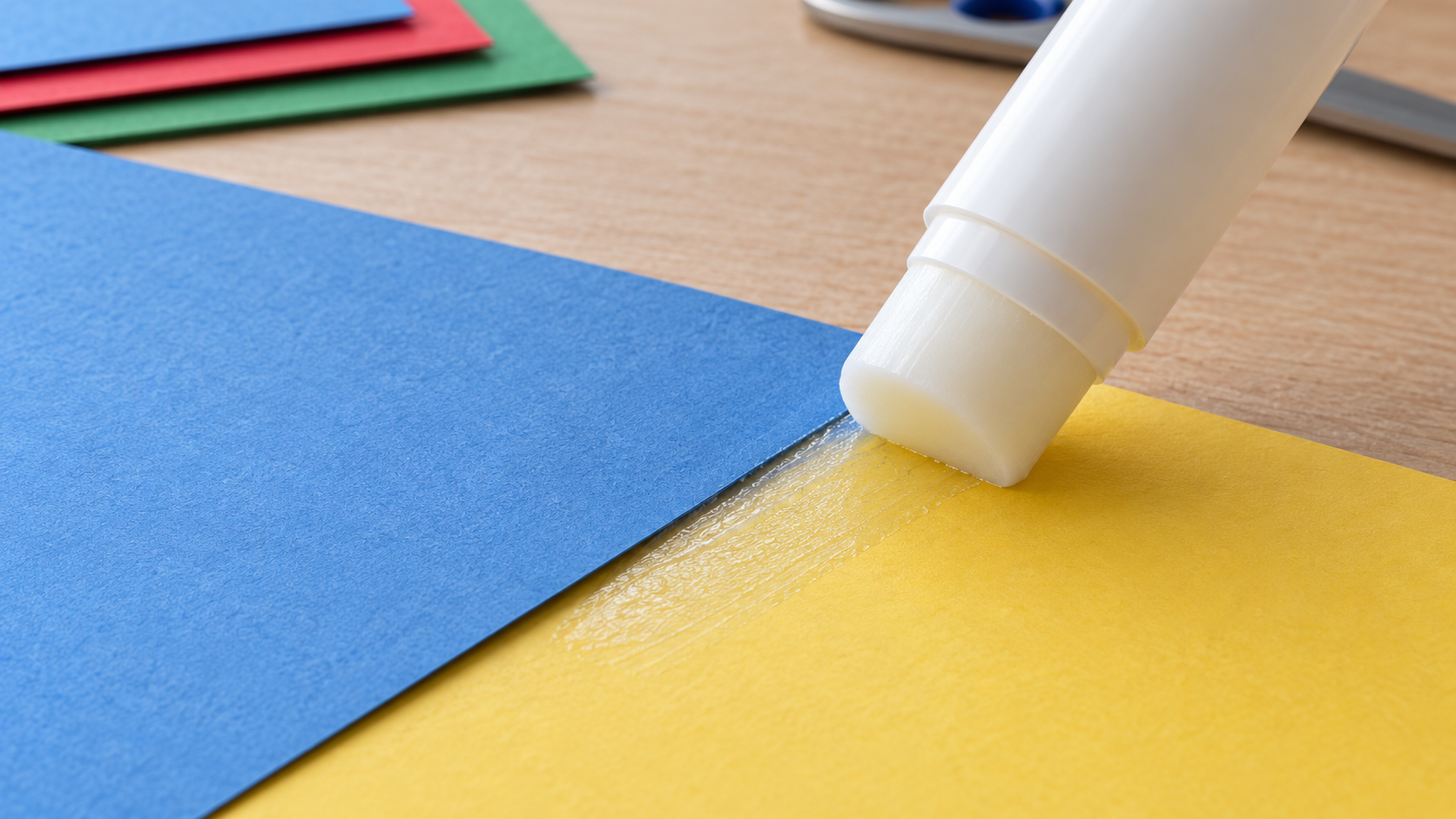
A glue stick is a solid-looking container for a soft, water-based adhesive. Rubbing it over paper transfers a thin layer containing polymer, water, and ingredients that give the material its firm gel structure. The fresh film wets the surface and flows around microscopic paper fibers. Pressing a second sheet against it brings both surfaces into intimate contact before the film begins to lose moisture.
The adhesive polymers are long molecules that can interact with cellulose in paper and entangle with one another. As water evaporates or is absorbed by the sheets, the film becomes more concentrated and less mobile. It changes from slippery paste to a continuous solid layer bridging the two surfaces. The bond is distributed across a broad area, so many small molecular attractions add up to useful holding force.
A soap-like or waxy gel network gives the stick its shape. It must be firm enough to rise on a threaded platform without slumping, yet soft enough to leave an even coating under light pressure. The twist mechanism converts cap rotation into straight movement of the adhesive column. Retracting the stick protects it from impact, while the tight cap slows evaporation that would dry the exposed end.
Coverage and timing determine strength. A patchy coat leaves unbonded zones, while thick lumps take longer to dry and can wrinkle thin paper. Joining pieces while the adhesive is still moist allows repositioning, but they should be pressed flat so air gaps and curled edges do not interrupt contact. Porous paper accepts the water and polymer well; glossy or plastic surfaces may resist wetting and offer little mechanical anchoring.
Heat, air, and dirt affect performance. A dried crust can drag or tear paper rather than spread smoothly. Excess warmth may soften the gel, and freezing can disrupt some formulations. The adhesive is intended for materials and conditions stated by its maker; a craft glue stick is not a structural adhesive. Clean fingers and a scrap backing sheet keep loose fibers and oils out of the bond.
The convenient stick separates application from curing. The gel structure prevents spills during storage, rubbing breaks the surface and transfers a controlled film, and moisture temporarily gives the polymer enough mobility to wet the paper. Drying then locks the molecules and fibers into a shared layer. The resulting bond is thin, light, and adequate for paper because it acts across thousands of microscopic contact points.
A glue stick transfers a moist polymer gel that wets paper fibers and becomes a solid connecting film as water leaves. Key terms include polymer, gel, wetting, cellulose, evaporation, absorption, contact area, and curing.
The cap slows water loss. Without it, the exposed end forms a dry skin that transfers unevenly and may no longer wet the paper well.
Porous paper accepts moisture and gives the adhesive fibers and texture to surround. Low-energy smooth plastic may resist wetting and mechanical anchoring.
Explore more "Explainers"
Discover additional explainers across politics, science, business, technology, and other fields. Each explainer breaks down a complex idea into clear, everyday language—helping you better understand how major concepts, systems, and debates shape the world around us.