

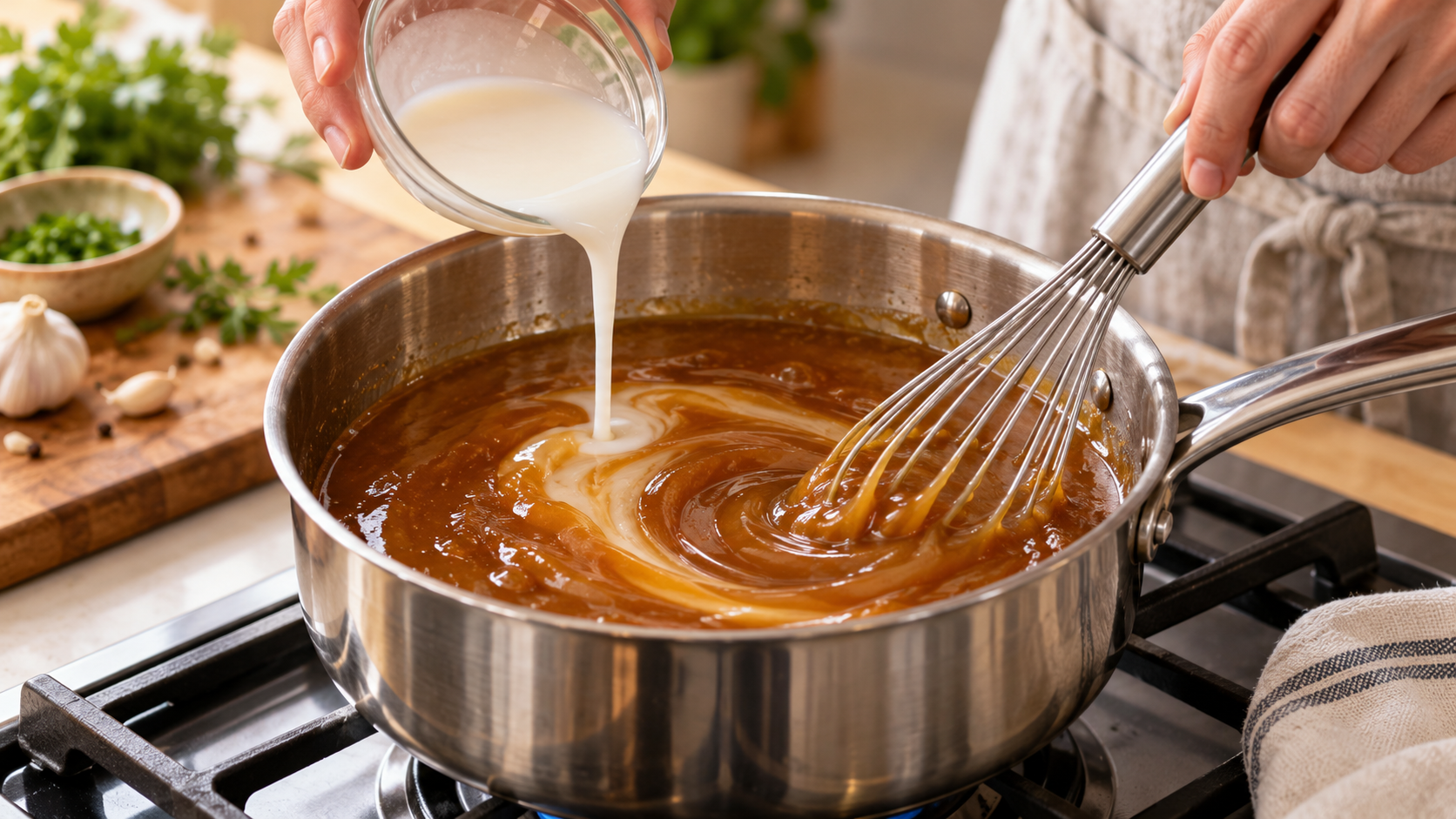
Cornstarch Gelatinization Explainer
Cornstarch thickens when its microscopic starch granules are heated in water. In a cool liquid the granules remain mostly intact and settle over time. As temperature rises, water penetrates their organized internal regions. The granules swell, lose order, and allow some starch molecules to move into the surrounding liquid. This transformation, called gelatinization, greatly increases resistance to flow.
A cold slurry separates the granules before heating. Mixing dry cornstarch directly into hot sauce wets the outside of each clump immediately, forming a thick shell around dry powder. Dispersing it first in cool water creates a pourable suspension that can spread through the sauce. Continuous stirring then keeps the granules separated as they heat and swell rather than collecting on the pan bottom.
Amylose and amylopectin are the principal starch molecules. Their proportions and branching influence clarity, texture, and stability. Swollen granules occupy more volume, while released polymers entangle and bind water between them. The sauce often changes from cloudy to more translucent as gelatinization progresses. On cooling, molecular associations strengthen further, so the final texture may be thicker than it looked while boiling.
Enough heat is necessary, but prolonged hard boiling can rupture swollen granules and reduce viscosity. Acid, high sugar concentration, strong mechanical shearing, and repeated freezing can also change the network. Adding cornstarch near the end of cooking limits exposure. A brief simmer completes gelatinization and cooks away a raw starch taste, but the exact amount and timing depend on the recipe’s water, fat, sugar, and acidity.
A thick sauce is not automatically safe or shelf-stable. Cornstarch controls texture, not microbial growth. It should be cooked and stored according to the food’s other ingredients. Reheating may thin or thicken the mixture as the structure changes, and freezing can make some ordinary cornstarch gels weep after thawing. Modified food starches are designed when greater heat, acid, or freeze-thaw stability is needed.
The thickening sequence moves from dispersion to swelling to network formation. Cold liquid keeps individual granules apart, heat supplies molecular mobility, water enters the granules, and escaped polymers increase friction throughout the liquid. Cooling then reinforces the new structure. Smooth results come from controlling each stage rather than treating cornstarch as an instant powder that simply makes any hot liquid solid.
Heat makes dispersed starch granules absorb water, swell, lose internal order, and release polymers that increase viscosity. Key terms include slurry, granule, gelatinization, amylose, amylopectin, swelling, viscosity, and retrogradation.
A cold slurry separates the particles. In hot liquid, dry powder can form gelatinized outer shells that trap dry starch inside lumps.
Yes. Prolonged heat and vigorous shear can rupture swollen granules and break down the structure that was providing viscosity.
Explore more "Explainers"
Discover additional explainers across politics, science, business, technology, and other fields. Each explainer breaks down a complex idea into clear, everyday language—helping you better understand how major concepts, systems, and debates shape the world around us.