

Butter Churning and Fat Globules Explainer
Cream is an oil-in-water emulsion: many tiny milk-fat globules are dispersed through a watery phase. Each globule has a protective membrane that helps keep it separate from its neighbors. Churning beats and folds the cream so air is incorporated at first and globules repeatedly collide. Mechanical stress damages their membranes, allowing exposed fat surfaces to stick together.
Temperature controls the fat’s physical state. Milk fat contains many molecules with different melting points, so cool cream holds a mixture of solid crystals and liquid fat. Partial crystals provide structure and help globules link without simply turning into oil. If the cream is too warm, the mass can become greasy; if too cold, fragile hard globules may join slowly and produce poor texture.
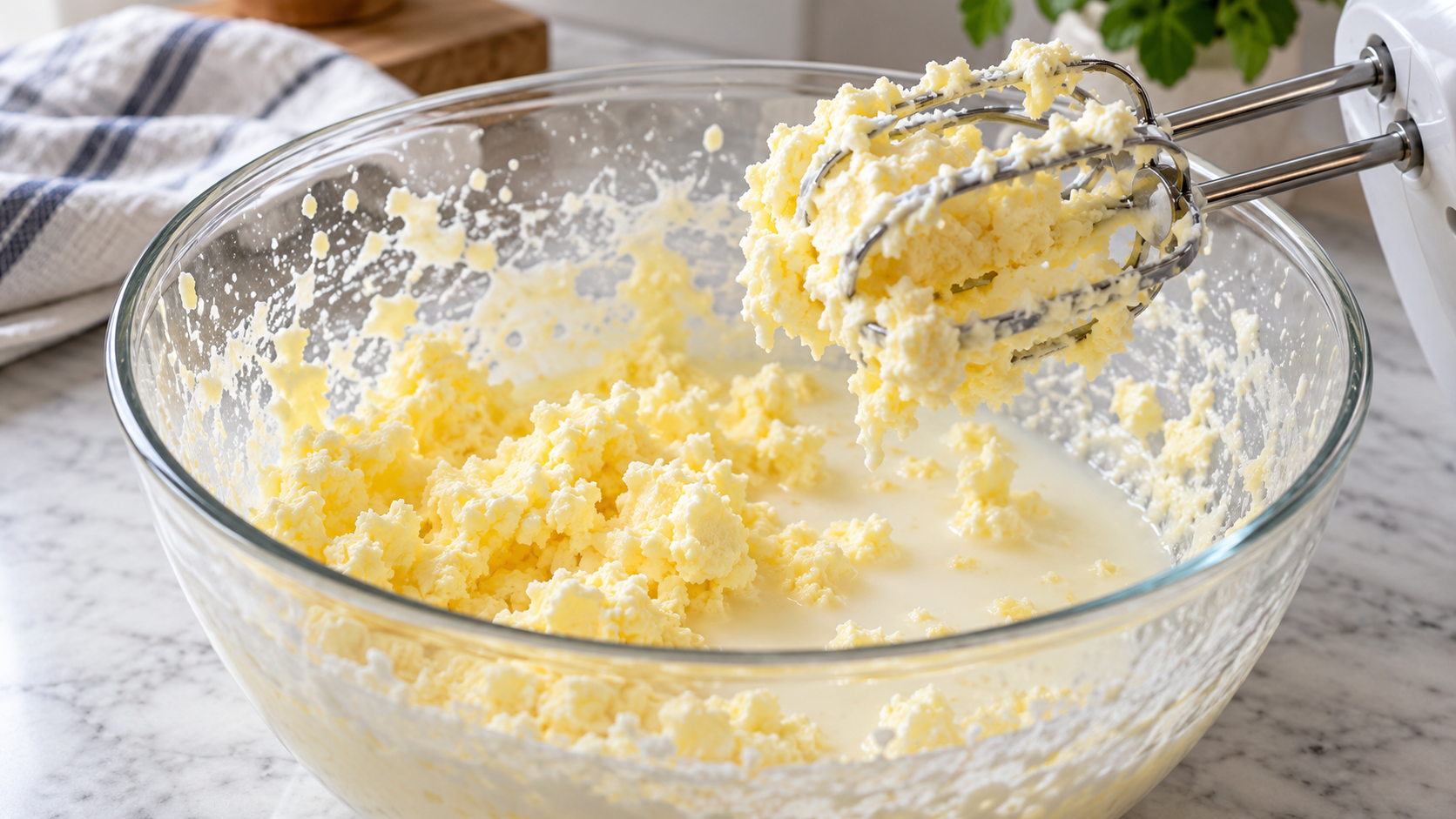
The cream initially becomes whipped because fat globules stabilize air bubbles. Continued agitation pushes the system past that stage. Clumps of fat grow, the foam collapses, and the continuous phase reverses: water is expelled while fat becomes the connected material. Yellow butter grains appear in a thinner white liquid. That liquid is traditional buttermilk, containing water, milk proteins, lactose, and relatively little fat.
Draining and washing the grains removes residual buttermilk that could shorten keeping quality. Working or kneading the butter presses grains together and distributes remaining water into small droplets. Salt may add flavor and influence preservation, but home butter still requires refrigeration and clean handling. Commercial processes control cream treatment, temperature, moisture, and microbial quality much more precisely.
Overworking warm butter can smear the fat structure and make the product oily, while inadequate working leaves large water pockets. Sour odors, unusual mold, or poor refrigeration are not corrected by rechurning. Pasteurized cream provides a safer starting point than raw cream, and equipment should be thoroughly clean. The separated buttermilk is perishable and should be chilled promptly.
Churning succeeds by deliberately destabilizing a stable emulsion. Collision and shear remove part of the protective barrier around fat globules, partial crystals bridge the exposed fat, and growing clusters squeeze out the water phase. The transition can seem sudden because the balance flips from droplets of fat in water to droplets of water within a connected fat matrix—the structure recognized as butter.
Agitation damages membranes around partially crystallized fat globules, letting them coalesce into butter grains while buttermilk separates. Key terms include emulsion, fat globule, membrane, crystal, shear, coalescence, phase inversion, and buttermilk.
Partially destabilized fat first supports air bubbles. Continued agitation makes fat clusters grow beyond foam stabilization until the network separates from the watery phase.
Butter needs a useful mixture of solid and liquid milk fat. Excess warmth makes it greasy, while excessive cold slows coalescence and can give a brittle texture.
Explore more "Explainers"
Discover additional explainers across politics, science, business, technology, and other fields. Each explainer breaks down a complex idea into clear, everyday language—helping you better understand how major concepts, systems, and debates shape the world around us.