

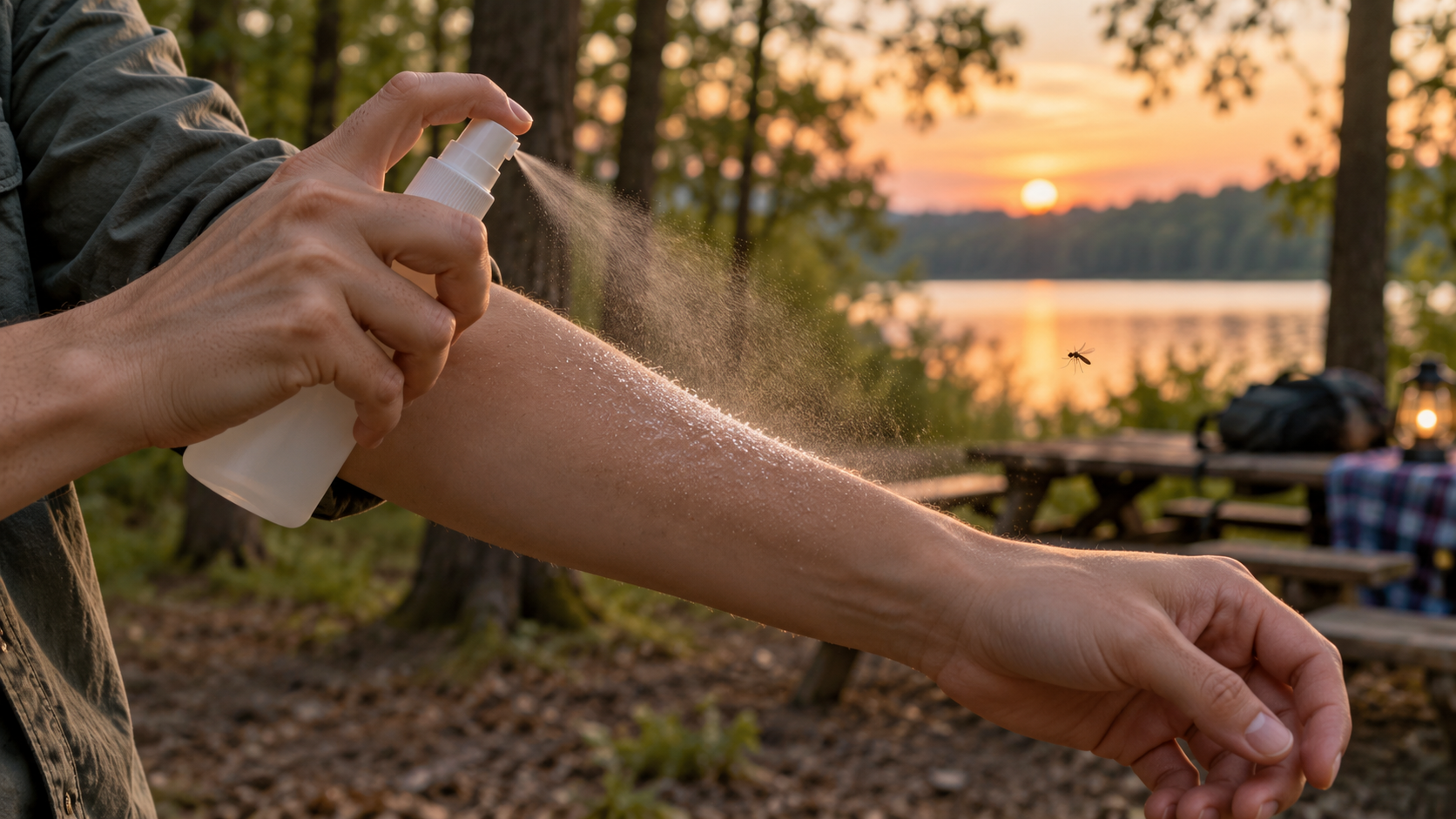
Skin-Applied Insect Repellent Explainer
Skin-applied insect repellent reduces the chance that certain biting pests will land and feed. Mosquitoes and ticks locate hosts through combinations of odor, carbon dioxide, heat, moisture, and movement. Active ingredients such as DEET or picaridin evaporate slowly from the treated surface and alter the chemical information around it. The exact sensory effects differ by pest and ingredient, but the result is deterrence rather than an invisible wall or immediate killing.
A repellent must occupy the air close to exposed skin or treated clothing, so coverage matters. Gaps can remain attractive even when a nearby area is protected. The product is spread only as directed and in the amount needed to cover the intended surface. Higher active-ingredient concentration often extends protection time rather than creating proportionally stronger moment-to-moment repulsion, and different pests can have different effective durations.
Formulation controls how the active ingredient is delivered. Sprays, lotions, wipes, and roll-ons leave different films and can vary in evaporation, feel, and compatibility with materials. Wind, heat, sweat, water, abrasion, and physical activity can shorten protection. Sunscreen and repellent serve different purposes; when both are needed, each label’s directions determine order and reapplication rather than mixing them into a homemade combination.
Registered repellents are evaluated for labeled uses, but safe use still depends on following that label. Products are not applied over cuts or irritated skin, under clothing, or near eyes and mouth. An adult applies repellent to a young child instead of letting the child handle the container, and treated hands are kept away from food and faces. After returning indoors, treated skin is washed and treated clothing is cleaned as directed.
Repellent does not replace physical barriers. Long sleeves, suitable pants, intact window screens, mosquito nets where appropriate, and avoidance of peak pest conditions can reduce exposure without adding more chemical. Products differ in the pests listed on the label, so a mosquito claim does not automatically establish the same protection against ticks. Natural origin also does not guarantee effectiveness, long duration, or freedom from irritation.
The mechanism is best understood as sensory disruption around a treated surface. Volatile molecules create a local chemical signal that makes normal host-finding less successful. The effect fades as material evaporates, washes off, or rubs away, which is why product choice, concentration, coverage, and time all matter. Used with clothing and environmental precautions, repellent provides a practical layer of bite prevention without needing to kill every insect nearby.
Repellent molecules alter the close-range chemical cues pests use to find a host, making treated skin less attractive. Key terms include active ingredient, DEET, picaridin, volatile, host cue, coverage, concentration, and protection time.
Skin-applied products are generally intended to deter landing and biting, not to kill all pests in the surrounding area.
A higher concentration often extends how long a product works, but performance depends on the ingredient, pest, conditions, coverage, and label directions.
Explore more "Explainers"
Discover additional explainers across politics, science, business, technology, and other fields. Each explainer breaks down a complex idea into clear, everyday language—helping you better understand how major concepts, systems, and debates shape the world around us.