

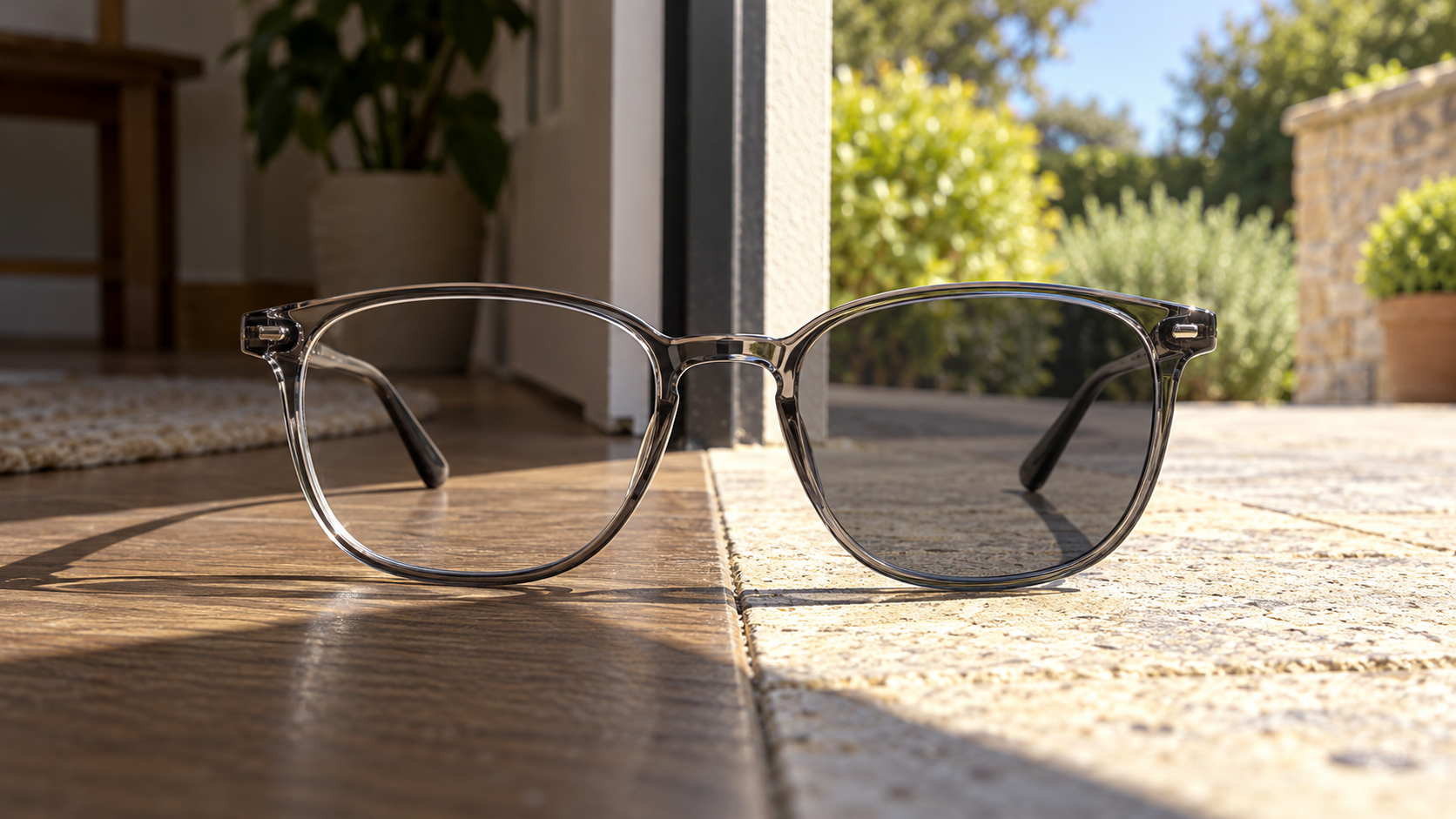
Photochromic Eyeglass Lens Explainer
Photochromic lenses contain light-sensitive molecules that can switch between two molecular arrangements. In their resting indoor form, the molecules absorb relatively little visible light, so the lens appears nearly clear. Ultraviolet and, in some products, short-wavelength visible light provide enough energy to change their structure. The activated form absorbs more of the visible spectrum, creating a darker tint without a battery, sensor, or mechanically moving layer.
The darkening reaction competes with a reverse reaction. As activating light continues, more molecules enter the absorbing state until activation and recovery approach a balance. Moving indoors removes most of the triggering wavelengths, so thermal motion and chemical relaxation return molecules toward the clear form. The lens fades gradually because millions of molecules are switching at finite rates rather than the tint being turned off by a single control.
Different lens materials use different photochromic systems. Traditional glass lenses may use tiny silver-halide particles, while modern plastics commonly contain organic dyes dispersed in or applied to the lens material. Designers combine molecules with different absorption bands to produce a useful neutral tint. The clear and dark transmission levels, activation speed, fading speed, durability, and color all depend on chemistry, lens construction, exposure history, and product design.
Temperature affects the balance. Many photochromic lenses become darker and fade more slowly in cold conditions, while heat can favor faster clearing and a lighter outdoor tint. A vehicle windshield blocks much of the ultraviolet light that activates many formulations, so lenses may not darken as strongly inside a car even when visible sunlight seems bright. Some newer products also respond to violet or visible light, but behavior still varies by design.
Photochromic darkening is not the same as polarization. Polarization selectively blocks light waves oriented in a direction associated with glare, while photochromism changes overall spectral transmission in response to light. A lens can include both features, but one does not imply the other. Dark tint also does not by itself prove adequate UV protection; optical protection and driving suitability depend on the tested specifications of the finished eyewear.
The everyday transformation is a reversible photochemical cycle. Light energy creates a more strongly absorbing molecular form, while the absence of that energy allows the molecules to relax toward clarity. Because exposure intensity, temperature, glass barriers, material, and age change the competing rates, the same pair may look different on a cold bright day and behind a warm windshield. The tint is adaptive, but it is neither instantaneous nor identical in every environment.
Light-sensitive molecules change into a form that absorbs more visible light when activated by UV or violet light, then reverse indoors. Key terms include photochromic, activation, absorption, transmission, reversible reaction, fading, UV, and temperature.
Many windshields block much of the ultraviolet light used for activation, so less of the photochromic material reaches its dark state.
No. Photochromism changes tint with light exposure; polarization filters light by orientation. A product must be designed and specified to provide both.
Explore more "Explainers"
Discover additional explainers across politics, science, business, technology, and other fields. Each explainer breaks down a complex idea into clear, everyday language—helping you better understand how major concepts, systems, and debates shape the world around us.