

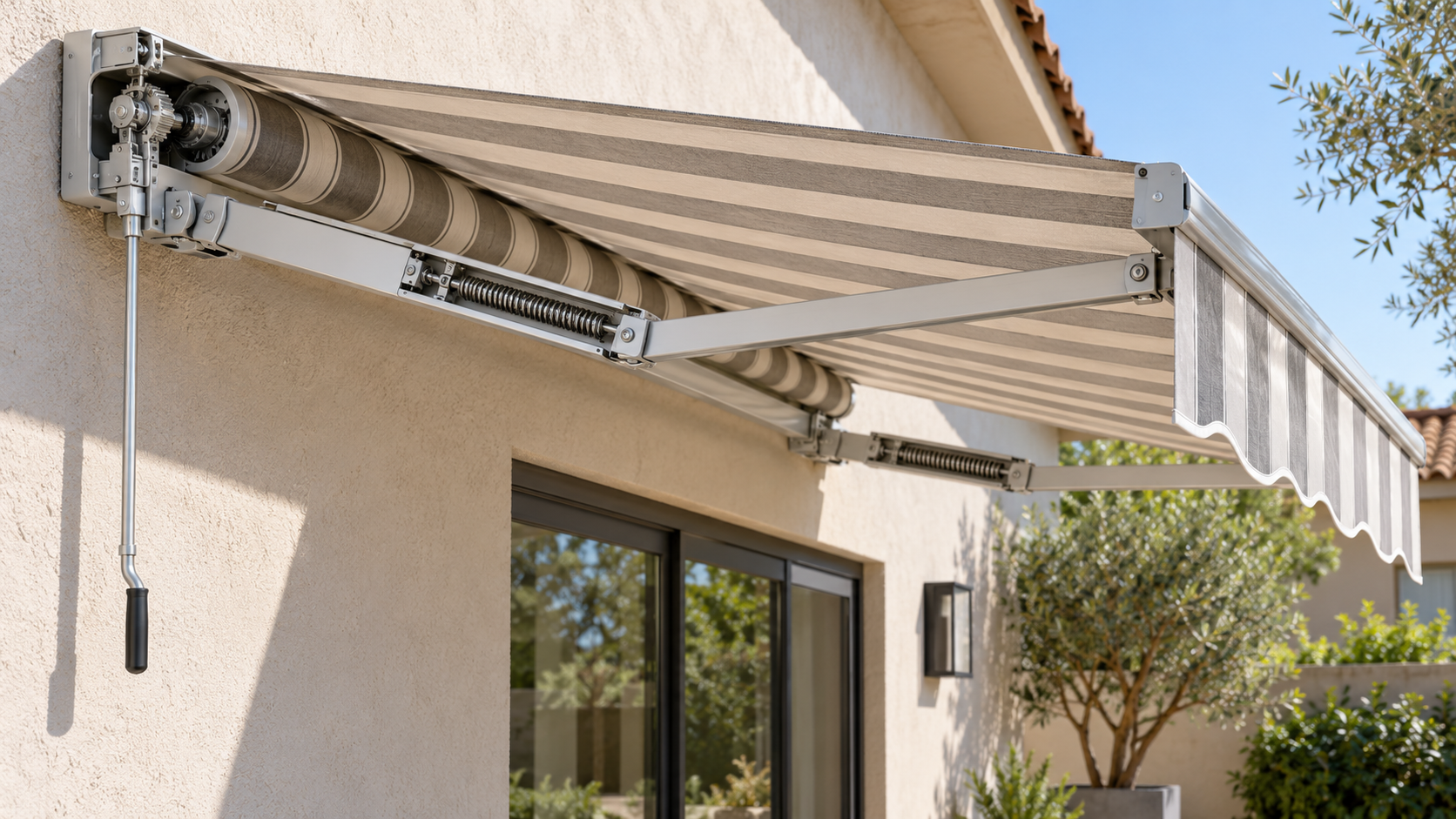
Retractable Folding-Arm Awning Explainer
A folding-arm patio awning stores its fabric around a roller tube mounted to the building. Two or more articulated arms connect a wall-side support to the front bar at the outer fabric edge. Strong internal springs or cables bias those arms toward the open position. When the roller releases fabric, the arms extend and push the front bar outward, keeping the canopy under tension instead of letting it hang loosely.
A manual crank turns a gearbox connected to the roller tube, while a powered awning uses a tubular motor. Rotating one direction unwinds fabric as the arms unfold; rotating the other winds fabric back onto the tube and forces the spring-loaded arms to fold at their elbows. The gear ratio gives the operator control over the large spring forces and broad canopy. End stops limit travel so the fabric is neither underwound nor pulled beyond its intended extension.
Each arm behaves like a linked lever. Tension springs, chains, or cables routed through the sections create an opening torque at the elbow. The front bar ties the arms together, while the roller controls how far they can move. Wall brackets and a torsion bar distribute reaction forces into the structure. Accurate alignment matters because one arm leading the other can wrinkle fabric, twist the front bar, or make the roller track unevenly.
Fabric tension allows rain to drain along the designed pitch and reduces flutter in light air, but an awning is not a rigid roof. A large extended surface creates powerful uplift and bending loads in wind. Many systems require retraction before wind or heavy weather, and optional sensors only reduce risk when correctly installed and maintained. Water pooling on inadequate pitch adds weight that can strain fabric, arms, fasteners, and the supporting wall.
The mounting surface must be structurally suitable, with brackets and fasteners installed for the actual substrate. Lubrication, cleaning, fabric care, travel-limit adjustment, and motor service follow the manufacturer. Hands stay clear of arm elbows and brackets because springs remain loaded even when the awning is partly folded. A frayed cable, bent arm, loose anchor, torn fabric, or uneven motion is evaluated before further operation rather than forced with the crank.
The awning works through a balance between controlled fabric length and stored spring force. The roller meters the canopy, the arms convert spring tension into outward reach, and the front bar keeps the leading edge straight. Reversing the roller overcomes the arms and packages the system against the wall. Smooth extension depends on synchronized geometry, sound anchors, correct limits, and weather judgment, because the mechanism is optimized for adjustable shade rather than permanent structural shelter.
The roller releases fabric while spring-loaded folding arms push a front bar outward; reversing the roller winds fabric and folds the arms. Key terms include roller tube, articulated arm, spring tension, front bar, gearbox, torsion bar, bracket, and travel limit.
Springs or cables inside the articulated arms create opening torque. The roller controls their extension by releasing or retrieving fabric.
The broad canopy develops large uplift and bending forces that can overload arms, brackets, fasteners, fabric, and the wall structure.
Explore more "Explainers"
Discover additional explainers across politics, science, business, technology, and other fields. Each explainer breaks down a complex idea into clear, everyday language—helping you better understand how major concepts, systems, and debates shape the world around us.