

On This Day in Business: June 17, 1946
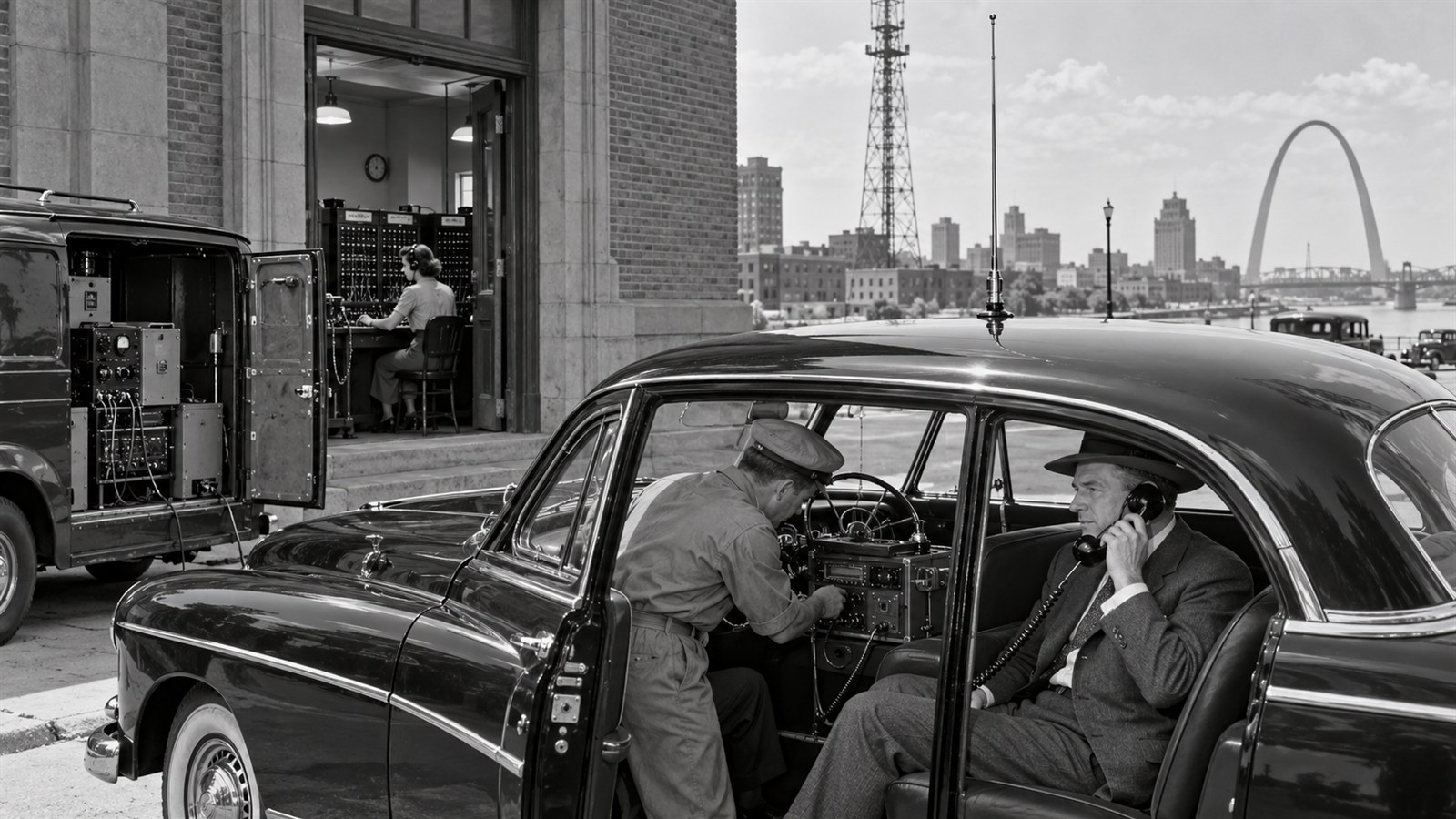
On June 17, 1946, the Bell System opened the first commercial mobile telephone service in St. Louis, Missouri. Equipment developed by Bell Laboratories connected vehicle-mounted radios to the public telephone network, while Motorola supplied early mobile units. A driver used a handset and communicated through a radio channel to an operator, who placed the call on the wired system. The equipment filled much of a car's trunk, consumed significant power, and served only a small number of simultaneous users. Even with those limits, customers could make and receive telephone calls while moving through the city, creating a new service category decades before handheld cellular phones.
The business targeted users for whom mobility justified high cost and inconvenience. Doctors, utilities, trucking companies, construction managers, and public-safety organizations could reach people in the field without waiting for them to find a fixed telephone. Service depended on a central radio transmitter with wide coverage and only a few available channels. Callers often waited for capacity, conversations were not private, and operators performed manual switching. The product was therefore closer to a scarce dispatch network than to modern personal telephony. Pricing and installation reflected that scarcity, keeping adoption limited while revealing demand for immediate communication beyond an office.
Engineers improved the system through more channels, automatic dialing, and additional coverage, but the basic architecture could not support mass use efficiently. Cellular design later divided territory into smaller coverage areas and reused frequencies, dramatically increasing capacity. Digital networks, smaller electronics, and competitive service plans eventually moved the telephone from the vehicle to the individual. The 1946 launch nevertheless established commercial habits that survived: carriers supplied network access, equipment makers built devices, regulators allocated spectrum, and customers paid recurring charges for the ability to connect from changing locations.
The milestone matters because early services often create a market before technology can serve it widely. Bell's mobile telephone was expensive, constrained, and operationally awkward, yet it proved that mobility had economic value. Businesses adopted it where delayed information cost more than the service. That pattern guides many infrastructure ventures: begin with customers whose urgent use can support limited capacity, learn from real operation, and improve the architecture until a broader market becomes possible. The first service was not a miniature smartphone network. It was a distinct solution shaped by the available spectrum, radios, and switching system, and it gave later innovators evidence that people would pay to carry connectivity with them.
Bell Laboratories equipment linked vehicle radios to the public telephone network when commercial service began in St. Louis.
A driver used a handset and radio channel while an operator manually connected the call to an ordinary telephone line.
Large equipment, high prices, few channels, and limited privacy kept the service focused on urgent professional use.
Doctors, utilities, fleets, contractors, and public-safety organizations gained value from reaching workers away from fixed phones.
Later cellular networks reused frequencies across small coverage areas, solving the capacity problem that constrained the original system.
The launch shows how a scarce premium service can validate demand long before engineering makes the category affordable to everyone.
Explore more of "On This Day ..."
Discover more events from the same date across news, politics, technology, sports, and other fields. Each link highlights significant moments that shaped history on different fronts.