

On This Day in Business: June 23, 1868
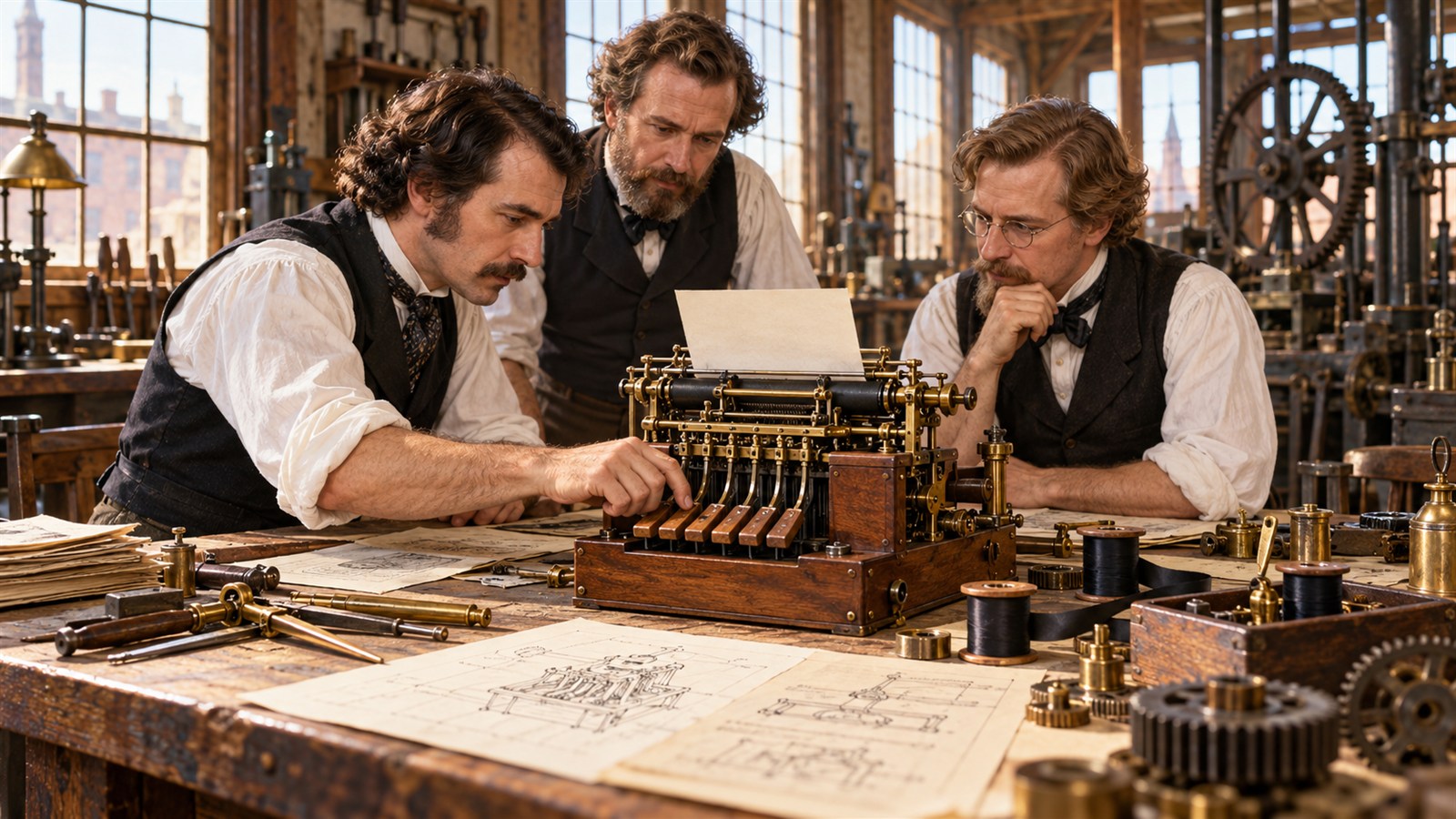
On June 23, 1868, Christopher Latham Sholes, Carlos Glidden, and Samuel W. Soule received U.S. Patent No. 79,265 for improvements in a type-writing machine. Working in Milwaukee, the inventors had developed mechanisms for moving type bars, holding paper, advancing a carriage, applying an inked ribbon, and cushioning the striking parts. Their patent model used piano-like keys and looked unlike the standardized office machines that followed. The device was imperfect, but it recorded a practical step toward mechanical writing at a moment when expanding businesses, newspapers, railroads, and government offices generated more correspondence than handwriting could efficiently support.
A supporter named James Densmore supplied money, pushed repeated redesign, and promoted the invention. The team had to solve jamming, alignment, inking, carriage motion, and manufacturing cost. Sholes also rearranged keys as the mechanism evolved, contributing to the QWERTY layout that later became a standard. In 1873, E. Remington & Sons agreed to manufacture a developed version. The arms maker brought precision metalworking, factory capacity, and a sales organization—complementary assets the inventors did not possess. Commercialization therefore depended on handing the concept to a company able to build and distribute machines consistently.
Adoption changed office labor and created new occupations. Typists could produce legible documents and copies more quickly, while businesses reorganized correspondence and recordkeeping around standardized forms. Early machines were expensive and required training, and the first designs forced operators to type without seeing the printed line immediately. Improvements and competition gradually made typewriters faster and easier to use. Training schools and employers reinforced keyboard standards: people learned the layout because offices used it, and offices kept it because trained people were available. That network effect helped a mechanical arrangement survive across later generations of equipment.
The patent matters because standards can emerge from the combined history of technology, manufacturing, and workforce investment rather than from abstract optimization. The inventors produced a workable mechanism; Remington made it a manufacturable product; schools and employers made typing a marketable skill. Each layer increased the cost of switching to alternatives. Modern keyboards preserve that accumulated coordination even though the original type-bar constraints have disappeared. The broader lesson is that a product can reshape an organization when it changes both the speed of a task and who performs it. Mechanical writing became office infrastructure because machines, training, document practices, and labor demand developed together. The machine also altered expectations about speed. Once typed correspondence became available, customers and managers could demand more documents and faster replies, absorbing part of the saved time in additional volume. Productivity tools frequently create new standards of responsiveness rather than simply reducing total work.
Patent No. 79,265 described type bars, paper carriage, ribbon inking, motion control, and cushioning for a writing machine.
The Milwaukee patent model used piano-style keys and remained far from the mature office typewriter that later followed.
James Densmore financed and pressed redesign while the inventors addressed jams, alignment, visibility, and manufacturing cost.
Remington supplied precision production and distribution, converting an inventor's mechanism into a commercial product category.
Typing schools and employer demand reinforced a common keyboard layout through a growing labor-market network effect.
The typewriter became infrastructure because machinery, manufacturing, training, office processes, and occupational roles evolved together.
Explore more of "On This Day ..."
Discover more events from the same date across news, politics, technology, sports, and other fields. Each link highlights significant moments that shaped history on different fronts.