

On This Day in Business: July 27, 1866
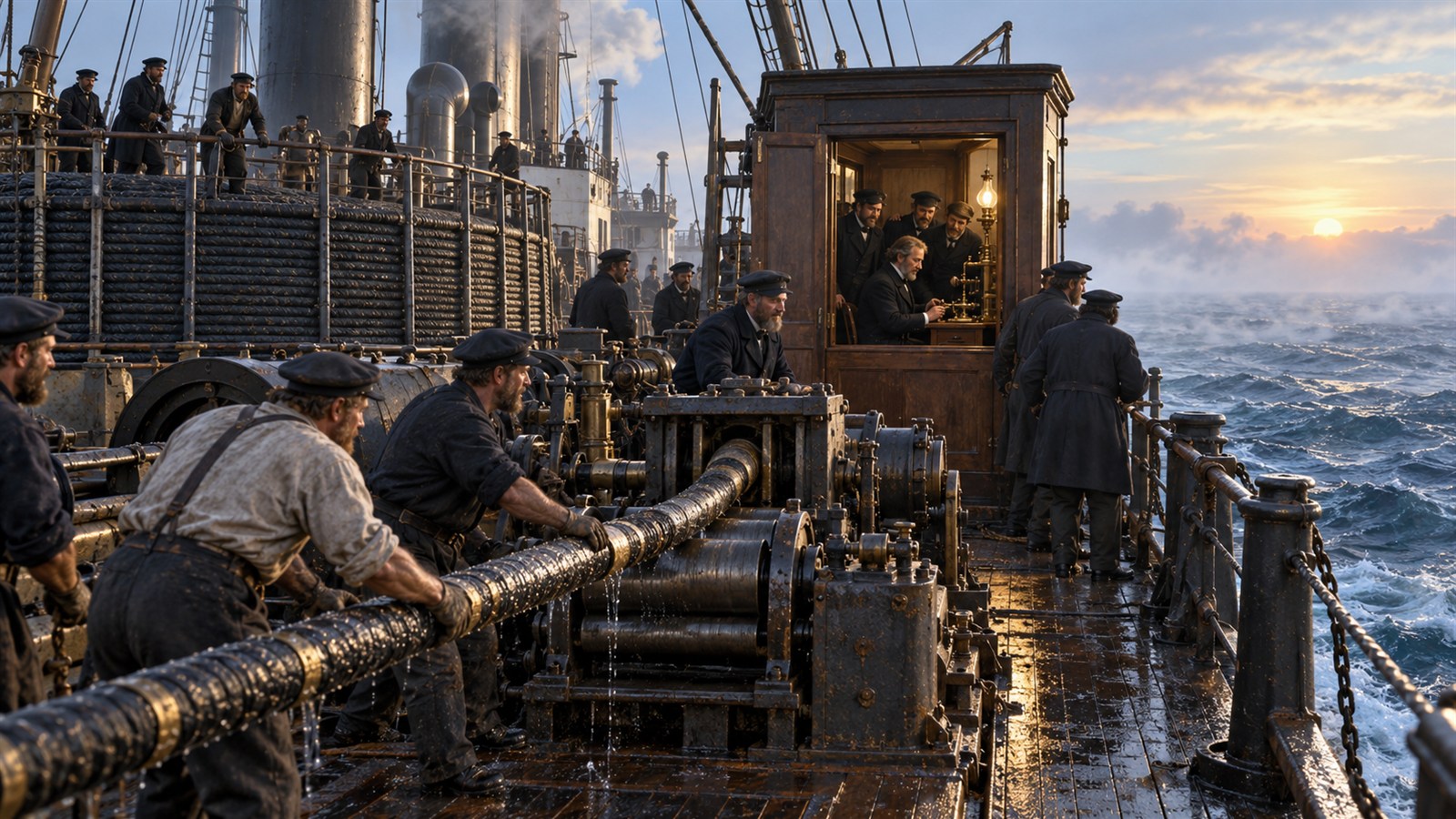
On July 27, 1866, the steamship Great Eastern brought a working transatlantic telegraph cable to Heart's Content, Newfoundland, completing a durable electrical link between Europe and North America. Earlier attempts had failed, including an 1858 cable that carried messages briefly before going silent. Financier Cyrus Field persisted through technical setbacks and repeated fundraising. The 1866 expedition used improved cable, testing instruments, handling machinery, and the enormous capacity of the Great Eastern to lay thousands of miles across the Atlantic floor.
Submarine telegraphy required an unusual combination of science, manufacturing, navigation, and finance. Copper conductors needed insulation, protective armor, consistent production, and careful storage. The cable had to leave the ship at the correct tension while depth, weather, and movement changed. Operators tested electrical condition continuously because a flaw discovered after laying could destroy the investment. Investors accepted years of risk before revenue, and governments cared about strategic communication as well as commercial traffic.
The working link reduced the time for messages between London and New York from days or weeks to minutes, although early telegrams were expensive and capacity was limited. Prices, orders, news, insurance information, diplomatic instructions, and financial decisions could cross the ocean while ships were still traveling. The expedition also recovered and completed the lost 1865 cable, adding capacity. Competing cables and better technology later lowered costs and made global telegraph networks more resilient.
The completion matters because faster information changes the value of distance. Businesses could react to foreign markets before physical goods arrived, reducing some uncertainty while increasing pressure to make decisions quickly. The cable created an information advantage, but only for customers able to pay and organizations prepared to act on the messages. Its construction also illustrates infrastructure persistence: a failed network can teach the material, financial, and operating lessons required for success. The durable connection emerged not from one brilliant component, but from improvements across the entire system. Cable companies had to price extremely scarce capacity. Charging by the word encouraged concise codes and created specialist intermediaries who compressed commercial messages. As additional cables expanded supply, prices fell and use broadened. Infrastructure economics thus influenced language itself: when every transmitted word carried a high cost, businesses redesigned communication to fit the network's constraint. News organizations were among the early beneficiaries. A foreign event could reach domestic readers before a ship carrying eyewitness accounts entered port, changing publication cycles and expectations of freshness. That speed increased the value of verification, because an inaccurate cable could move markets and public opinion before correction traveled through the same narrow channel.
Cyrus Field and his partners returned to the Atlantic after several failures, including the short-lived 1858 cable.
The Great Eastern landed a working cable at Heart's Content, Newfoundland, on July 27, 1866.
Cable manufacture, insulation, armor, electrical testing, navigation, tension control, weather, and financing all had to succeed.
Messages that once traveled with ships could cross between Europe and North America in minutes.
Market prices, orders, news, insurance, finance, and diplomacy began operating on a much faster international timetable.
The project shows that major infrastructure succeeds through system-wide learning and persistence after visible failure.
Explore more of "On This Day ..."
Discover more events from the same date across news, politics, technology, sports, and other fields. Each link highlights significant moments that shaped history on different fronts.