

“The price of inaction is far greater than the cost of a mistake.”
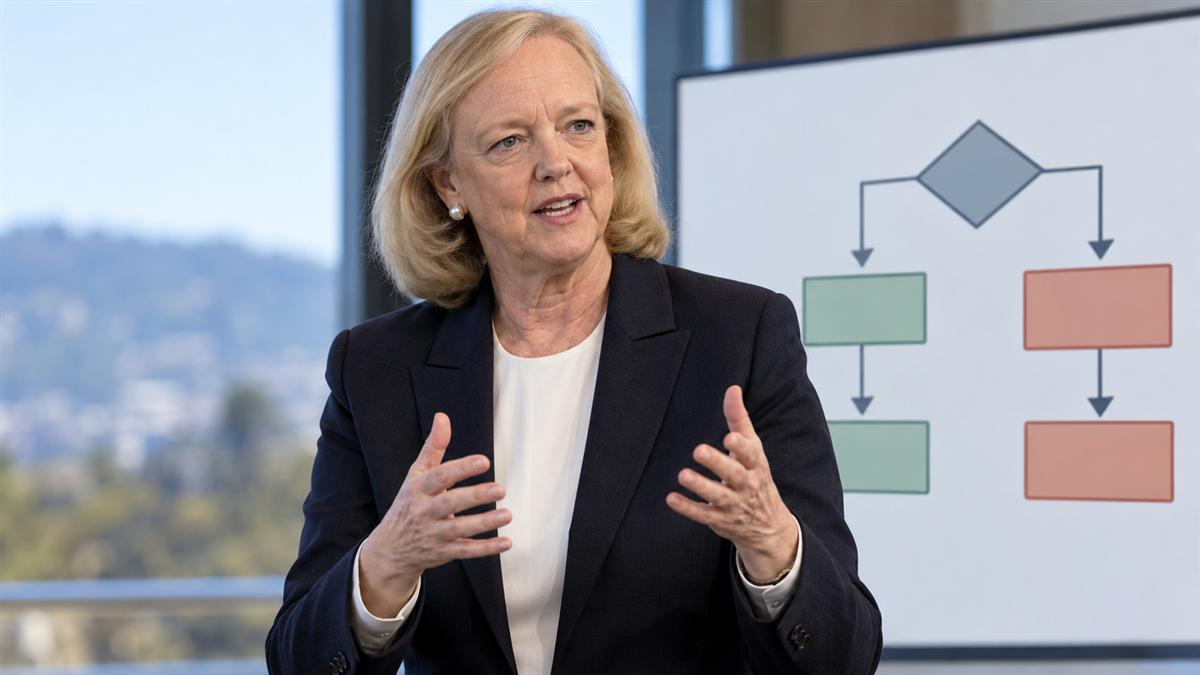
Meg Whitman shared this lesson at Stanford while reflecting on eBay’s rapid growth. In a fast-moving company, delay can allow a market, customer need, or organizational problem to move beyond reach, while many decisions can be corrected when the mistake is recognized quickly. The comparison is not between action and perfect certainty; it is between two kinds of risk. Inaction has consequences that often remain invisible because no decision document records the opportunity, learning, or trust lost while people waited. Behind the concise wording is a claim about how organizations create results. It encourages leaders to look beyond individual effort and examine design, incentives, information, relationships, and the customer context that determine whether a good intention becomes reliable performance.
Leaders can classify decisions by reversibility and stakes, set shorter deadlines for reversible choices, and define monitoring and correction in advance. A decision owner needs authority to move and an obligation to surface evidence that the choice is failing. Managers can translate the claim into a small experiment with a baseline, an owner, a defined customer or employee outcome, and a review date. Specificity protects the work from drifting into broad language that nobody can challenge or verify.
Some mistakes are irreversible or impose serious harm, so speed cannot override safety, rights, law, or fiduciary duty. The useful lesson is to reduce unnecessary paralysis, not to celebrate recklessness. Preparation determines which decisions can move quickly. Responsible use also requires naming the tradeoff. Speed, cost, autonomy, safety, equity, and learning may not all improve at once. People closest to the consequences should have a meaningful voice, and uncertainty should be reported instead of hidden behind confidence.
AI creates pressure to act and fear of falling behind. Companies can use contained pilots, protected data, human oversight, and outcome thresholds to learn without exposing customers or employees to an unbounded experiment. Waiting without a learning plan is also a choice. A decision audit can identify items stalled despite being reversible, assign a deadline and test, and separately mark the high-consequence choices that require deeper assurance before action. Evidence from the experiment can guide scaling, revision, or stopping. The durable lesson is to join purpose with measurement and human judgment, so the organization becomes better at seeing reality and responding before a local success or failure hardens into mythology. Recording the decision and its limits gives colleagues a foundation they can inspect, challenge, and improve instead of asking them to rely on memory, authority, or an unexplained result.
Meg Whitman shared this lesson at Stanford while reflecting on eBay’s rapid growth. In a fast-moving company, delay can allow a market, customer need, or organizational problem to move beyond reach, while many decisions can be corrected when the mistake is recognized quickly.
The comparison is not between action and perfect certainty; it is between two kinds of risk. Inaction has consequences that often remain invisible because no decision document records the opportunity, learning, or trust lost while people waited.
Leaders can classify decisions by reversibility and stakes, set shorter deadlines for reversible choices, and define monitoring and correction in advance. A decision owner needs authority to move and an obligation to surface evidence that the choice is failing.
Some mistakes are irreversible or impose serious harm, so speed cannot override safety, rights, law, or fiduciary duty. The useful lesson is to reduce unnecessary paralysis, not to celebrate recklessness. Preparation determines which decisions can move quickly.
AI creates pressure to act and fear of falling behind. Companies can use contained pilots, protected data, human oversight, and outcome thresholds to learn without exposing customers or employees to an unbounded experiment. Waiting without a learning plan is also a choice.
A decision audit can identify items stalled despite being reversible, assign a deadline and test, and separately mark the high-consequence choices that require deeper assurance before action.
Explore more "Quotes of The Day"
Discover more notable quotes from influential voices across politics, science, business, technology, sports, and culture. Each quote offers insight into how ideas, beliefs, and decisions shape the world around us.