

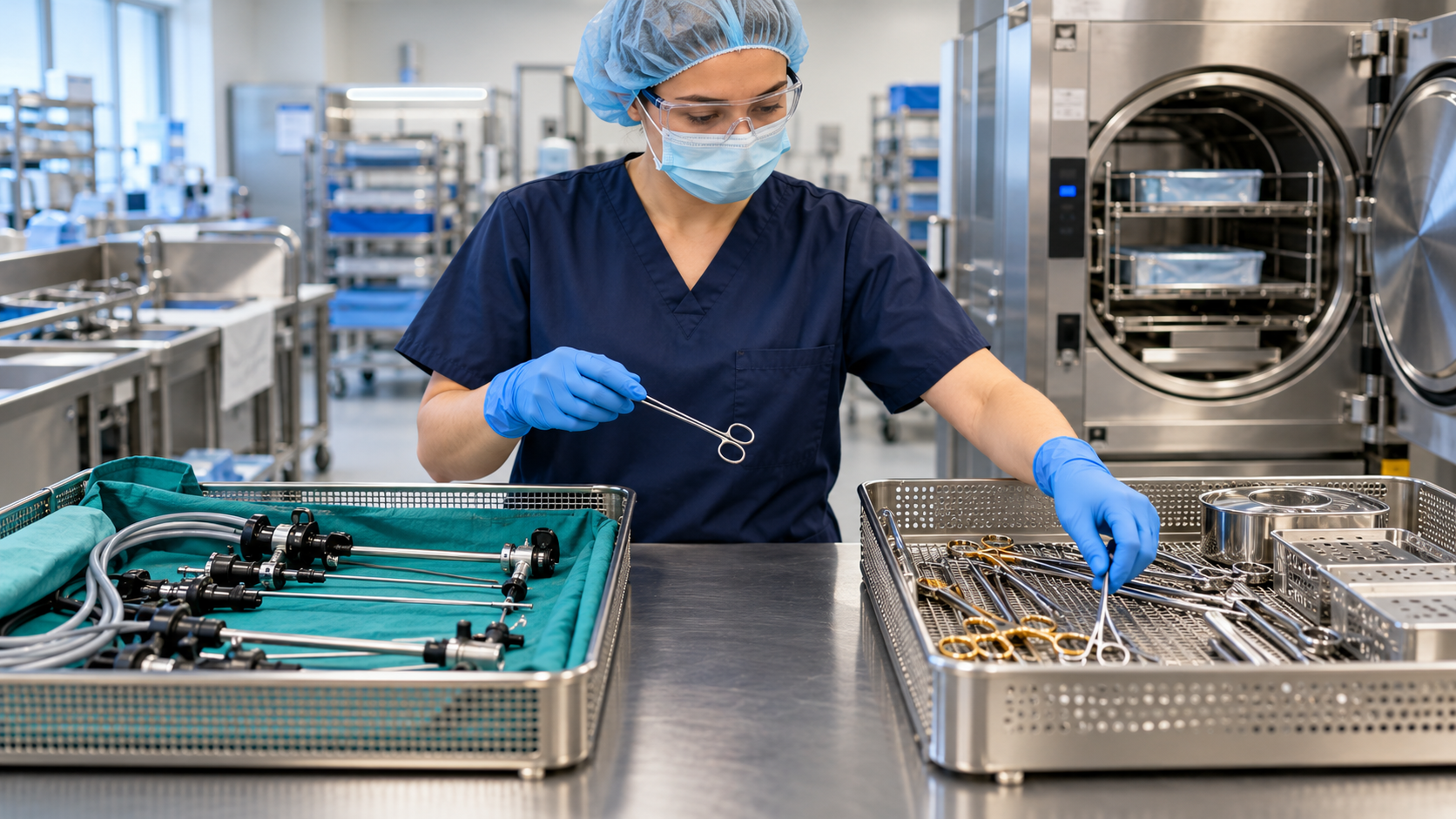
Sterilization vs. Disinfection Explainer
Sterilization and disinfection are different levels of microbial control. Sterilization destroys or eliminates all forms of microbial life, including highly resistant bacterial spores. Disinfection eliminates many or all disease-causing microorganisms on inanimate objects, but its effectiveness varies by level and it does not necessarily remove spores.
The required process depends on how an item is used. Critical devices that enter sterile tissue or the vascular system require sterilization. Semicritical items that contact mucous membranes or nonintact skin generally require at least high-level disinfection. Noncritical items that touch intact skin usually need cleaning and lower-level disinfection.
Cleaning comes first because blood, tissue, and other material can shield microorganisms and interfere with the process. Reprocessing also depends on concentration, temperature, contact time, device design, packaging, drying, storage, and the manufacturer’s validated instructions. A chemical name alone does not show that the full process was effective.
Complex instruments require trained staff, quality monitoring, and traceable workflows. Some devices cannot tolerate every method, and shortcuts can damage equipment or leave contamination behind. Healthcare facilities should match the method to infection risk and device compatibility, verify cycles or solutions, and investigate breaches promptly.
The Spaulding approach links reprocessing intensity to the tissue an item contacts.
Greater infection risk requires a higher level of microbial control.
Organic and inorganic material can block disinfectants or sterilants from reaching surfaces.
Cleaning also reduces the microbial load before the final process.
Effectiveness depends on the validated method, concentration, time, temperature, and device design.
Monitoring and documentation help verify that the complete process was followed.
Explore more "Explainers"
Discover additional explainers across politics, science, business, technology, and other fields. Each explainer breaks down a complex idea into clear, everyday language—helping you better understand how major concepts, systems, and debates shape the world around us.