

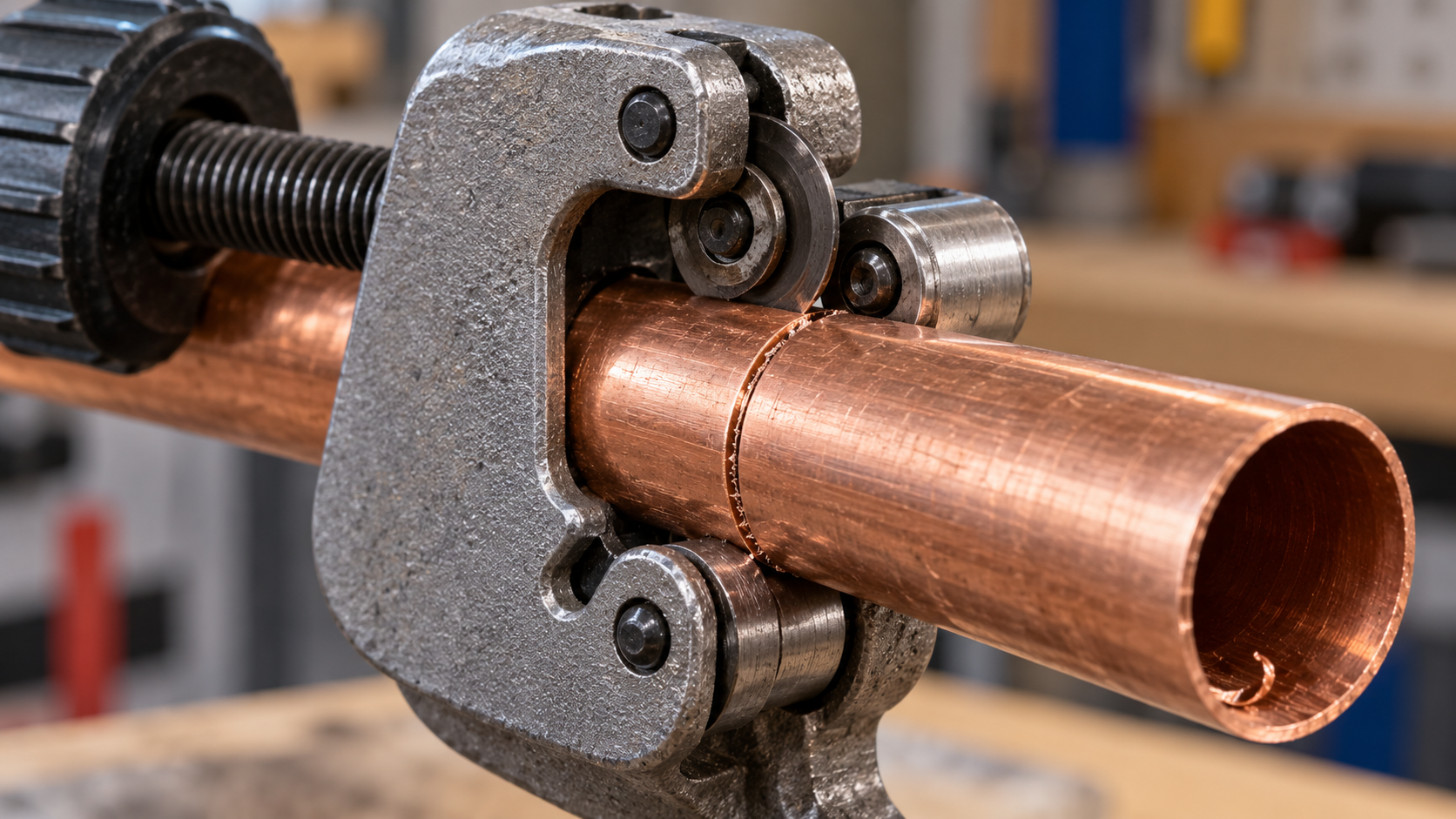
Cutter Wheel, Guide Rollers, and Progressive Feed
A wheel-type pipe cutter separates tubing or pipe by pressing a hardened circular wheel into the wall while guide rollers carry the tool around the same track. A feed screw advances the wheel in small increments; each trip around the pipe deepens the narrow circumferential groove until the remaining wall parts, usually by displacement rather than saw-chip removal. The result depends on the relationship among the working edge or gripping surfaces, the tool’s moving linkage, and the way the work is supported.
A feed screw advances the wheel in small increments; each trip around the pipe deepens the narrow circumferential groove until the remaining wall parts, usually by displacement rather than saw-chip removal. Parts that seem secondary still control the outcome. Guides keep motion on axis, springs or threads store and redirect force, and relief or open space lets chips, displaced material, or moving parts clear instead of jamming.
Real-world performance depends on tool type, cutter-wheel profile, pipe material, wall thickness, diameter, feed increment, guide alignment, wheel sharpness, lubrication, rotation clearance, work support, and final reaming. These variables change leverage, contact pressure, accuracy, surface damage, tool life, and the amount of control the user feels during the operation.
The correct cutter and wheel are placed square to supported pipe, a light initial track is established, and pressure is increased gradually between complete rotations rather than forced in one pass. A change in resistance, sound, alignment, or finish is a reason to stop and inspect the setup rather than adding force automatically.
Aggressive feeding can flare the end, raise a large internal burr, distort thin tubing, make the wheel spiral off track, or break the wheel. Eye protection, stable work support, and keeping hands outside the tool’s closing or cutting path remain basic safeguards. The product maker’s instructions should control compatible sizes, materials, adjustments, and permitted use.
In short, the tool works by converting a manageable hand motion into a concentrated and constrained action at the work. A feed screw advances the wheel in small increments; each trip around the pipe deepens the narrow circumferential groove until the remaining wall parts, usually by displacement rather than saw-chip removal. Consistent results come from correct sizing, full engagement, square alignment, gradual force, and stopping before a small mismatch becomes damage.
A wheel-type pipe cutter separates tubing or pipe by pressing a hardened circular wheel into the wall while guide rollers carry the tool around the same track. A feed screw advances the wheel in small increments; each trip around the pipe deepens the narrow circumferential groove until the remaining wall parts, usually by displacement rather than saw-chip removal.
Guide rollers hold the frame perpendicular while the cutter wheel repeatedly follows one circumferential track.
The wheel displaces metal inward as it penetrates, leaving a ridge that can restrict flow or interfere with threading and fittings.
Explore more "Explainers"
Discover additional explainers across politics, science, business, technology, and other fields. Each explainer breaks down a complex idea into clear, everyday language—helping you better understand how major concepts, systems, and debates shape the world around us.