

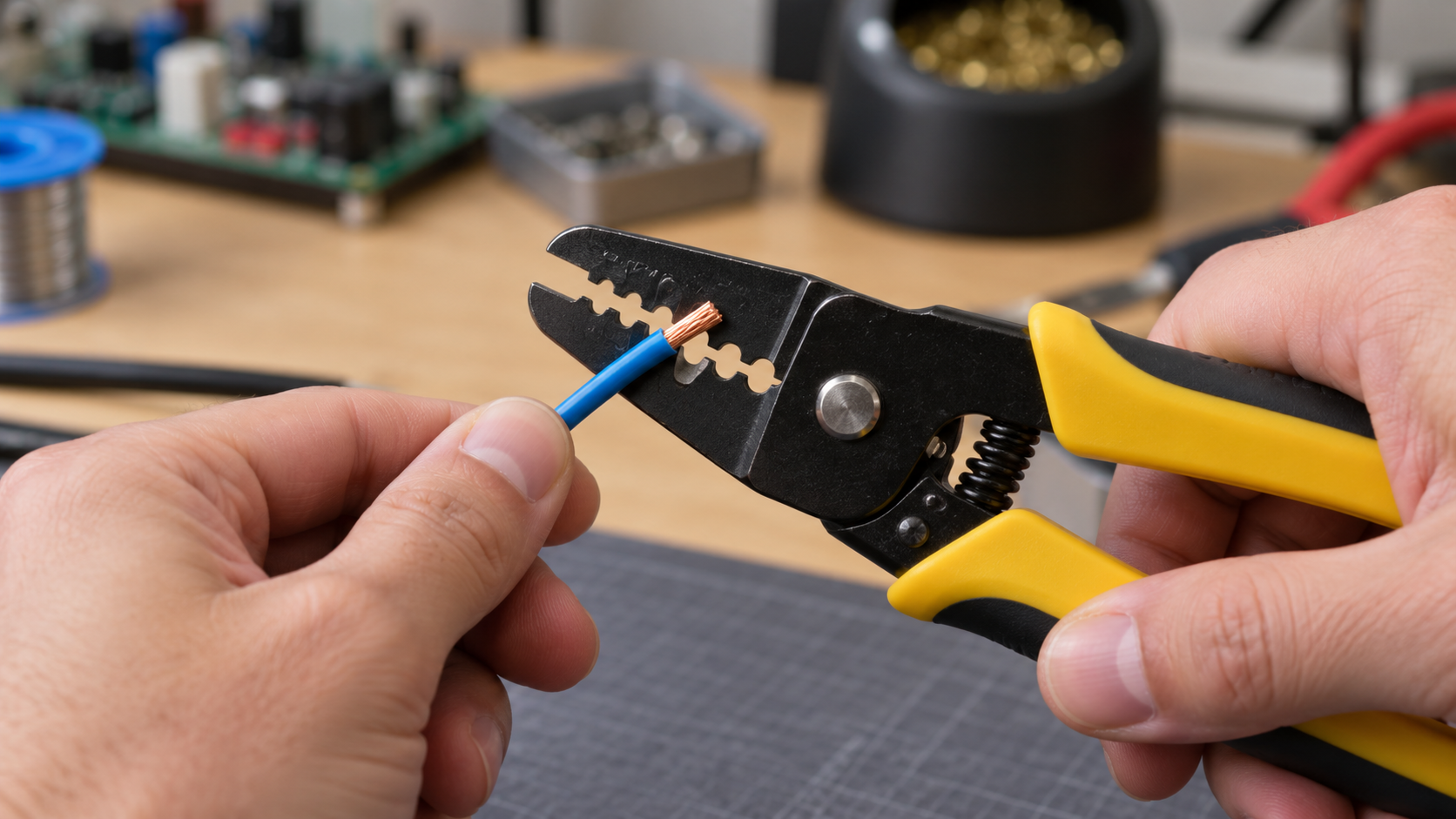
Sized Notches, Opposing Edges, and Insulation Pull-Off
A gauge-type wire stripper uses paired notches sized to cut through insulation around a conductor while stopping short of the metal itself. The chosen notch closes around the wire and shears or scores the jacket; with the handles still closed, pulling the tool slides the separated sleeve off the conductor. The result depends on the relationship among the working edge or gripping surfaces, the tool’s moving linkage, and the way the work is supported.
The chosen notch closes around the wire and shears or scores the jacket; with the handles still closed, pulling the tool slides the separated sleeve off the conductor. Parts that seem secondary still control the outcome. Guides keep motion on axis, springs or threads store and redirect force, and relief or open space lets chips, displaced material, or moving parts clear instead of jamming.
Real-world performance depends on solid or stranded conductor, wire gauge, insulation thickness and material, notch accuracy, blade sharpness, tool angle, pull direction, strip length, conductor hardness, temperature, live-circuit status, and inspection. These variables change leverage, contact pressure, accuracy, surface damage, tool life, and the amount of control the user feels during the operation.
Power is disconnected and verified, the exact solid or stranded gauge opening is selected, the strip length is measured, and the bare conductor is inspected for nicks or lost strands. A change in resistance, sound, alignment, or finish is a reason to stop and inspect the setup rather than adding force automatically.
The wrong notch can nick the conductor or fail to sever the jacket, and ordinary plastic-dipped handles do not make a non-rated tool safe on energized wiring. Eye protection, stable work support, and keeping hands outside the tool’s closing or cutting path remain basic safeguards. The product maker’s instructions should control compatible sizes, materials, adjustments, and permitted use.
In short, the tool works by converting a manageable hand motion into a concentrated and constrained action at the work. The chosen notch closes around the wire and shears or scores the jacket; with the handles still closed, pulling the tool slides the separated sleeve off the conductor. Consistent results come from correct sizing, full engagement, square alignment, gradual force, and stopping before a small mismatch becomes damage.
A gauge-type wire stripper uses paired notches sized to cut through insulation around a conductor while stopping short of the metal itself. The chosen notch closes around the wire and shears or scores the jacket; with the handles still closed, pulling the tool slides the separated sleeve off the conductor.
The same gauge can have different outside and conductor behavior, so the maker calibrates openings to cut insulation without damaging the specific construction.
A nick reduces cross-sectional area and creates a stress concentration that can overheat or break during bending and service.
Explore more "Explainers"
Discover additional explainers across politics, science, business, technology, and other fields. Each explainer breaks down a complex idea into clear, everyday language—helping you better understand how major concepts, systems, and debates shape the world around us.