

On This Day in Politics: April 3, 1948
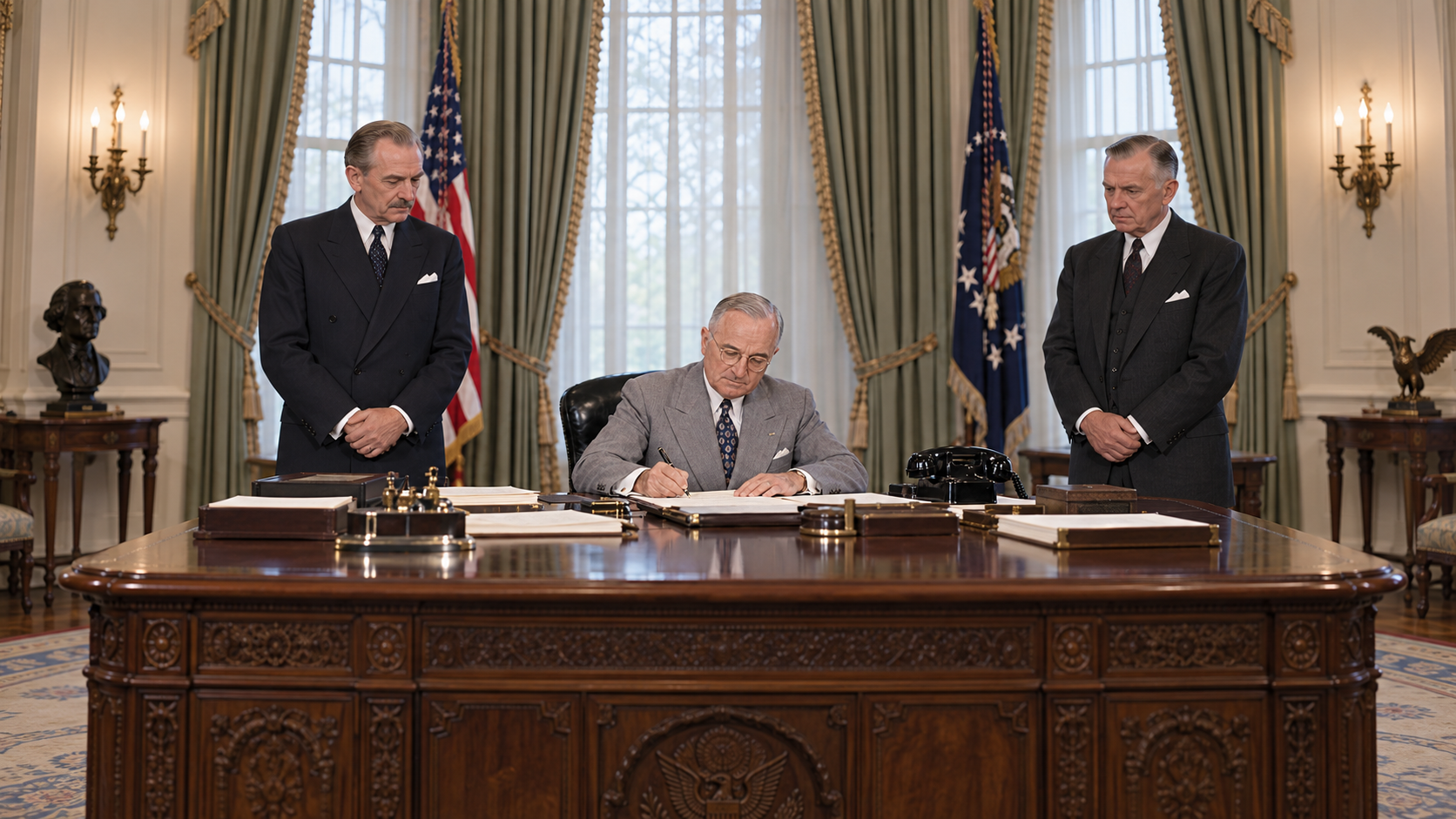
On April 3, 1948, President Harry S. Truman signed the Foreign Assistance Act in Washington, establishing the European Recovery Program best known as the Marshall Plan. Members of Congress and administration officials gathered around him for the signing. The legislation translated an ambitious diplomatic proposal into an operating framework for American assistance to war-damaged Europe. It did not mark the original announcement of the idea, which Secretary of State George C. Marshall had presented in 1947. Nor did one signature complete Europe’s recovery. It authorized a sustained program whose effects would depend on later funding, administration, and the work of European governments, businesses, and communities.
Marshall had outlined the proposal at Harvard University on June 5, 1947, asking European countries to develop a cooperative reconstruction plan that the United States could support. The problem extended beyond damaged buildings. Transport, production, trade, and confidence in national economies had been severely disrupted by war. Political instability gave the economic crisis added urgency as relations between the Soviet Union and Western governments deteriorated. Debate in the United States included concerns about cost and the purpose of foreign aid. The communist takeover in Czechoslovakia in February 1948 strengthened the case of supporters who argued that economic recovery and political security could not be treated as unrelated problems.
Truman’s statement on the day of signing emphasized congressional cooperation and the ability of democratic debate to produce action. He presented the measure as a contribution to reconstruction, stability, and peace. The bipartisan setting mattered: a Democratic president worked with a Republican-controlled Congress during an election year. The agreement showed that major foreign-policy commitments could draw support across party lines, even amid domestic competition. At the same time, official language about common prosperity expressed the administration’s aims rather than a guarantee of results. The program still required choices about priorities, supplies, and spending, along with continuing support from the lawmakers who controlled appropriations.
Over the following four years, Congress appropriated $13.3 billion for European recovery. Aid helped provide capital and materials, supported renewed production, and expanded markets for American goods. The Soviet Union rejected participation and prevented countries under its control from joining, so the program operated in Western Europe. Historians continue to debate the precise share of recovery attributable to the aid itself, alongside European efforts and other changes. Its political legacy is clearer: the Marshall Plan strengthened transatlantic relationships and made large-scale economic assistance an established instrument of American foreign policy. April 3 marks the legislative commitment behind that development, while its implementation and consequences unfolded over the years that followed.
Marshall’s proposal was announced in June 1947, months before the legislation was signed.
Recovery involved rebuilding economic connections as well as repairing physical damage.
The law emerged from cooperation between a Democratic president and a Republican Congress.
Congressional appropriations and administrative decisions remained necessary after the signing.
Soviet opposition limited participation to Western Europe.
The program helped establish foreign economic assistance as a continuing part of American policy.
Explore more of "On This Day ..."
Discover more events from the same date across news, politics, technology, sports, and other fields. Each link highlights significant moments that shaped history on different fronts.