

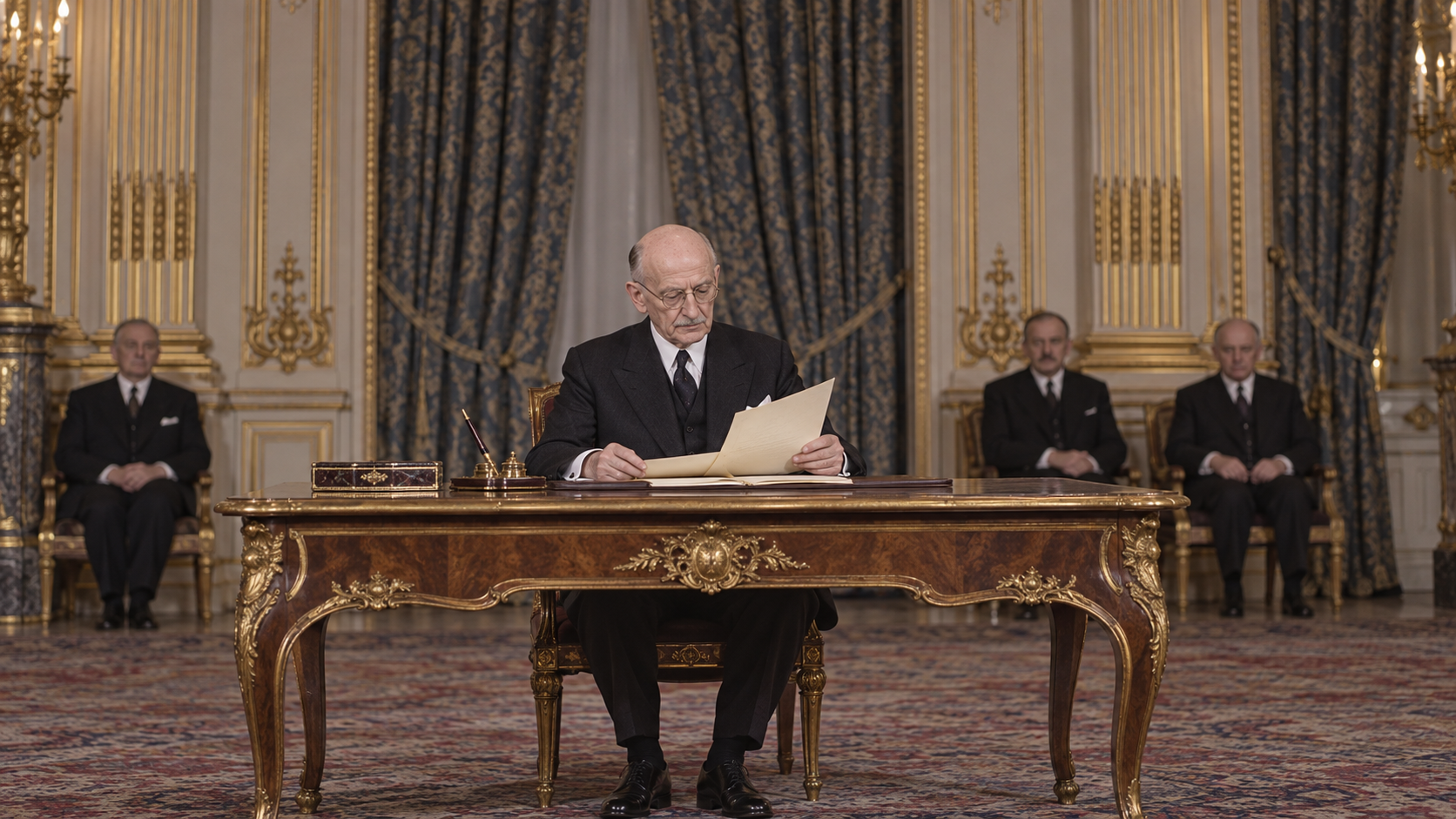
On This Day in Politics: April 18, 1951
On April 18, 1951, Belgium, France, the Federal Republic of Germany, Italy, Luxembourg, and the Netherlands signed the Treaty of Paris establishing the European Coal and Steel Community. The agreement committed the six countries to a new system for managing two industries central to economic recovery and military production. It was a treaty signing, not the immediate opening of a common market. Ratification followed, and the treaty entered into force on July 23, 1952. The anniversary marks an important decision to create shared institutions among states whose recent history included occupation, destruction, and war, giving European cooperation a more concrete legal form.
The treaty followed the proposal announced by French Foreign Minister Robert Schuman on May 9, 1950. Schuman’s declaration called for French and German coal and steel production to be placed under a common High Authority, with participation open to other European countries. Its political purpose was to bind material interests together so that rivalry would become harder to translate into another war. The proposal treated practical economic arrangements as a starting point for wider cooperation. It did not promise that Europe could be united through a single declaration. Instead, it argued that shared achievements could gradually build solidarity among governments and populations with a history of conflict.
The resulting community combined economic responsibilities with a distinctive institutional structure. A High Authority would exercise powers under the treaty, while a council brought national governments into the process. An assembly drawn from national parliaments provided supervision, and a court addressed legal questions. The arrangement therefore involved more than periodic diplomatic meetings: it created bodies with continuing responsibilities and a framework for reviewing their actions. Its economic work included market rules, investment, competition, and measures affecting workers in the industries concerned. The common market opened in stages during 1953, first for coal, iron ore, and scrap, and later for steel, demonstrating the difference between establishing a legal framework and implementing it.
The Paris treaty was one of the foundations of the institutions that later developed into the European Union, but the 1951 agreement itself covered a defined industrial community. Its limited scope was part of its significance: cooperation began with resources that mattered directly to reconstruction and security. The treaty was concluded for fifty years and expired in July 2002, after its institutional legacy had become part of a much wider European system. April 18 remains a landmark because six governments accepted common rules and oversight in strategically important sectors. The choice showed how economic policy could serve a political ambition for more durable peace without requiring every question of European integration to be settled at once.
Six countries signed the Treaty of Paris on April 18, 1951.
It established the European Coal and Steel Community.
The treaty followed Schuman’s proposal of May 9, 1950.
It entered into force on July 23, 1952.
The common market opened in stages during 1953.
The fifty-year treaty expired in July 2002.
Explore more of "On This Day ..."
Discover more events from the same date across news, politics, technology, sports, and other fields. Each link highlights significant moments that shaped history on different fronts.