

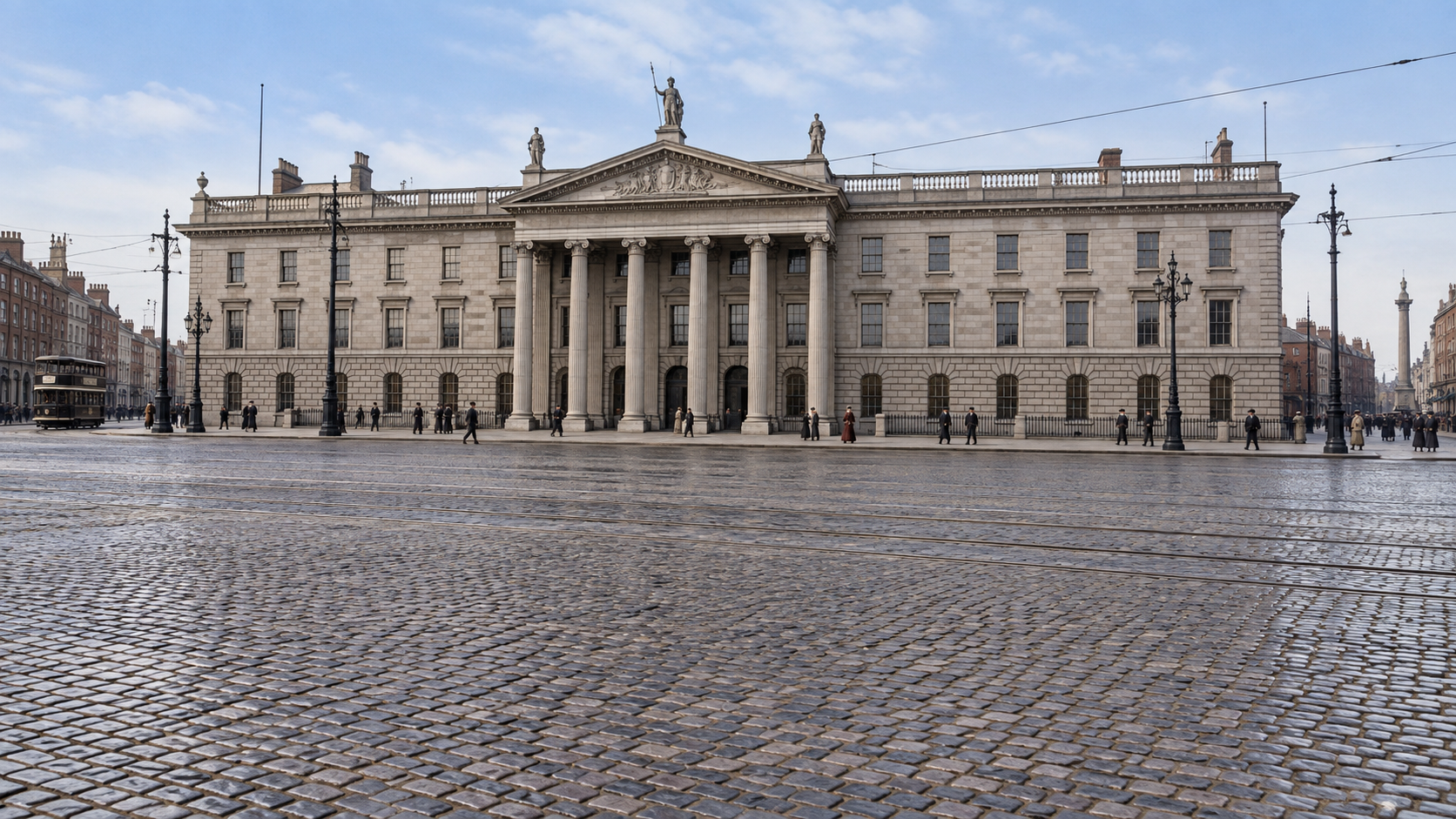
On This Day in Politics: April 24, 1916
On April 24, 1916, Easter Monday, Irish republicans occupied key buildings in Dublin and proclaimed an Irish Republic. Patrick Pearse read the proclamation after the General Post Office had been seized, making that building the best-known center of the Easter Rising. The action challenged British rule through an armed insurrection and a declaration of political authority. Members of the Irish Volunteers and Irish Citizen Army took part, while other participants supported the occupied positions in different roles. The proclamation announced an independent state, but the insurgents did not control Ireland as a whole. Their claim and their immediate military position were two very different things.
The opening followed confusion over plans for the rebellion. Eoin MacNeill’s countermand had disrupted the intended mobilization, and the organizers decided to proceed on Monday after delaying the start. Many participants assembled at Liberty Hall before moving to their assigned positions, most of which were occupied by noon. James Connolly was responsible in theory for directing operations across the Dublin positions, but limited supplies and communications left outlying commanders heavily dependent on their own resources. British forces began responding during the afternoon and evening. Fighting at City Hall killed Seán Connolly, the officer commanding there, and the remaining members of that garrison surrendered later that night.
The proclamation set out the political purpose behind the occupation. Signed by seven leaders, it asserted Ireland’s right to national sovereignty and claimed the allegiance of Irish men and women. It promised religious and civil freedom and equal rights and opportunities, while envisaging a permanent government chosen by the votes of both men and women. Until such a government could be established, the proclaimed provisional government claimed responsibility for civil and military affairs. Those commitments gave the document a significance beyond the positions held in Dublin. They described an intended political order and a basis for legitimacy, even though the leaders had not obtained an electoral mandate for launching the Rising.
British forces suppressed the rebellion during the following days, and Dublin suffered deaths, injuries, and extensive destruction. The military defeat did not end the political consequences. Executions of leaders, imprisonment, and other actions during and after the suppression helped turn opinion against British administration and strengthened republican organizing. Later campaigns combined political mobilization with armed struggle, eventually leading to the creation of the Irish Free State in 1922. That later settlement was not the immediate result proclaimed on Easter Monday. April 24 remains important because the Rising joined an armed challenge to a durable statement of national and civic aspirations, creating a reference point for subsequent arguments about independence, representation, and the responsibilities of an Irish state.
The Easter Rising began on Monday, April 24, 1916.
Republicans occupied the General Post Office and other Dublin positions.
Patrick Pearse proclaimed an Irish Republic after the GPO was seized.
Seven leaders signed the proclamation.
The document envisaged voting rights for both men and women.
Military defeat was followed by major political consequences.
Explore more of "On This Day ..."
Discover more events from the same date across news, politics, technology, sports, and other fields. Each link highlights significant moments that shaped history on different fronts.