

On This Day in Politics: April 25, 1974
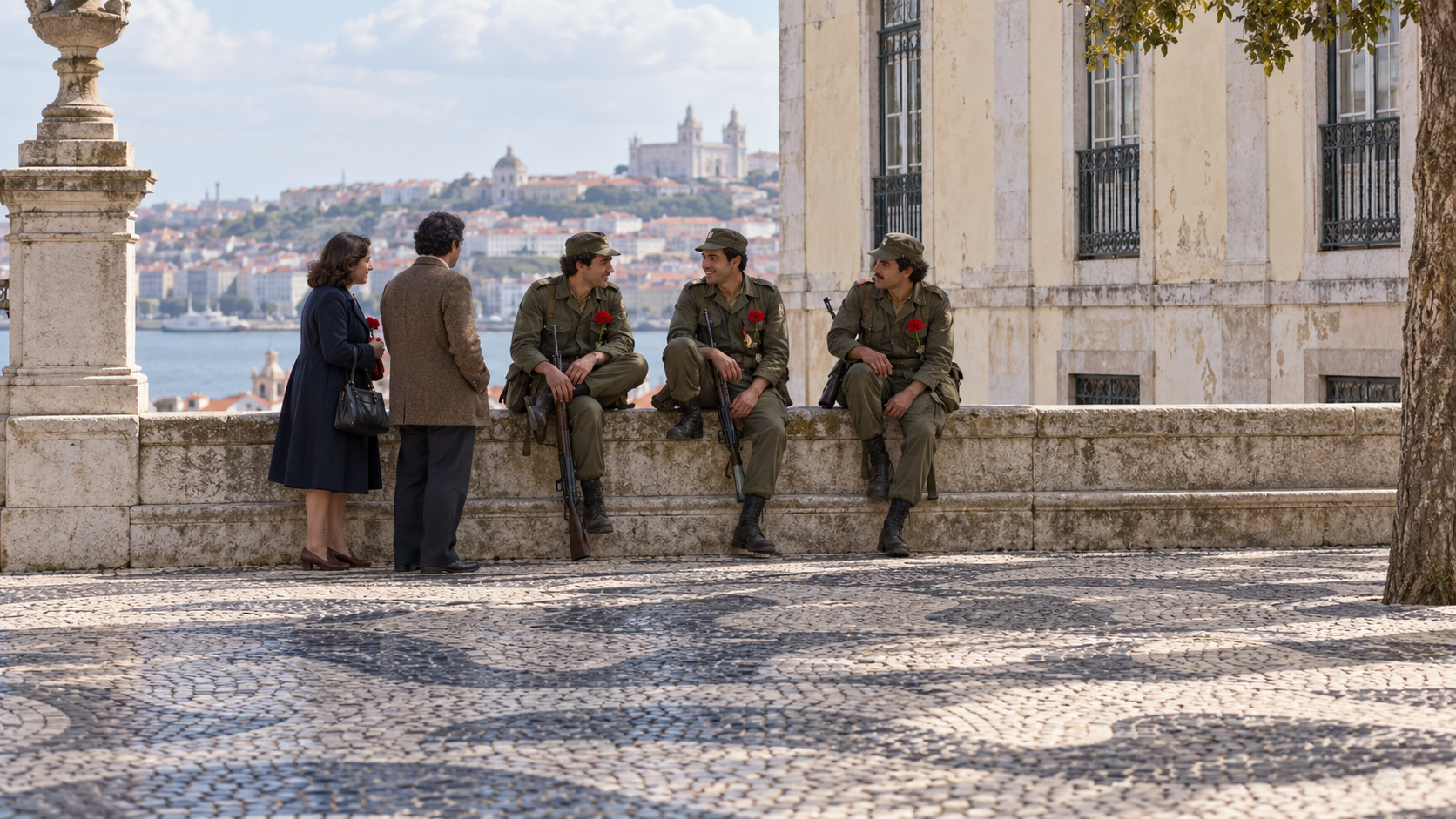
On April 25, 1974, military officers of Portugal’s Armed Forces Movement, known as the MFA, overthrew the Estado Novo dictatorship. Troops occupied strategic positions, and Prime Minister Marcello Caetano surrendered after taking refuge in Lisbon’s Carmo barracks. Captain Salgueiro Maia became one of the operation’s prominent figures, while General António de Spínola received Caetano’s surrender. Crowds joined soldiers in the streets, and carnations became the uprising’s enduring symbol. The day removed an authoritarian government and created an opening for political participation. It did not settle the country’s new constitutional order or resolve the conflicts over how power should be exercised.
The movement developed amid Portugal’s prolonged colonial wars in Africa and dissatisfaction within the armed forces. Officers who challenged the government linked the overseas impasse to the political system at home. The dictatorship had restricted political competition, censored expression, and used a political police force against opponents. Its overthrow therefore raised questions that reached beyond replacing a prime minister: who could organize, who could speak publicly, and who would decide the country’s future. The familiar images of flowers and celebrating crowds convey an important part of the revolution, but they should not obscure either the coercive institutions it displaced or the uncertainty that followed their collapse.
The MFA’s program set out a transitional framework. It called for power initially to pass to a National Salvation Junta, followed by a provisional civilian government, and promised an elected constituent assembly within twelve months. Other measures included an amnesty for political prisoners and the abolition of prior censorship, although the program also envisaged temporary media oversight. It endorsed freedoms of association and expression and recognized that the colonial wars required a political solution. These were commitments and arrangements for a transition, rather than proof that a stable democracy already existed. Military leaders and civilian political forces would contest the direction and pace of change.
Portugal elected its Constituent Assembly on April 25, 1975, a year after the uprising. The constitution it produced was approved on April 2, 1976, and entered into force on April 25, when legislative elections also took place. Those later milestones distinguish the fall of the dictatorship from the establishment of constitutional democratic institutions. Decolonization and sharp domestic disputes formed part of the intervening period. April 25 remains central to Portugal’s political calendar because it opened the space in which those transformations became possible. Its lasting significance lies in the end of authoritarian rule and the subsequent struggle to place public authority on an electoral and constitutional foundation.
The Armed Forces Movement overthrew Portugal’s dictatorship on April 25, 1974.
Marcello Caetano surrendered after taking refuge in Lisbon’s Carmo barracks.
Carnations carried by soldiers and civilians became the revolution’s symbol.
The MFA program promised political freedoms and an elected constituent assembly.
Voters elected the Constituent Assembly on April 25, 1975.
The new constitution entered into force on April 25, 1976.
Explore more of "On This Day ..."
Discover more events from the same date across news, politics, technology, sports, and other fields. Each link highlights significant moments that shaped history on different fronts.