

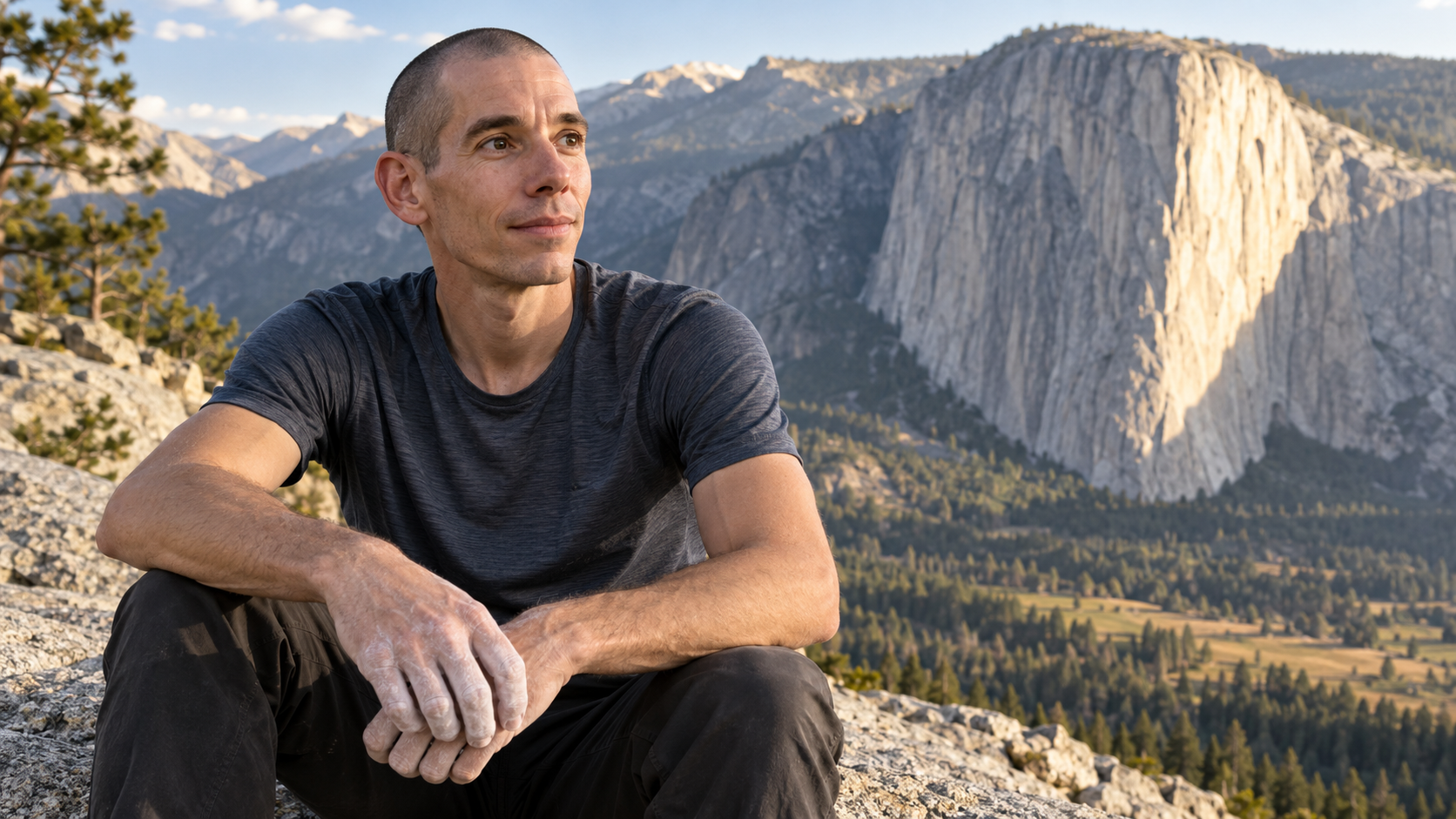
“I didn’t want to be a lucky climber. I wanted to be a great climber.”
Alex Honnold said, “I didn’t want to be a lucky climber. I wanted to be a great climber.” Honnold said this in a TED talk about free-soloing El Capitan’s Freerider route in Yosemite without ropes. He contrasted an earlier climb that felt uncertain with the years of preparation behind the 2017 ascent. The line explains why merely surviving was not enough for him: he wanted an execution built on rehearsal, route knowledge, technical control, and an honest relationship with fear. The words are compact, but their meaning depends on the occasion in which they were spoken.
The El Capitan climb was extraordinary, but the talk emphasizes ordinary preparation repeated at high precision. Honnold climbed the route with protection, memorized sequences, practiced difficult moves, and visualized the wall. Free soloing carries consequences that cannot be copied responsibly as a motivational stunt. His achievement belonged to a specialist who had spent years narrowing uncertainty within a chosen risk. That history keeps the quotation connected to practice rather than allowing it to drift into a generic slogan. It also explains why the line belongs in a sports series: competition made the principle visible, while the speaker’s wider life showed where the principle could help and where it could be misunderstood.
The distinction between luck and greatness is about process, not invulnerability. Luck exists in every sport, and preparation cannot eliminate all danger. Honnold’s standard was to avoid depending on luck for problems he could anticipate. That makes the quotation valuable beyond climbing: competence means making hidden work strong enough that the public moment is an expression of preparation rather than a gamble disguised as confidence. A careful reading preserves both its motivational value and the limits that real people and real competitions impose. Motivation becomes more credible when it respects context instead of treating every obstacle as identical or every result as a moral judgment.
Spectators often see the outcome and miss the protected rehearsals that preceded it. The quote redirects admiration toward study, repetition, and conservative decision-making. It should never encourage untrained imitation. A responsible athlete can ask where success currently depends on chance, then add practice, equipment, feedback, or a safer progression. Greatness is not refusing protection; it is building reliable judgment about when protection is essential. Used this way, the quotation supports better decisions as well as stronger effort. For readers, the practical question is not how to imitate a famous career. It is how to translate the underlying idea into one honest, proportionate action in the situation directly ahead.
Honnold said this in a TED talk about free-soloing El Capitan’s Freerider route in Yosemite without ropes. He contrasted an earlier climb that felt uncertain with the years of preparation behind the 2017 ascent. The line explains why merely surviving was not enough for him: he wanted an execution built on rehearsal, route knowledge, technical control, and an honest relationship with fear.
The wording and surrounding record are documented in the primary source and supported by this additional source.
The distinction between luck and greatness is about process, not invulnerability. Luck exists in every sport, and preparation cannot eliminate all danger. Honnold’s standard was to avoid depending on luck for problems he could anticipate. That makes the quotation valuable beyond climbing: competence means making hidden work strong enough that the public moment is an expression of preparation rather than a gamble disguised as confidence.
The line is most responsible when it encourages deliberate action without pretending that effort controls every condition, injury, institution, or outcome.
Spectators often see the outcome and miss the protected rehearsals that preceded it. The quote redirects admiration toward study, repetition, and conservative decision-making. It should never encourage untrained imitation. A responsible athlete can ask where success currently depends on chance, then add practice, equipment, feedback, or a safer progression. Greatness is not refusing protection; it is building reliable judgment about when protection is essential.
Its continuing value lies in turning admiration into a practical question about preparation, support, judgment, and the next decision.
Explore more "Quotes of The Day"
Discover more notable quotes from influential voices across politics, science, business, technology, sports, and culture. Each quote offers insight into how ideas, beliefs, and decisions shape the world around us.