

Multi-Agent Reinforcement Learning Explainer
Multi-agent reinforcement learning, or MARL, trains several decision-making agents that share an environment. Their goals may be cooperative, competitive, or mixed, and each agent’s action can change what the others observe and learn.
This interaction makes the environment appear nonstationary: from one agent’s perspective, transition patterns change as other policies update. Training may centralize information for learning while allowing decentralized decisions during deployment.
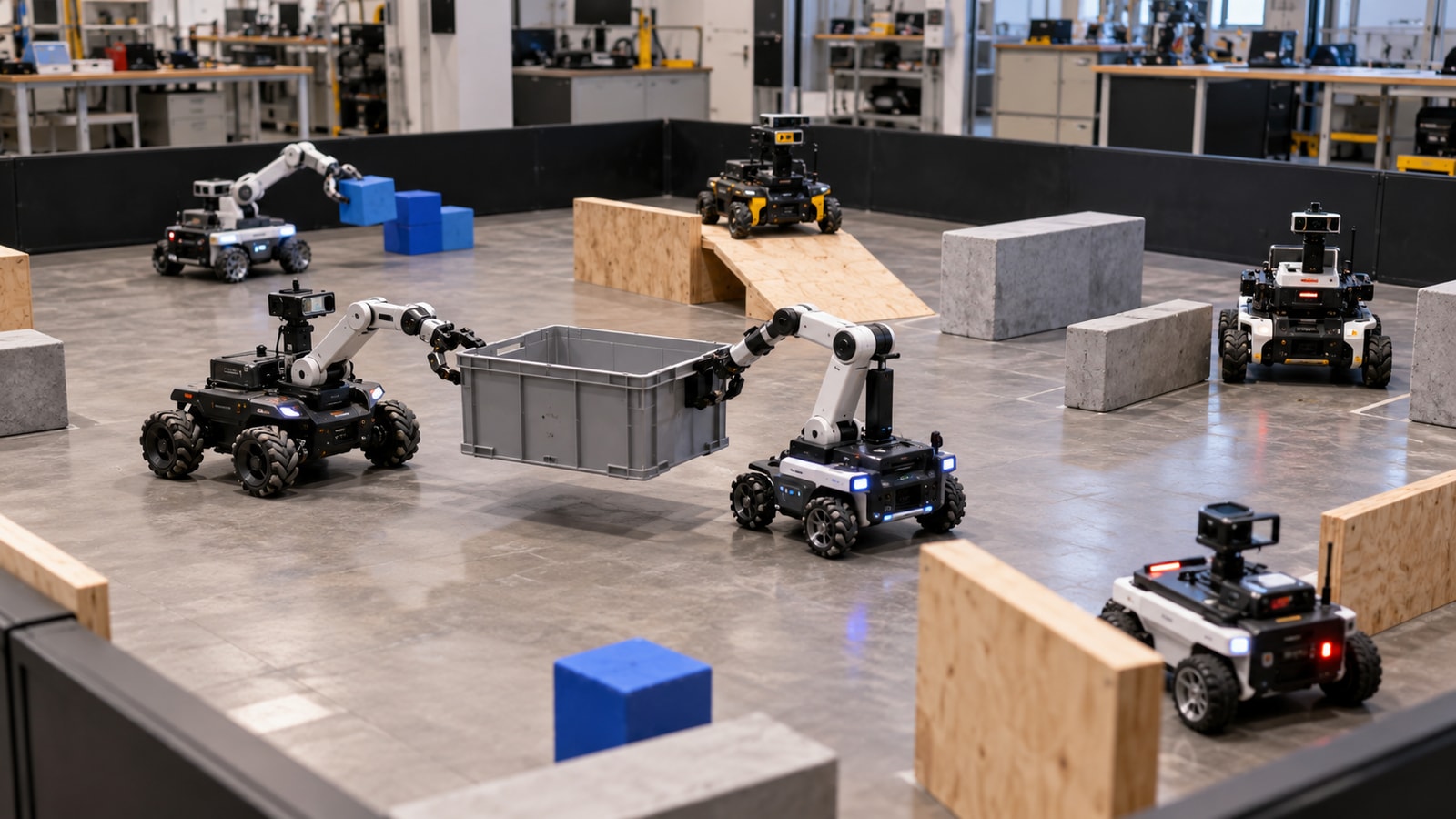
MARL is studied for games, traffic control, robotics teams, resource allocation, and simulations of economic or social behavior. Communication and role specialization can emerge, but they may also need explicit incentives or architectural support.
Coordination can be fragile, credit for a team result is hard to assign, and policies may fail with new partners. Benchmarks can hide unrealistic assumptions. Testing requires varied teammates, opponents, communication failures, and independent safety constraints.
Multi-agent reinforcement learning studies how several learning agents cooperate, compete, or do both in a shared environment.
Key terms include multi-agent, cooperation, competition, nonstationarity, centralized training, decentralized execution, credit assignment and coordination.
An agent’s experience depends on policies that other agents are updating at the same time.
Centralized training can use shared information even when deployment decisions must remain local.
A team can overfit to familiar teammates, opponents, or communication patterns.
Cross-play, failure tests, and diverse populations reveal whether cooperation generalizes.
Explore more "Explainers"
Discover additional explainers across politics, science, business, technology, and other fields. Each explainer breaks down a complex idea into clear, everyday language—helping you better understand how major concepts, systems, and debates shape the world around us.