

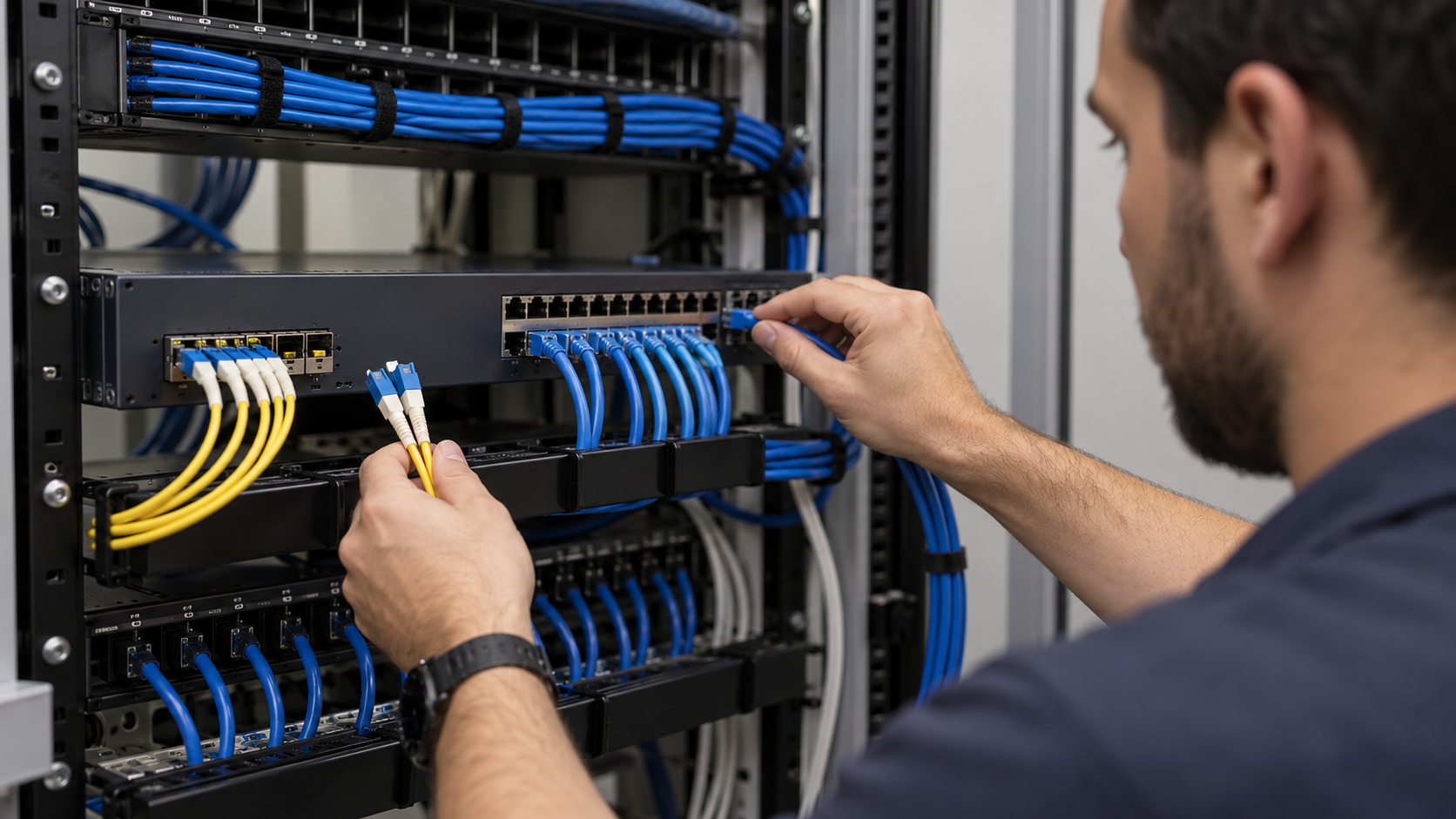
Ethernet moves data across local networks by carrying framed packets over copper, fiber, or backplane links under the IEEE 802.3 family of standards. The useful starting point is to separate the job the technology performs from the products that implement it. Vendors may expose different controls, but compatible systems share core rules so independently built components can work together. Understanding that boundary also prevents the feature from being credited with protections it was never designed to provide. It is also useful to identify the trust boundary: which component makes a decision, which evidence it relies on, and what another component is allowed to assume afterward in normal operation.
A frame contains source and destination media-access addresses, a payload, and an error-detecting check. Switches learn which addresses appear on each port and forward frames toward the appropriate destination. Those parts operate under rules that define message or data formats and the conditions under which a result is accepted. Implementations also keep state because a later step often depends on what happened earlier. Logs, counters, traces, and diagnostic tools make that state observable and help distinguish a normal delay from overload, configuration error, or active attack. Performance comes from dividing work carefully, reusing established state where safe, and avoiding unnecessary coordination without weakening the correctness rules.
A device obtains the destination link-layer address, builds a frame, sends encoded symbols on the link, and a switch checks and forwards it. The receiver verifies the frame check and passes the payload to the next protocol layer. Each stage should validate what it receives before committing to the next stage. Timeouts and bounded retries handle ordinary loss, while explicit errors stop a bad state from silently spreading. Versions can differ, but a reliable implementation preserves the central contract and fails in a defined way when required evidence is absent or inconsistent. Recovery is part of the sequence too: after a restart or interrupted message, participants must know what was durable, what may repeat, and which operation can safely resume.
Standardized speeds, media, framing, and switching make Ethernet interoperable, inexpensive, and scalable from home networks to data centers. The improvement is strongest when surrounding components respect the same assumptions. Monitoring still matters because averages can hide one failed region, unusual client, or slow path. Engineers compare success rates, latency, capacity, and error causes before deciding that a deployment is working as intended. A sound design therefore connects the technical advantage to a measurable service goal rather than assuming that the mere presence of the feature creates value.
Broadcast domains, loops, oversubscription, damaged cables, mismatched settings, congestion, and failed switches can disrupt service. Ethernet itself does not guarantee end-to-end delivery or confidentiality. Compatibility and safe defaults also matter during upgrades because old and new behavior may coexist. A mixed environment creates fallback and configuration risk if teams cannot see which path a request used. Defense in depth treats this mechanism as one layer rather than the entire system. Human decisions remain important: broad permissions, unreviewed defaults, missing alarms, or a recovery procedure that nobody has tested can defeat an otherwise careful technical design.
Operators use tested cabling and optics, redundant loop-controlled paths, virtual LANs, quality-of-service where justified, port authentication, capacity monitoring, and encryption for sensitive traffic. Documentation should record ownership, expected behavior, failure modes, and a tested recovery route. Changes are safest when introduced gradually with metrics and a way to reverse them. The operational question is not simply whether a feature is enabled, but whether surrounding identities, policies, capacity, versions, and human procedures make its promise true. Teams should rehearse the most likely failure, confirm that alerts reach an accountable person, and review settings after major workload, software, or threat changes.
Ethernet frames use link-layer addresses; IP operates above Ethernet and routers move packets between networks.
Learning lets a switch send known unicast frames only to the port where the destination was recently observed.
Yes. IEEE 802.3 defines many copper and optical physical layers at different speeds and distances.
Explore more "Explainers"
Discover additional explainers across politics, science, business, technology, and other fields. Each explainer breaks down a complex idea into clear, everyday language—helping you better understand how major concepts, systems, and debates shape the world around us.