

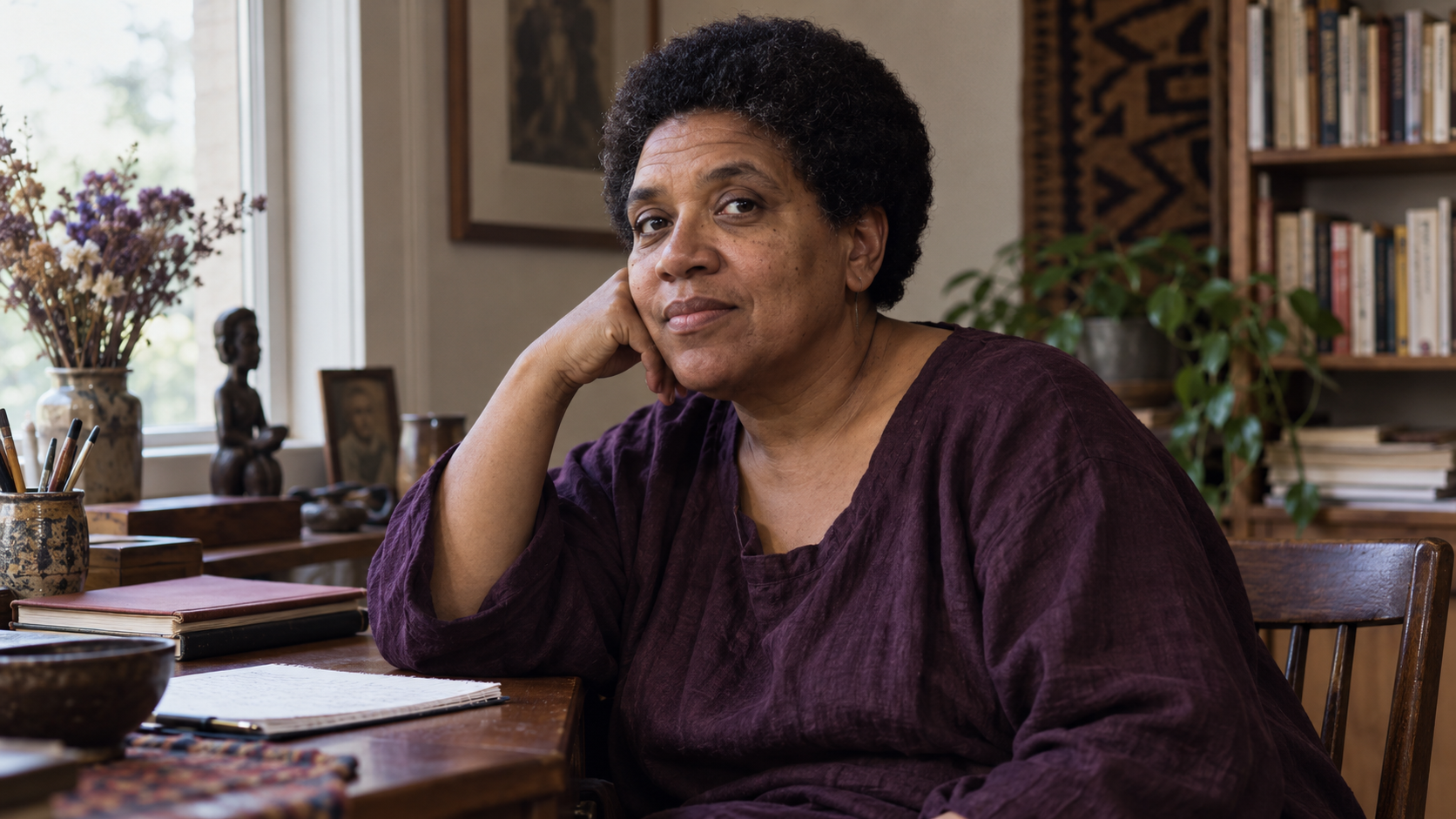
“Caring for myself is not self-indulgence, it is self-preservation, and that is an act of political warfare.”
Audre Lorde placed this sentence in the epilogue to A Burst of Light, published in 1988. The essay records her life with cancer alongside her work as a Black lesbian poet and activist. Immediately before the quotation, she considers how easily extending her capacities can become exhausting them, and how difficult that boundary can be to recognize. That surrounding passage matters: the subject is a person attempting to protect a vulnerable body while continuing a life that holds relationships, creative work, and political commitments. Her concern is not simply how to feel refreshed after a demanding day. It is how to remain present in a world whose demands do not pause when someone becomes ill. The March date marks this entry in the quotation series; it does not identify when she wrote the sentence.
The wording challenges a moral judgment often attached to attending to one’s own needs. If someone is expected to give endlessly, any limit can look like selfishness to those who benefit from that giving. Lorde reverses that expectation by treating her continued existence as something worth defending. The final political phrase connects a private decision to the wider conditions in which she lived. Racism, sexism, and the marginalization of lesbians form part of that context; removing them turns a situated argument into a generic wellness slogan. Sara Ahmed’s later discussion of the passage emphasizes how resources and social support affect whose efforts to cope are recognized as legitimate. Smithsonian curators have also drawn attention to the way popular uses of self-care can lose their connection to Black feminist thought. Neither reading requires every act of rest to carry the same meaning or every patient to adopt Lorde’s language.
For health conversations, the quotation offers a question about whose needs are permitted to interrupt the schedule. Imagine a person managing illness who is also the reliable organizer of family life: acknowledging the need for help changes the distribution of care, rather than merely changing that person’s attitude. This is an interpretation of Lorde’s perspective, not a claim that a particular routine prevents or cures disease. Her own descriptions of treatments and bodily experience belong to her historical account and cannot settle another patient’s medical decisions. What can travel beyond that account is a refusal to make worth depend on constant usefulness. Preserving energy, speaking honestly about limitations, and accepting assistance may allow a person to remain involved in what matters to them. The sentence asks readers to see that continued involvement as compatible with dependence and finite capacity, instead of treating a vulnerable body as a failure of commitment.
The sentence appears in the epilogue to A Burst of Light, first published in 1988. The surrounding passage distinguishes developing one’s capacities from exhausting them.
Lorde writes from her experience of cancer and from her commitments as a Black lesbian writer and activist. Those circumstances are essential to the political meaning of the quotation.
The quotation challenges the assumption that attending to one’s own needs is necessarily selfish. It asks whose continued life and participation are treated as worth protecting.
Its political language also concerns the uneven distribution of recognition and support. A commercial wellness slogan can obscure those conditions if it removes Lorde’s context.
One useful reading concerns whether people living with illness can ask for help without having to justify their value through constant giving. This is an interpretation, rather than an instruction for any individual patient.
Lorde’s memoir does not establish clinical recommendations or promise that self-care cures disease. Its contribution here is a perspective on dignity, limited energy, and the right to remain involved in life.
Explore more "Quotes of The Day"
Discover more notable quotes from influential voices across politics, science, business, technology, sports, and culture. Each quote offers insight into how ideas, beliefs, and decisions shape the world around us.