

On This Day in Business: August 3, 1921
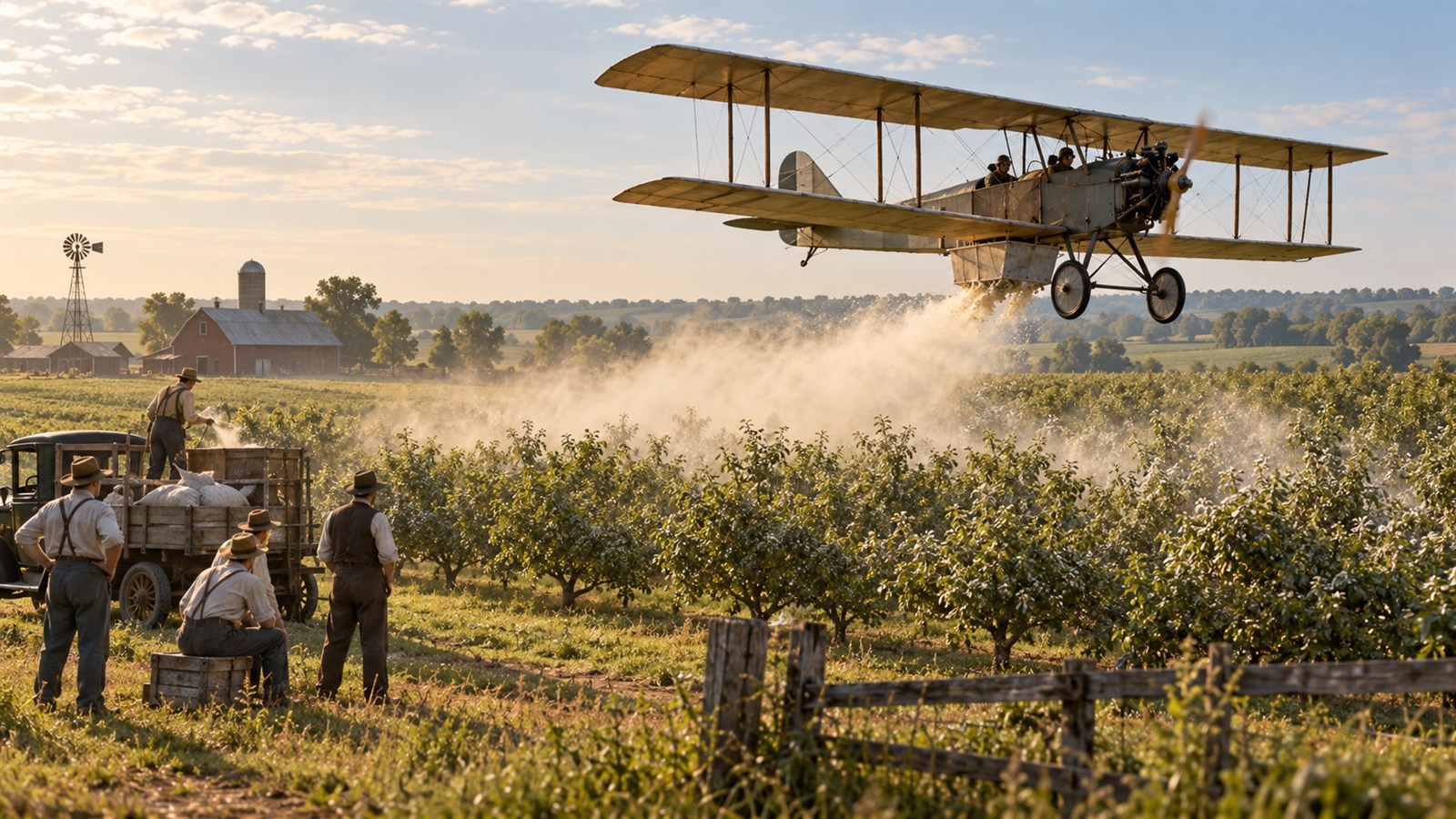
On August 3, 1921, pilot John A. Macready flew a modified Curtiss JN-4 low over trees near Troy, Ohio, while powdered lead arsenate fell from a hopper attached to the airplane. The U.S. Army Air Service and the Department of Agriculture organized the test to fight a caterpillar infestation threatening catalpa trees. Ground application was slow and difficult, so the team asked whether an aircraft could spread treatment quickly and evenly. The experiment worked well enough to prove that aviation could become more than transportation, reconnaissance, or spectacle; it could sell a specialized service directly to farmers.
The test combined technologies that had matured separately. Airplanes had become more reliable during World War I, agricultural science was identifying chemical controls for pests, and commercial farming was seeking ways to manage larger acreages. A simple hopper and release mechanism joined those capabilities. The resulting system was imperfect by modern standards, and the chemical used then is recognized as hazardous. Even so, the operating logic was clear. An aircraft could cover difficult ground rapidly, reduce the time between detecting a threat and responding to it, and make aerial application economical where the value of the crop justified the flight.
Entrepreneurs soon turned the demonstration into a business. Huff-Daland Dusters began commercial operations in the 1920s and built aircraft specifically for agricultural work. The company became part of a lineage that eventually led to Delta Air Lines, illustrating how a specialized industrial service can create capabilities transferable to a much larger market. Crop dusting demanded skilled pilots, dependable maintenance, route planning, weather judgment, and relationships with customers spread across wide regions. Those same disciplines supported the growth of scheduled aviation, even though passenger travel and farm application served very different buyers.
Aerial application later expanded to fertilizers, seeds, and improved pest controls, while regulation and environmental science changed what operators could apply and how they worked. Today's agricultural aviation businesses use GPS guidance, precision nozzles, and detailed safety rules, but the core economic promise remains recognizable: put the right material over a large area quickly when timing matters. The 1921 flight is therefore a story about an industry emerging from a practical field problem. It demonstrates how combining an existing machine with a new task can create a service category, a supply chain, and unexpected paths into adjacent businesses. It also underscores that innovation must evolve with evidence: later safety and environmental standards became essential to making the service more precise, accountable, and sustainable.
On August 3, 1921, John Macready flew a modified biplane over infested trees near Troy, Ohio.
The test was organized by the U.S. Army Air Service and the Department of Agriculture.
A hopper released powdered insecticide as the airplane flew at low altitude.
The demonstration showed that aircraft could treat large or difficult areas quickly.
Commercial crop-dusting firms soon created purpose-built equipment and regional service networks.
Agricultural aviation later helped supply operating experience that fed the wider airline industry.
Explore more of "On This Day ..."
Discover more events from the same date across news, politics, technology, sports, and other fields. Each link highlights significant moments that shaped history on different fronts.