

On This Day in Business: August 10, 1909
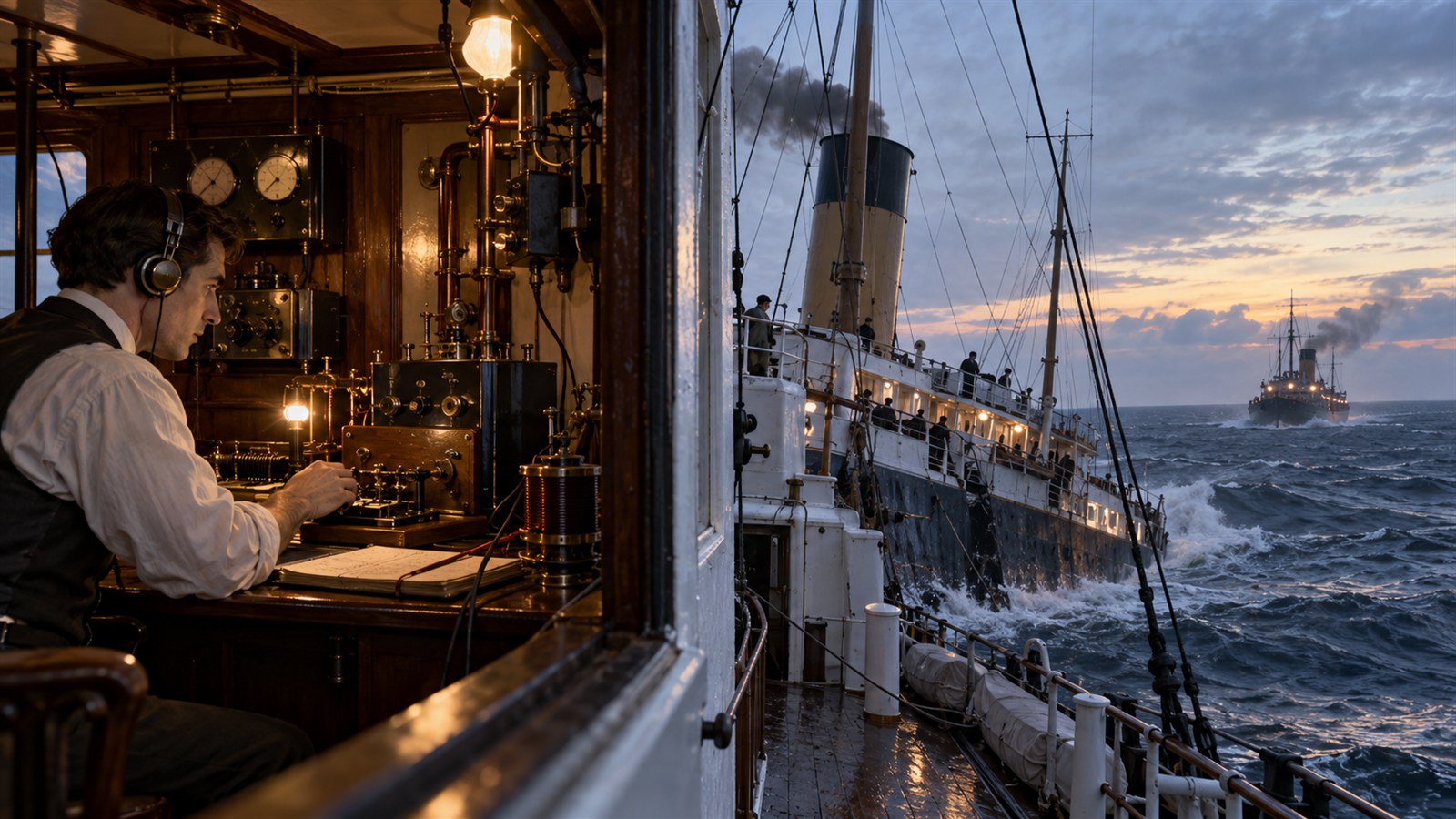
On August 10, 1909, the American steamship Arapahoe lost propulsion off the North Carolina coast and used wireless radio to send an SOS distress signal. The call was among the earliest shipboard uses of the newly adopted three-letter code in the United States. Help reached the disabled vessel, and no dramatic sinking was required for the episode to matter. The practical success showed shipowners, passengers, insurers, and governments that wireless equipment could turn an isolated emergency into a coordinated response. A communication technology had become part of the safety value offered by a transportation business.
Maritime companies had long depended on visual signals, nearby ships, and chance encounters when trouble occurred beyond shore. Wireless telegraphy changed the economics of distance. A ship could report a mechanical failure, request assistance, and provide a position before conditions became catastrophic. Installing equipment required capital, trained operators, power, antennas, and shore stations, but those costs could be weighed against avoided losses and stronger customer confidence. Standard distress codes made the network more useful because operators of different ships and nationalities could recognize the same urgent message without lengthy explanation.
The Arapahoe incident came during a period when competing wireless companies, shipping lines, and regulators were still defining responsibilities. A network is only as dependable as its operating rules. Ships needed listening schedules, qualified personnel, compatible frequencies, and procedures for relaying messages. Later disasters, especially the Titanic in 1912, exposed remaining gaps and drove stricter international requirements. The market for marine radio therefore grew alongside regulation. Equipment makers sold hardware, training expanded, and communications became embedded in the routine operation of commercial fleets rather than treated as an optional novelty.
Modern ships use satellites, digital distress systems, and automated location data, yet their safety networks follow the same principle demonstrated in 1909: connectivity creates value when it is reliable, standardized, and monitored. The episode also shows how risk management can accelerate adoption. A technology may first appear as a convenience, but a credible safety benefit changes purchasing decisions and regulatory expectations. Wireless radio did not prevent every maritime loss, but it shortened the distance between a problem and a response. That capability became an essential service surrounding global shipping, insurance, rescue, and trade. It also created accountability: distress traffic could be logged, relayed, and reviewed, giving operators and regulators evidence for improving future procedures. Commercial insurers and ship operators could also treat communication capacity as a measurable risk-control feature. That encouraged investment before a disaster, when prevention spending can otherwise be difficult to justify against more visible cargo and machinery needs.
The steamship Arapahoe transmitted an SOS after losing propulsion on August 10, 1909.
The call was an early American shipboard use of the recently adopted distress code.
Wireless radio allowed a vessel beyond sight of land to coordinate assistance quickly.
Standard signals increased the value of a network shared by ships, stations, and different operators.
Equipment, trained personnel, and listening procedures became part of maritime operating costs.
The incident helped demonstrate why radio would become essential infrastructure for shipping safety.
Explore more of "On This Day ..."
Discover more events from the same date across news, politics, technology, sports, and other fields. Each link highlights significant moments that shaped history on different fronts.