

On This Day in Life: August 2, 1870
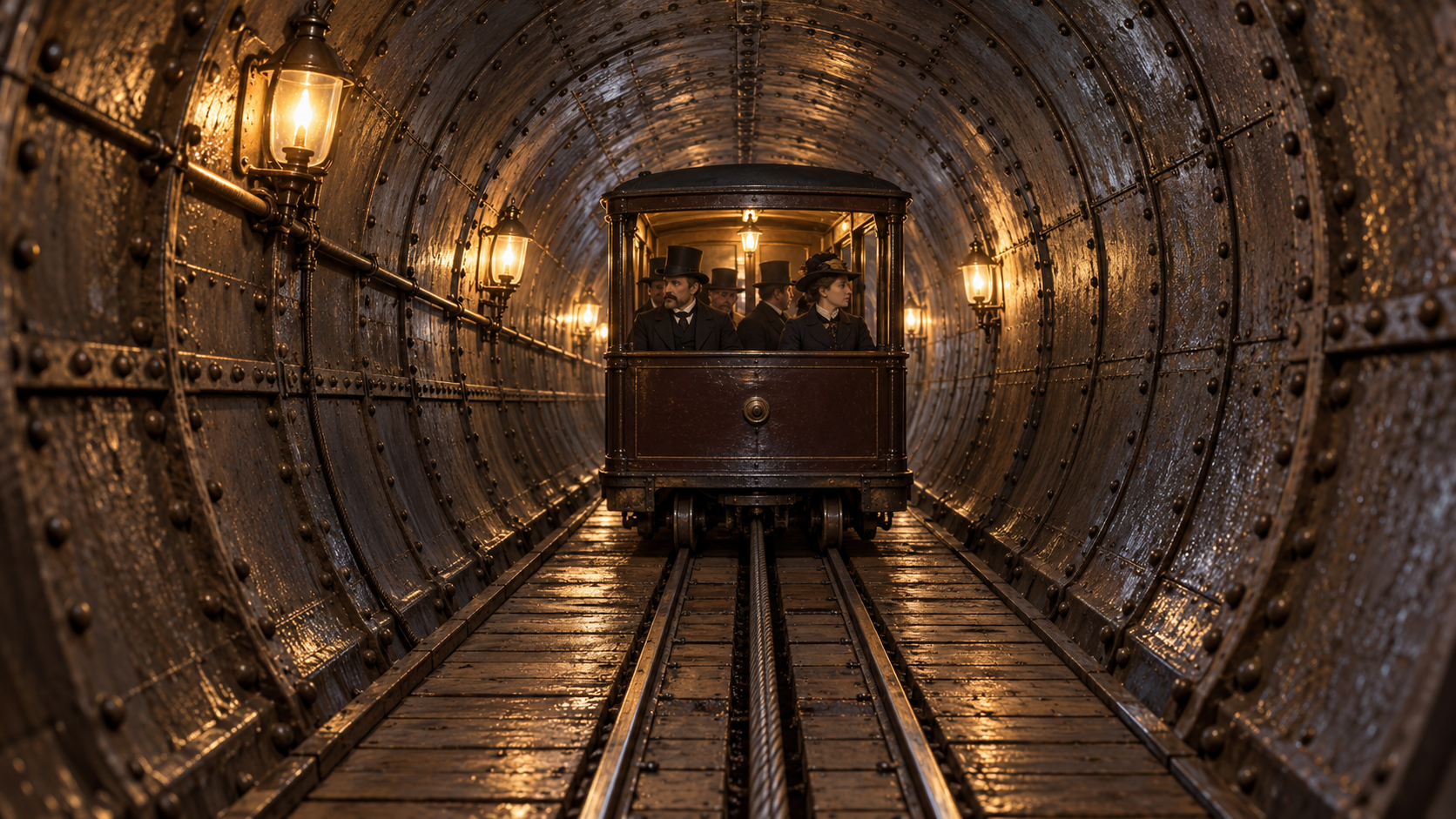
On August 2, 1870, the Tower Subway opened to passengers beneath the River Thames between Tower Hill and the south bank, using a tiny cable-hauled carriage inside a circular iron-lined tunnel. The date matters in lifestyle history because a brief underground ride previewed the tube-shaped journeys that would become routine in modern cities. It was not merely a headline for institutions or specialists; it touched the settings, objects, expectations, and shared rituals through which people organized ordinary days. Passengers in Victorian coats and hats descended into a riveted circular tunnel barely wider than its compact carriage, with wooden planks, rails, lamps, and iron segments receding into the distance. Seen at human scale, the episode shows how a public milestone becomes meaningful through repeated personal choices, conversations, and memories.
Engineer James Henry Greathead used an improved tunneling shield to drive the narrow passage through the clay. Lifts carried customers down to the tunnel, where the carriage ran on rails and was pulled by a continuously moving cable. The system charged separate first- and second-class fares, although the only practical advantage for first-class customers was priority entering lifts and boarding. The setting is essential to understanding why the event attracted attention. New ideas rarely arrive in isolation: they meet existing technology, commerce, custom, law, and desire. Contemporary newspapers, public spaces, shops, schools, workplaces, or homes carried the story outward, giving people practical ways to interpret it. Some welcomed the change, others doubted it, and many first encountered it indirectly. That mixture of novelty and familiarity helped the moment travel from a single date into a broader change in behavior.
The railway demonstrated that passengers could travel through a deep cylindrical tunnel rather than a shallow cut-and-cover trench. The cramped single carriage and cable machinery were not commercially successful, and the rail service lasted only a few months before the tunnel reopened as a pedestrian crossing. In daily life, the consequences appeared through altered routines, new expectations, and different ways of spending time or money. Greathead’s shield and the iron segment lining helped establish methods later used for London’s deep-level electric railways. The Tower Subway itself remained useful to pedestrians until Tower Bridge opened in 1894 and eventually became part of a hydraulic power and utility route. The benefits were never the whole story; major changes also exposed questions about access, responsibility, fairness, cost, and who had power to define progress. Those tensions deserve a place beside the celebration because they show how culture actually develops. The event mattered not because everyone experienced it in the same way, but because it opened a durable argument about how people wanted to live.
Today, the legacy remains visible: urban travelers routinely move through deep bored tunnels, while the Tower Subway is remembered as an ingenious experiment whose engineering mattered more than its short-lived business model. Familiarity can make that inheritance easy to overlook, yet the practices surrounding it were built through years of experimentation, adaptation, criticism, and use. Looking back does more than celebrate an anniversary. It reveals the chain between public decisions and private habits, between ambitious ideas and the small acts that make them ordinary. On this day, one historical moment became part of the texture of modern life. Remembering the full setting lets the milestone feel less like a frozen fact and more like a living part of experience.
On August 2, 1870, the Tower Subway opened to passengers beneath the River Thames between Tower Hill and the south bank, using a tiny cable-hauled carriage inside a circular iron-lined tunnel.
Engineer James Henry Greathead used an improved tunneling shield to drive the narrow passage through the clay. Lifts carried customers down to the tunnel, where the carriage ran on rails and was pulled by a continuously moving cable. The system charged separate first- and second-class fares, although the only practical advantage for first-class customers was priority entering lifts and boarding.
The railway demonstrated that passengers could travel through a deep cylindrical tunnel rather than a shallow cut-and-cover trench. The cramped single carriage and cable machinery were not commercially successful, and the rail service lasted only a few months before the tunnel reopened as a pedestrian crossing.
The event matters in lifestyle history because a brief underground ride previewed the tube-shaped journeys that would become routine in modern cities.
Greathead's shield and the iron segment lining helped establish methods later used for London's deep-level electric railways. The Tower Subway itself remained useful to pedestrians until Tower Bridge opened in 1894 and eventually became part of a hydraulic power and utility route.
The legacy remains visible today: urban travelers routinely move through deep bored tunnels, while the Tower Subway is remembered as an ingenious experiment whose engineering mattered more than its short-lived business model.
Explore more of "On This Day ..."
Discover more events from the same date across news, politics, technology, sports, and other fields. Each link highlights significant moments that shaped history on different fronts.