

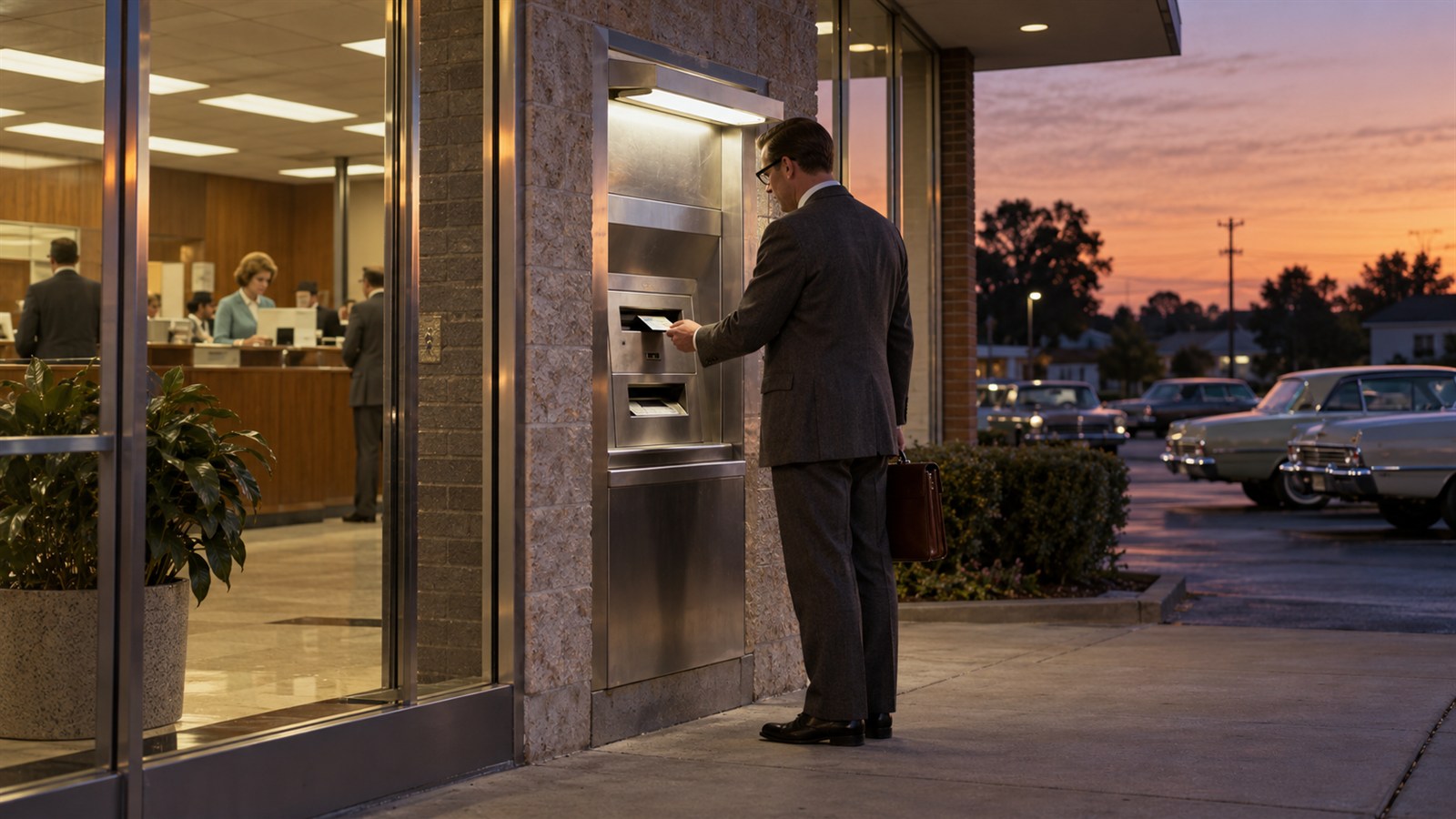
On This Day in Business: September 2, 1969
On September 2, 1969, Chemical Bank introduced an automated teller machine at its branch in Rockville Centre, New York. The installation let customers obtain cash when the banking lobby was closed, a striking change in an industry built around counters, paper records, and limited business hours. The machine was developed by Docutel and promoted with the idea that the branch would open at nine and never close again. Early machines performed fewer tasks than today's ATMs, yet the commercial promise was already clear: routine transactions could move from a staffed window to a self-service channel available at the customer's convenience.
The ATM combined mechanical cash dispensing, electronic identification, communications, and bank accounting. Each part had to work reliably because the product handled both money and trust. Banks needed controls against fraud, equipment that could withstand continuous public use, and procedures for loading cash and reconciling transactions. Customers, meanwhile, had to accept entering credentials into a machine and receiving currency without a teller present. Adoption therefore depended as much on confidence and usability as on engineering. A successful installation reduced pressure on branches while giving the bank a service advantage it could advertise.
As networks expanded, ATMs changed the economics of retail banking. A machine could serve withdrawals, deposits, balance inquiries, and transfers at locations where a full branch would be expensive. Shared networks allowed customers to use machines owned by other institutions, creating new fee arrangements and requiring common technical standards. Banks could extend their geographic reach through shopping centers, airports, and street locations, while consumers came to expect access beyond traditional hours. The channel also changed labor inside branches, shifting employees away from some repetitive cash transactions toward sales, advice, and more complicated service work.
Digital banking has since moved many activities to websites and phones, but the ATM remains an important bridge between electronic accounts and physical cash. Its history shows how automation often succeeds by beginning with one frequent, clearly defined customer need. The first U.S. machine did not replace the bank; it unbundled a single service from the building and the clock. That step created a platform for larger changes in payments, card networks, and self-service finance. It also established a lasting operational bargain: customers gain speed and availability, while institutions invest in security, maintenance, and systems that make unattended service feel dependable. The September 1969 opening turned that bargain into a visible part of everyday commerce. ATMs also forced banks to master a new kind of physical network. Cash forecasting, armored transport, telecommunications, software updates, and round-the-clock monitoring became part of retail service, showing that customer convenience on the surface often rests on complicated logistics that remain largely invisible.
Chemical Bank opened an automated teller machine in Rockville Centre, New York, on September 2, 1969.
The early machine gave customers access to cash outside normal lobby hours.
Docutel supplied technology that joined identification, dispensing, records, and bank controls.
Banks gained a lower-cost service channel while customers gained convenience and availability.
Shared ATM networks later required technical standards, settlement rules, and new fee arrangements.
The ATM helped prepare consumers and institutions for electronic, self-service financial products.
Explore more of "On This Day ..."
Discover more events from the same date across news, politics, technology, sports, and other fields. Each link highlights significant moments that shaped history on different fronts.