

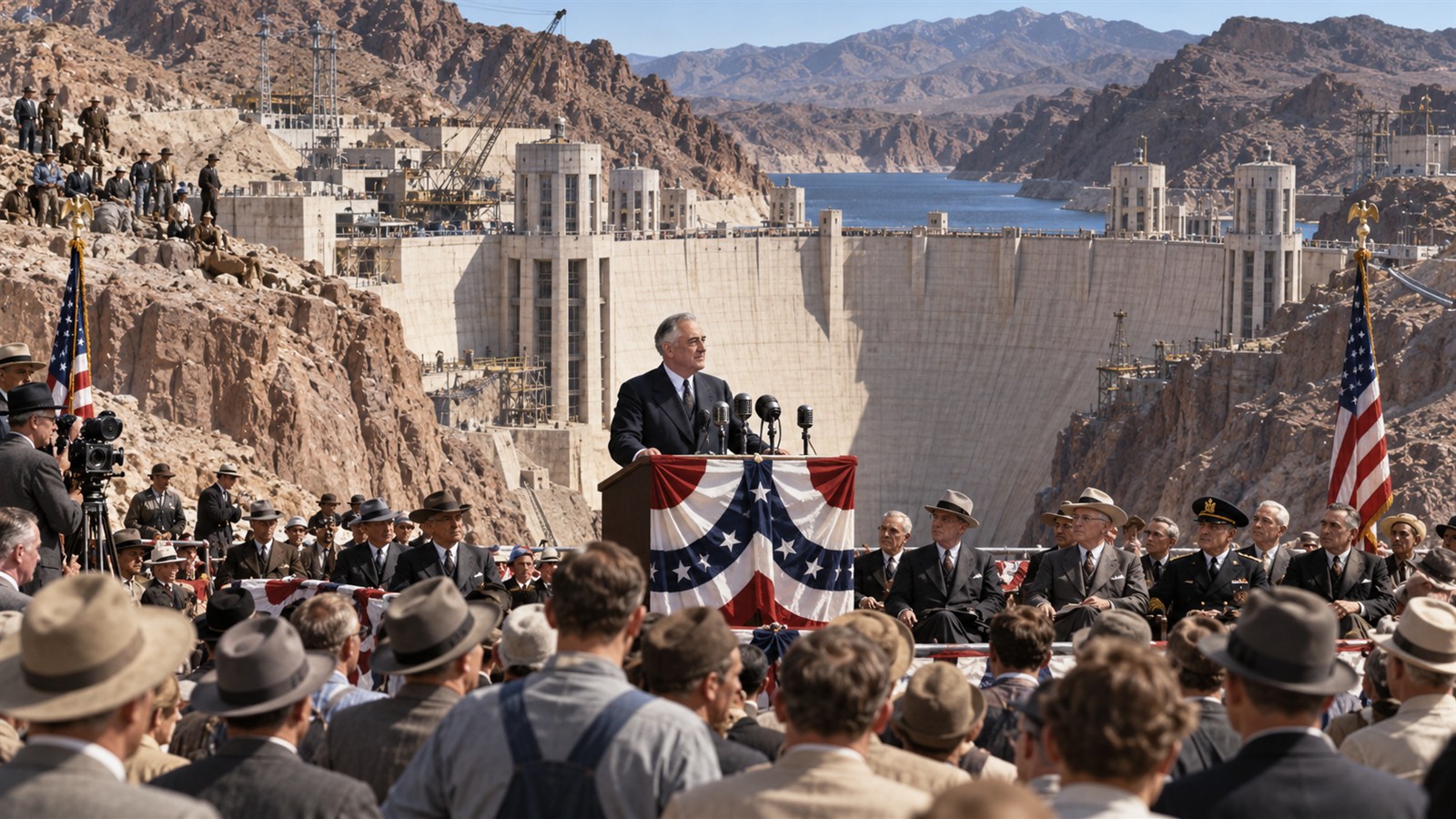
On This Day in Business: September 30, 1935
President Franklin D. Roosevelt dedicated Boulder Dam on September 30, 1935, before thousands of spectators in Black Canyon on the Colorado River. The structure, later officially named Hoover Dam, had been built by the federal Bureau of Reclamation and a consortium known as Six Companies. At 726 feet high, it was then the tallest dam in the world. Construction required rerouting the river, excavating canyon walls, pouring enormous concrete blocks, and coordinating thousands of workers, rail lines, cableways, equipment, and supply contracts in a remote desert environment.
The dam served several economic purposes at once. It controlled floods, stored water for farms and growing cities, and generated hydroelectric power for the Southwest. Long-term contracts and federal authority made it possible to finance a project whose benefits crossed state lines and unfolded over decades. The reservoir and transmission system turned geography into infrastructure, supporting irrigation, industry, urban expansion, and later recreation. No single private buyer could easily capture all of those returns, which is why public investment and negotiated allocations were central to the business model.
Construction also carried serious human costs. Workers faced extreme heat, falls, blasting hazards, carbon monoxide, and demanding schedules. The project accelerated the development of Boulder City to house labor and administration, while the dam and reservoir transformed ecosystems and the river's natural flow. Indigenous communities and downstream environments bore consequences that were not fully represented in the contracts celebrated at the dedication. The structure's economic gains therefore cannot be separated from questions about labor protection, water rights, displacement, and environmental responsibility.
Hoover Dam remains a major source of power, water management, and engineering identity, although drought and changing river conditions now challenge assumptions made during the twentieth century. Its September 1935 dedication marked the completion of a monumental asset, not the end of its obligations. Maintenance, allocation, safety, and adaptation continue for as long as the structure serves the region. The business lesson is the long horizon of infrastructure. Financing and construction attract attention, but real value depends on governance that can manage a shared resource across states, industries, generations, and climate conditions. Boulder Dam demonstrated the productive scale government can mobilize, while its legacy asks how that scale should account for every community and system it changes. Revenue from power and water contracts helped connect engineering output with repayment, while shared governance allocated benefits across jurisdictions. That structure made the dam a regional economic platform rather than a single-purpose structure, but it also locked later generations into decisions requiring periodic renegotiation.
President Franklin Roosevelt dedicated Boulder Dam on September 30, 1935.
The Bureau of Reclamation and Six Companies coordinated the giant Colorado River project.
Flood control, water storage, irrigation, and hydroelectric power created regional economic value.
Federal financing and long-term contracts addressed benefits that crossed private and state boundaries.
Workers and affected communities bore safety, environmental, and distributional costs.
The dam's continuing value depends on maintenance, governance, water allocation, and adaptation to drought.
Explore more of "On This Day ..."
Discover more events from the same date across news, politics, technology, sports, and other fields. Each link highlights significant moments that shaped history on different fronts.