

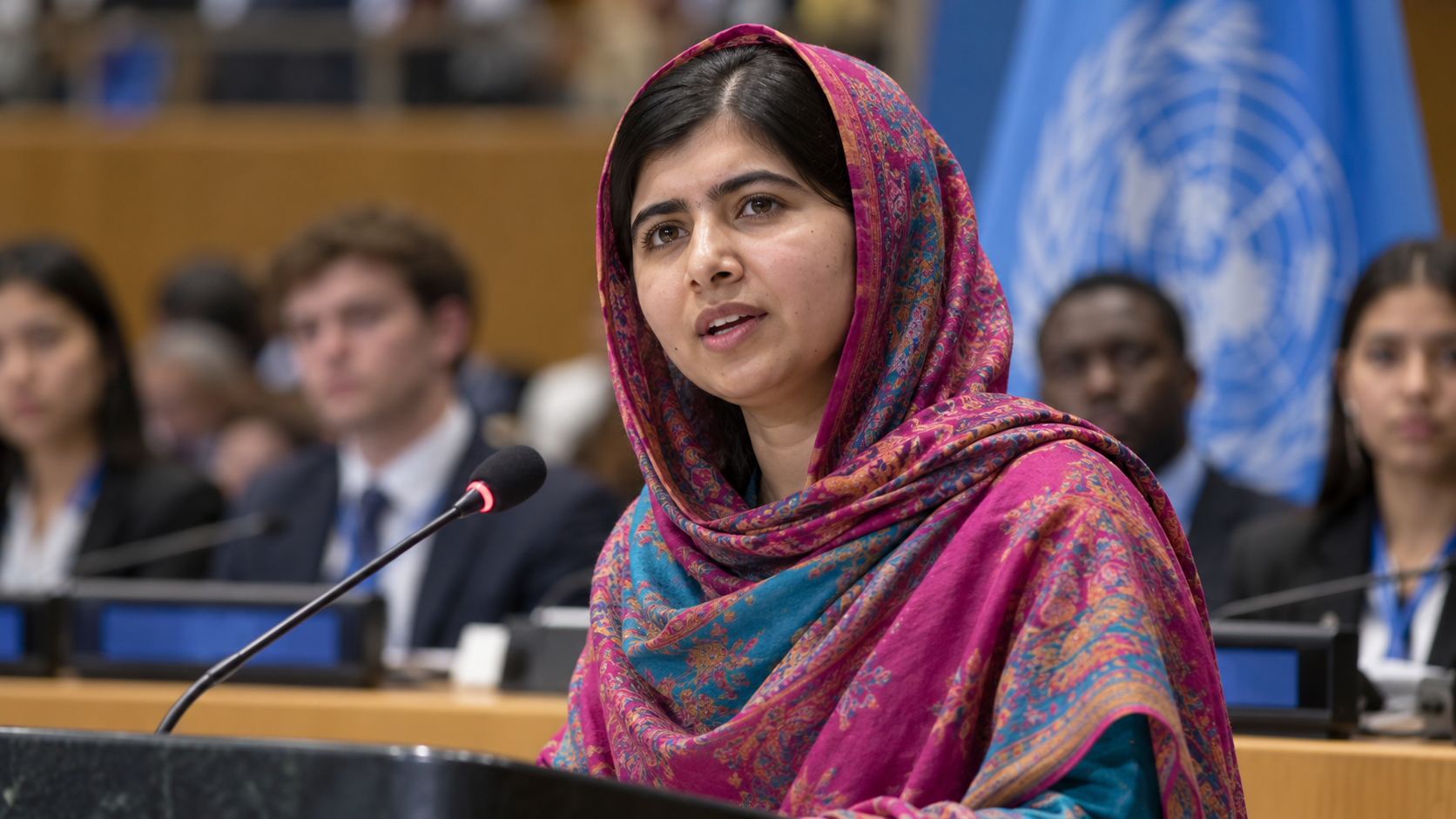
“One child, one teacher, one pen and one book can change the world.”
Malala Yousafzai spoke these words at the United Nations on July 12, 2013, her sixteenth birthday and her first major public speech after surviving an assassination attempt by the Pakistani Taliban. The original order is “one pen and one book,” though the pair is often reversed in quotation graphics. She addressed youth delegates and called for free, compulsory education for every child, placing her own experience inside a universal demand rather than presenting it as an isolated story.
The repetition of “one” makes enormous change feel actionable. Systems require policy, funding, safety, infrastructure, and public commitment, yet they are built through particular relationships: a learner meeting a teacher, using tools, encountering an idea. The sentence honors scale without losing the individual. A classroom can alter a life, and many altered lives can reshape a society’s expectations about who may speak, work, lead, and decide.
Malala’s words should not shift responsibility from governments onto heroic children and teachers. A pen and book have power only when students can reach a safe school, teachers are trained and paid, families are supported, and discrimination does not close the door. Education can also be distorted by censorship or propaganda. Her speech called for rights and collective action, not a sentimental belief that classroom materials alone can defeat violence or poverty.
The line remains urgent wherever access to learning is unequal or information is deliberately restricted. Its practical invitation is specific: support one learner, one teacher, or one institution in a way that removes a real barrier. Donate a relevant book, fund transport, tutor consistently, defend a library, translate information, or advocate for a budget. Small actions become transformative when they are reliable and connected to larger systems. Malala’s sentence keeps the world in view while showing where a person can place a hand. Ask the learner or teacher what obstacle is most immediate before deciding what to provide. A device without connectivity, a book in the wrong language, or a program without safe transport may look generous while remaining unusable. Effective support joins attention to persistence. It follows up, learns from the result, and treats students as participants in the solution rather than symbols of someone else’s compassion. The “one” in the sentence is a starting point that gains strength through connection, not a limit on shared responsibility. Each supported learner can become another source of knowledge, leadership, and change. That is how a single classroom reaches beyond its walls.
Malala delivered the line at the United Nations on July 12, 2013, her sixteenth birthday, after surviving an attack for advocating girls’ education.
Her speech called for free, compulsory schooling for every child and framed education as a universal right.
The original transcript orders the objects as “one pen and one book,” a detail often reversed in popular reproductions.
Individual teachers and learners need safe schools, funding, rights, and public institutions; the quote is not an excuse to deny systemic responsibility.
Barriers to education still include violence, discrimination, cost, distance, disability, and restricted access to trustworthy information.
Support one learner, teacher, library, or school with a specific contribution that removes an identified barrier.
Explore more "Quotes of The Day"
Continue exploring how writers, thinkers, artists, and advocates have described the choices that shape an everyday life.