

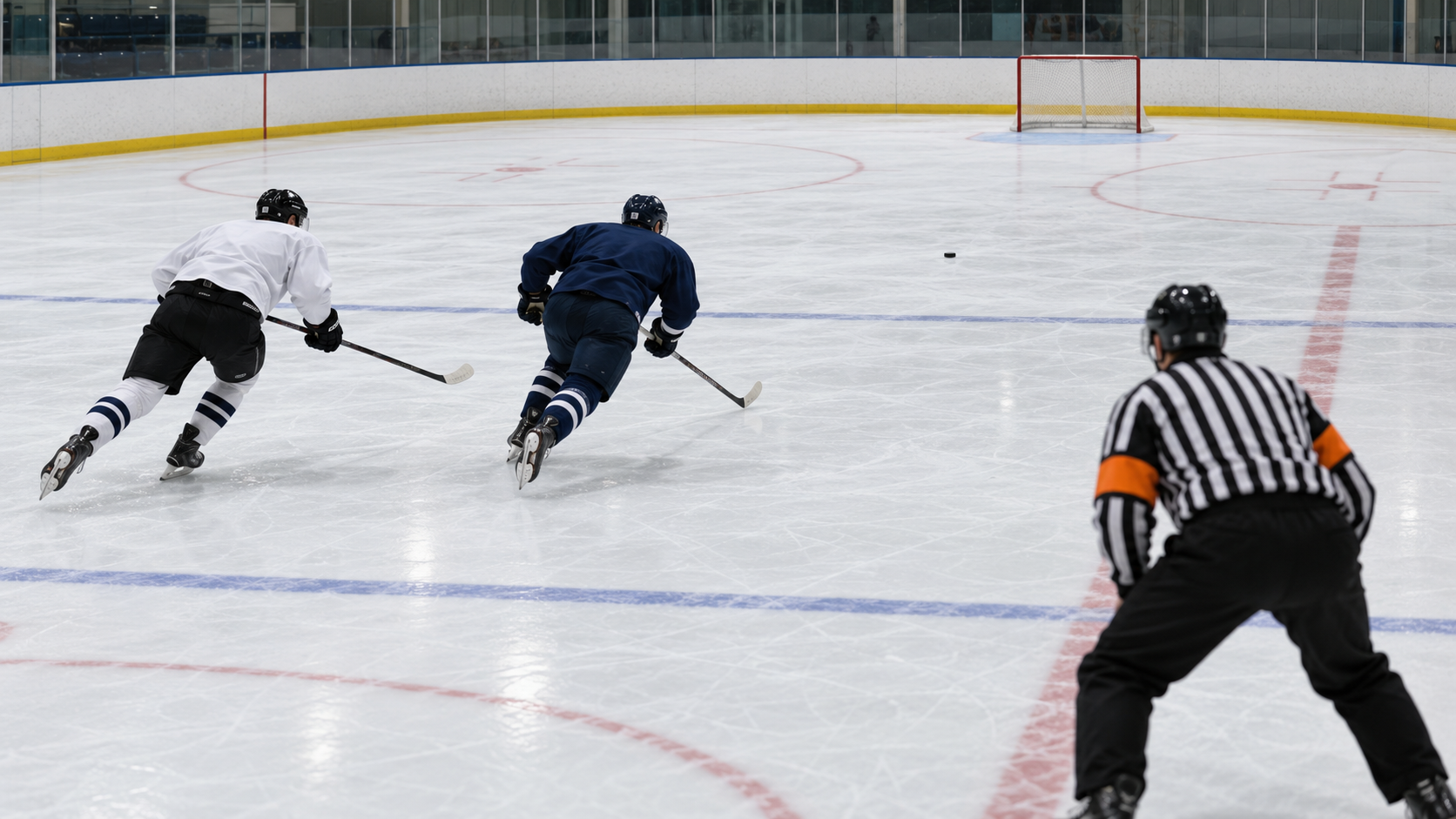
How Hockey Icing Works Explainer
Icing stops a team from relieving pressure by simply firing the puck the length of the rink. In most situations, icing occurs when a player shoots or deflects the puck from the defensive side of the center red line, the puck crosses the opposing goal line, and nobody legally touches it first. Play is stopped and the faceoff returns to the offending team’s defensive zone.
The NHL uses hybrid icing. As the puck approaches the end zone, a linesperson judges which player would likely reach it first at the faceoff dots. If the defending skater has the positional advantage, icing can be called before a dangerous full-speed race reaches the end boards. If the attacking player is clearly ahead, play continues. The system preserves a chance to negate icing while reducing collision risk.
Several circumstances cancel or prevent the call. Icing is waved off if the puck enters the goal, if an opponent touches it, or if officials judge that an opposing player could have played it but chose not to. A team playing shorthanded may ice the puck without penalty under NHL rules. The exact exceptions can differ in other leagues, so the competition’s rulebook matters.
After an icing call, the offending team generally cannot substitute players, which punishes a tired group that tried to escape pressure. The faceoff location also gives the attacking team an immediate territorial advantage. Icing is therefore both a flow rule and a tactical constraint: it encourages controlled breakouts, rewards forechecking, and makes a careless long clearance costly without treating every long shot as an offense.
The puck begins on the shooting team’s side of the center red line and travels untouched beyond the opponent’s goal line. A linesperson then applies the competition’s icing standard.
The purpose is to discourage teams from repeatedly clearing the puck the full length of the rink simply to avoid pressure.
Officials compare the likely first players to the puck as they reach the end-zone faceoff dots. A defender with the advantage can trigger an early whistle.
An attacker clearly positioned to arrive first can negate the call. This judgment limits dangerous high-speed contact near the end boards.
A touch, a playable puck declined by the opponent, a goal, or a league-specific shorthanded exception can prevent icing.
The resulting faceoff is in the offending team’s zone, and NHL substitution restrictions can leave tired players trapped on the ice.
Explore more "Explainers"
Discover additional explainers across politics, science, business, technology, and other fields. Each explainer breaks down a complex idea into clear, everyday language—helping you better understand how major concepts, systems, and debates shape the world around us.