

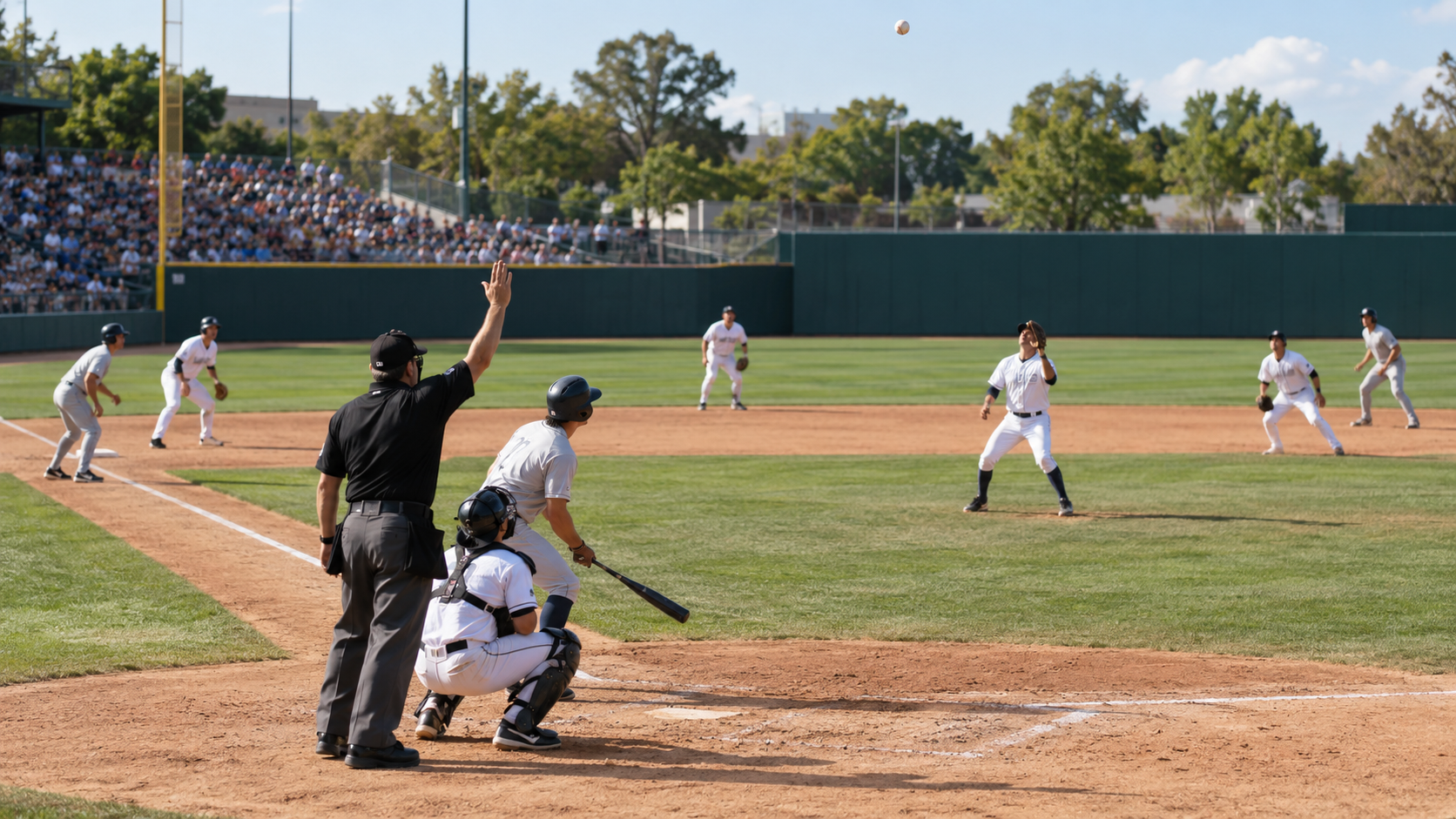
How Baseball’s Infield Fly Rule Works Explainer
The infield fly rule protects runners from a deliberately mishandled routine pop-up. Without it, an infielder could let an easy fly ball fall, then turn a quick double play because runners had stayed close to their bases in case of a catch. The rule removes that unfair choice by declaring the batter out before the ball is caught or hits the ground.
The call can apply only when there are fewer than two outs, runners occupy first and second base or all three bases, and the batter hits a fair fly ball that is not a line drive or attempted bunt. An umpire must judge that an infielder could catch it with ordinary effort. The ball does not have to be on the infield, and an outfielder can make the catch if an infielder could reasonably have handled it.
Once the umpire signals an infield fly, the batter is out. The ball remains live, so runners may advance at their own risk. If the ball is caught, they generally must tag up before advancing, just as on any caught fly. If it falls untouched, runners are not forced to advance because the batter has already been retired, though they may still choose to run.
The umpire should call the play promptly, but the judgment depends on the ball’s height, location, wind, lighting, and the defenders’ positioning. A difficult drifting pop-up may not qualify, while a ball beyond the dirt can. The rule is about ordinary effort and the game situation, not a painted boundary. That is why similar-looking pop-ups can produce different calls without either decision being inconsistent.
There must be fewer than two outs and runners on first and second, or on first, second, and third. The hit must be a fair fly ball other than a line drive or bunt.
An umpire must also decide that an infielder could make the catch with ordinary effort. The fielder who actually reaches the ball does not control the ruling.
The batter is immediately out, which removes the force play created by the batter becoming a runner. The ball is still live.
Runners may hold or advance at their own risk. On a catch they must tag up; on a drop they are not forced to leave their bases.
Ordinary effort changes with wind, sun, field conditions, ball height, and defensive positioning. There is no automatic distance from home plate.
The call exists to prevent a cheap double play, not to reward or punish a fielding mistake. Umpires apply it to the opportunity visible on that play.
Explore more "Explainers"
Discover additional explainers across politics, science, business, technology, and other fields. Each explainer breaks down a complex idea into clear, everyday language—helping you better understand how major concepts, systems, and debates shape the world around us.