

On This Day in Lifestyles: October 14, 1947
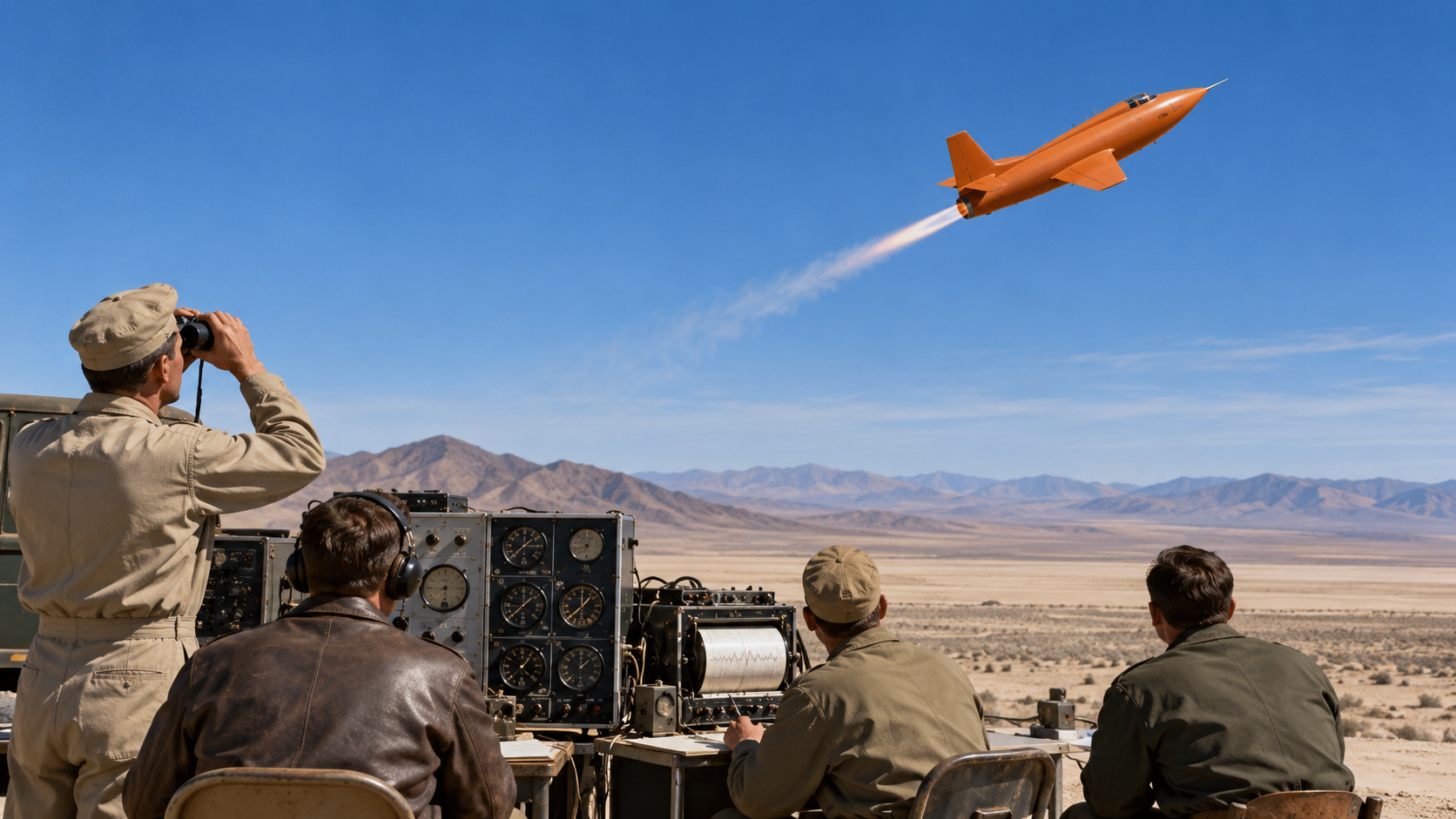
On October 14, 1947, Air Force pilot Chuck Yeager flew the rocket-powered Bell X-1 faster than the speed of sound over California’s Mojave Desert. The date matters in lifestyle history because an experimental flight changed the practical limits people placed on speed and distance. It was not merely a headline for institutions or specialists; it touched the settings, objects, expectations, and shared rituals through which people organized ordinary days. The vivid orange X-1 climbed above the Mojave while engineers watched instruments in a sparse 1947 desert control room Seen at human scale, the episode shows how a public milestone becomes meaningful through repeated personal choices, conversations, and memories.
A B-29 carried the orange experimental aircraft aloft before releasing it at altitude. Yeager, flying with injured ribs, ignited the rocket chambers and reached approximately Mach 1.06 under carefully measured test conditions. The X-1’s shape drew from a stable .50-caliber bullet, and an adjustable tail helped overcome dangerous control problems near sonic speed. The setting is essential to understanding why the event attracted attention. New ideas rarely arrive in isolation: they meet existing technology, commerce, custom, law, and desire. Contemporary newspapers, public spaces, shops, schools, workplaces, or homes carried the story outward, giving people practical ways to interpret it. Some welcomed the change, others doubted it, and many first encountered it indirectly. That mixture of novelty and familiarity helped the moment travel from a single date into a broader change in behavior.
The flight showed that the so-called sound barrier was an engineering challenge rather than an absolute wall. Instrumentation, ground crews, pilots, aerodynamic theory, and incremental tests all mattered as much as personal courage. The achievement remained classified for months, so its public meaning developed after the technical work had already advanced. In daily life, the consequences appeared through altered routines, new expectations, and different ways of spending time or money. Supersonic research influenced military aircraft, high-speed aerodynamics, pressure suits, controls, and later spaceflight programs. Commercial supersonic travel proved possible but costly and environmentally contentious, leaving speed balanced against fuel use, noise, safety, and access. The benefits were never the whole story; major changes also exposed questions about access, responsibility, fairness, cost, and who had power to define progress. Those tensions deserve a place beside the celebration because they show how culture actually develops. The event mattered not because everyone experienced it in the same way, but because it opened a durable argument about how people wanted to live.
Today, the legacy remains visible: experimental aviation still relies on teams, simulation, telemetry, and patient testing as designers revisit supersonic travel and lower-boom aircraft. Familiarity can make that inheritance easy to overlook, yet the practices surrounding it were built through years of experimentation, adaptation, criticism, and use. Looking back does more than celebrate an anniversary. It reveals the chain between public decisions and private habits, between ambitious ideas and the small acts that make them ordinary. On this day, one historical moment became part of the texture of modern life. Remembering the full setting lets the milestone feel less like a frozen fact and more like a living part of experience.
On October 14, 1947, Air Force pilot Chuck Yeager flew the rocket-powered Bell X-1 faster than the speed of sound over California's Mojave Desert.
A B-29 carried the orange experimental aircraft aloft before releasing it at altitude. Yeager, flying with injured ribs, ignited the rocket chambers and reached approximately Mach 1.06 under carefully measured test conditions. The X-1's shape drew from a stable .50-caliber bullet, and an adjustable tail helped overcome dangerous control problems near sonic speed.
The flight showed that the so-called sound barrier was an engineering challenge rather than an absolute wall. Instrumentation, ground crews, pilots, aerodynamic theory, and incremental tests all mattered as much as personal courage. The achievement remained classified for months, so its public meaning developed after the technical work had already advanced.
The event matters in lifestyle history because an experimental flight changed the practical limits people placed on speed and distance.
Supersonic research influenced military aircraft, high-speed aerodynamics, pressure suits, controls, and later spaceflight programs. Commercial supersonic travel proved possible but costly and environmentally contentious, leaving speed balanced against fuel use, noise, safety, and access.
The legacy remains visible today: experimental aviation still relies on teams, simulation, telemetry, and patient testing as designers revisit supersonic travel and lower-boom aircraft.
Explore more of “This Day in Lifestyles”
Discover more moments in everyday life, design, education, travel, food, fashion, and culture. Each story connects a calendar date with an event that changed how people lived.