

On This Day in Business: December 23, 1947
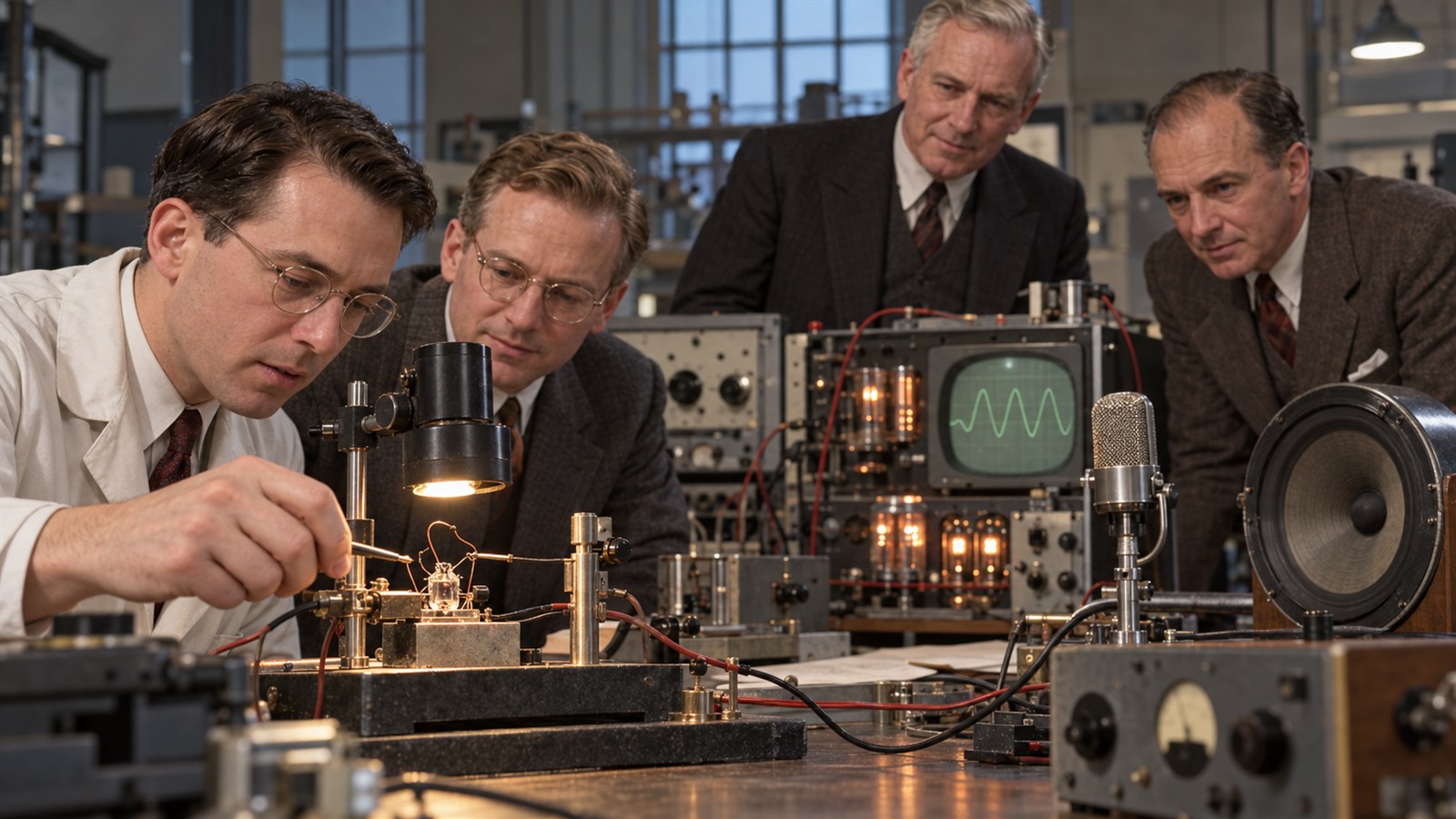
On December 23, 1947, John Bardeen and Walter Brattain demonstrated the point-contact transistor to Bell Laboratories officials. Their small device used two closely spaced gold contacts on germanium to amplify an electrical signal, offering a potential solid-state alternative to bulky and power-hungry vacuum tubes. The immediate invention was only one layer of the opportunity. Commercial value depended on interfaces, complementary products, training, support, and confidence that the new system would keep improving. Early adopters were not simply buying hardware or software; they were accepting workflow change and uncertainty about an emerging standard.
The successful effect had appeared a week earlier after sustained research into semiconductor surfaces. The demonstration made amplification audible and measurable for management, connecting theoretical insight, materials preparation, precise bench work, and the communications problems Bell Labs hoped to solve. Adoption required translation between specialists and ordinary users. Performance claims had to become understandable tasks, while cost, reliability, and compatibility determined whether an impressive demonstration could survive outside the laboratory. Documentation and service therefore mattered nearly as much as the breakthrough itself.
The first transistor was delicate and difficult to manufacture consistently. William Shockley soon developed the junction transistor concept, and years of engineering were needed before solid-state devices could be produced reliably at scale. Licensing and research across many companies then expanded applications and manufacturing knowledge. As more organizations participated, learning and network effects strengthened the proposition. New uses attracted investment, investment improved tools, and better tools brought additional users. That cycle could create durable advantage, but it also made governance important because technical choices by a small group affected a widening market.
Transistors became foundations for radios, computers, telecommunications, controls, and eventually integrated circuits. The event shows how a fragile laboratory result can carry enormous option value. Organizations must protect fundamental research while building the process engineering, intellectual-property strategy, and supplier capability required for mass use. The modern lesson is to design the ecosystem along with the product. Dependable support, open pathways for complements, sensible standards, and clear incentives can turn a clever prototype into infrastructure. Without those surrounding relationships, even remarkable technology may remain isolated or arrive before customers are ready. In practical terms, the advantage came from linking a clear public or customer promise to disciplined execution. Capital and attention had to be committed before demand was certain, partners had to coordinate, and leaders had to keep learning after the first milestone passed into history. The strongest legacy was not the announcement alone, but the repeatable capability, institution, or market that people built around it afterward.
Bardeen and Brattain demonstrated the transistor on December 23, 1947.
Two gold contacts on germanium amplified an electrical signal.
The device promised an alternative to bulky vacuum tubes.
The first point-contact design was difficult to manufacture consistently.
Junction transistors and process engineering improved scalability.
Solid-state electronics later transformed communications, computing, and consumer products.
Explore more of "On This Day ..."
Discover more events from the same date across news, politics, technology, sports, and other fields. Each link highlights significant moments that shaped history on different fronts.