

On This Day in AI: January 7, 1954
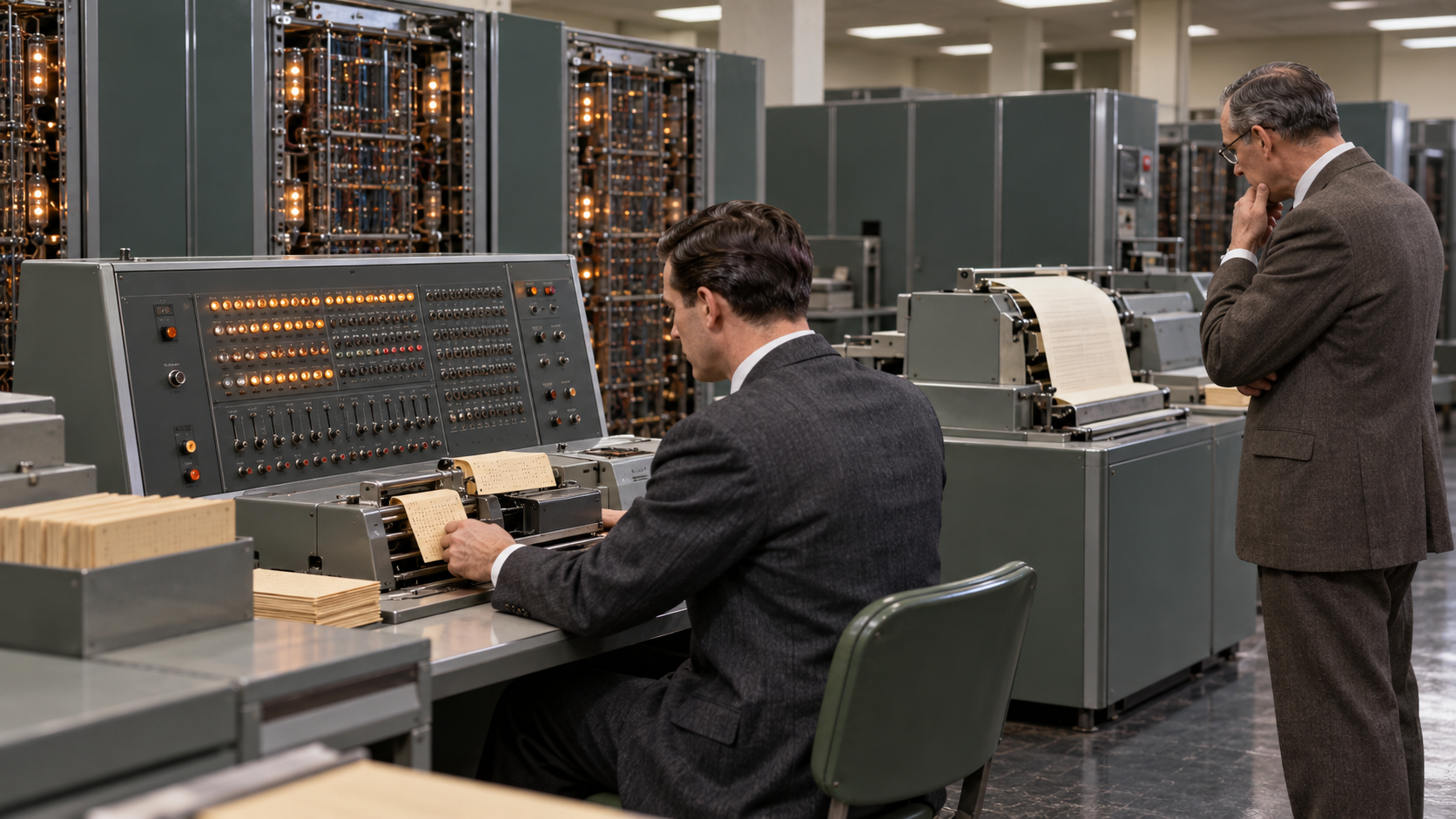
On January 7, 1954, at IBM’s headquarters in New York City, a Georgetown University and IBM team publicly demonstrated a computer translating Russian sentences into English. Georgetown linguist Leon Dostert and IBM applied-science director Cuthbert Hurd led the effort, with Peter Sheridan writing the program and Paul Garvin directing much of the linguistic work. An operator who did not know Russian entered transliterated sentences on punched cards. The IBM 701 then searched a 250-item bilingual vocabulary, applied six rules for selecting and reordering words, and printed English output. About sixty prepared sentences, many dealing with chemistry, were processed for reporters. The event is widely regarded as the first public demonstration of machine translation on an electronic computer.
The project grew from an urgent postwar interest in using computers for more than arithmetic. Warren Weaver’s influential 1949 memorandum had encouraged researchers to consider translation as a problem that might yield to information theory, cryptography and formal rules. Cold War agencies also wanted faster access to Soviet scientific literature. The IBM 701 was the company’s first commercial scientific computer, but its memory and processing limits forced the team to keep the experiment tightly bounded. Every demonstration sentence was selected in advance to fit the small dictionary and rule set. The system therefore did not understand open-ended Russian or resolve the ambiguity, idiom and context that professional translators routinely manage. It was a genuine engineering demonstration, but not a general-purpose translator.
Newspaper coverage spread quickly and encouraged hopes that high-quality automatic translation might arrive within a few years. Funding and research activity expanded, while later systems exposed how difficult language really was. Larger vocabularies multiplied ambiguity, and grammatical rules that worked for one domain often failed in another. A 1966 review by the Automatic Language Processing Advisory Committee criticized the field’s progress and helped reduce United States support. Even so, the January 7 demonstration established an enduring goal: make a machine transform meaning across languages rather than merely calculate numbers. It also gave researchers a concrete system to criticize, improve and compare, helping machine translation become a recognized research discipline rather than a speculative idea. The result also influenced how newspapers and public officials imagined future human-computer communication. Modern statistical and neural translation systems use very different methods and vastly more data, yet they address the same challenge placed before the public in 1954. The experiment matters both as a breakthrough and as an early lesson in separating a successful prototype from a solved problem.
The program used a 250-item Russian-English dictionary and six rules attached to dictionary entries. Punched cards carried transliterated Russian into the IBM 701, which selected words, changed their order and printed English.
The roughly sixty test sentences were chosen in advance, mostly from chemistry and general subjects. That design proved the mechanism worked under controlled conditions without showing that the computer could translate unrestricted language.
Machine translation promised faster access to Soviet scientific writing during the Cold War. The public demonstration made a non-numerical use of computers visible at a moment when electronic computing was still unfamiliar.
Press reports often emphasized the dramatic output more than the narrow vocabulary and prepared sentences. Predictions of rapid progress helped attract support but also established expectations the field could not soon meet.
Researchers later moved from hand-built rules toward statistical methods trained on bilingual text, then toward neural networks that learn broad patterns from large datasets. Each shift addressed limitations visible in the 1954 system.
Today's translators are far more flexible, but ambiguity, cultural context and rare language coverage remain difficult. The demonstration's lasting value is both technical and cautionary: a compelling prototype can open a field without completing it.
Explore more of "On This Day ..."
Discover more events from the same date across news, politics, technology, sports, and other fields. Each link highlights significant moments that shaped history on different fronts.